When Stephanie Turner was born in Arkansas in 1993, her family was told something no parent ever wants to hear.
Doctors feared she might survive only 30 minutes to an hour.
But Stephanie had other plans.
She would not simply survive that first hour.
She would live for 23 years.
And along the way, she would accomplish something doctors had never documented before: becoming the first known woman with harlequin ichthyosis to give birth.
Stephanie was born with harlequin ichthyosis, an exceptionally rare genetic skin disorder that causes the body to produce unusually thick skin. The skin can crack deeply, making it difficult for the body to retain moisture and protect itself from infection.
For a newborn, those complications can be extremely dangerous.
Stephanie’s early life involved challenges most people could never imagine. Her cracked skin left her vulnerable to dehydration and infections, while her condition also interfered with her body’s ability to regulate temperature.
But somehow, she kept going.
As she grew older, caring for her skin became a permanent part of her daily life. Moisturizers and treatments were not occasional necessities—they were part of a routine she depended on to stay healthy.
There were other challenges, too.
People stared.
Some asked uncomfortable questions.
Others struggled to look beyond her appearance and see the young woman underneath.
Yet Stephanie refused to let a rare diagnosis decide what her life could become.
She wanted the things many young women dream about: love, a family, and children of her own.
Eventually, she met Curtis.
They married, and Stephanie began thinking seriously about motherhood.
Pregnancy, however, carried significant risks.
Her skin did not stretch in the same way as typical skin. Her difficulty regulating body temperature created additional concerns, and pregnancy could potentially place additional stress on her already fragile body.
Stephanie knew all of this.
She chose to move forward anyway.
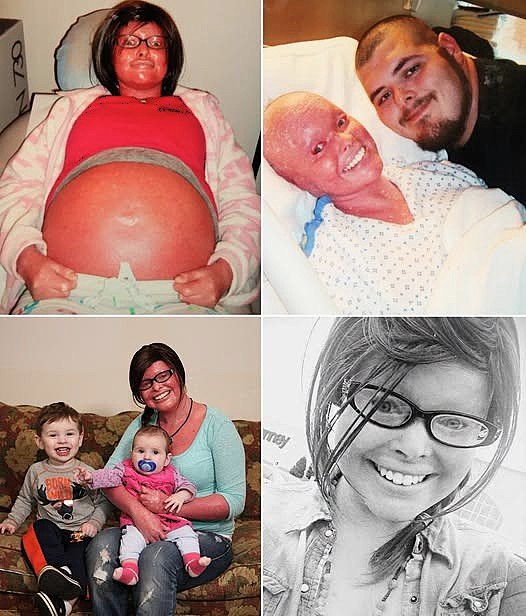
In May 2013, at just 20 years old, Stephanie gave birth to a healthy baby boy named William.
For Stephanie, the moment was extraordinary.
The little girl doctors once feared might not survive her first hour had grown into a young woman holding her own child.
And William was only the beginning.
Eight months after giving birth to her son, Stephanie discovered she was pregnant again.
Her family understandably worried.
Another pregnancy so soon after the first was frightening, particularly given the risks associated with her condition.
But Stephanie continued.
In November 2014, she gave birth to her second child, a daughter named Olivia.
Both of her children were born without harlequin ichthyosis.
Stephanie had become a mother twice.
She also became an example to others living with rare conditions and disabilities that a diagnosis did not necessarily have to determine the boundaries of a person’s dreams.
Motherhood wasn’t easy.
Stephanie still needed constant skin care. She had to be careful about heat and temperature changes. Ordinary activities could require planning and adjustments that other parents might never consider.
But she raised her children.
She loved them.
And she continued speaking publicly about her condition, helping bring attention to a disorder that very few people had ever encountered.
Then, unexpectedly, everything changed.
On March 3, 2017, Stephanie died at only 23 years old.
Her death left her husband to raise their two young children—William, who was three, and Olivia, who was just two.
It is difficult to imagine what her mother must have thought during those final years.
In 1993, she had been warned that her newborn daughter might have less than an hour to live.
Yet that little girl survived.
She grew up.
She learned to live with a condition that affected nearly every part of her daily life.
She found love.
She married.
She became a mother.
And she held two healthy children in her arms.
Stephanie’s life was tragically short, but it was far longer and fuller than those first predictions ever suggested.
Her story is not simply about a rare medical condition.
It is about a woman who was given an extraordinarily uncertain beginning and still found reasons to dream.
Sometimes, the most powerful part of a person’s story isn’t how long they lived.
It’s everything they managed to experience during the time they were given.
And for Stephanie, that included becoming the mother she had hoped to be.