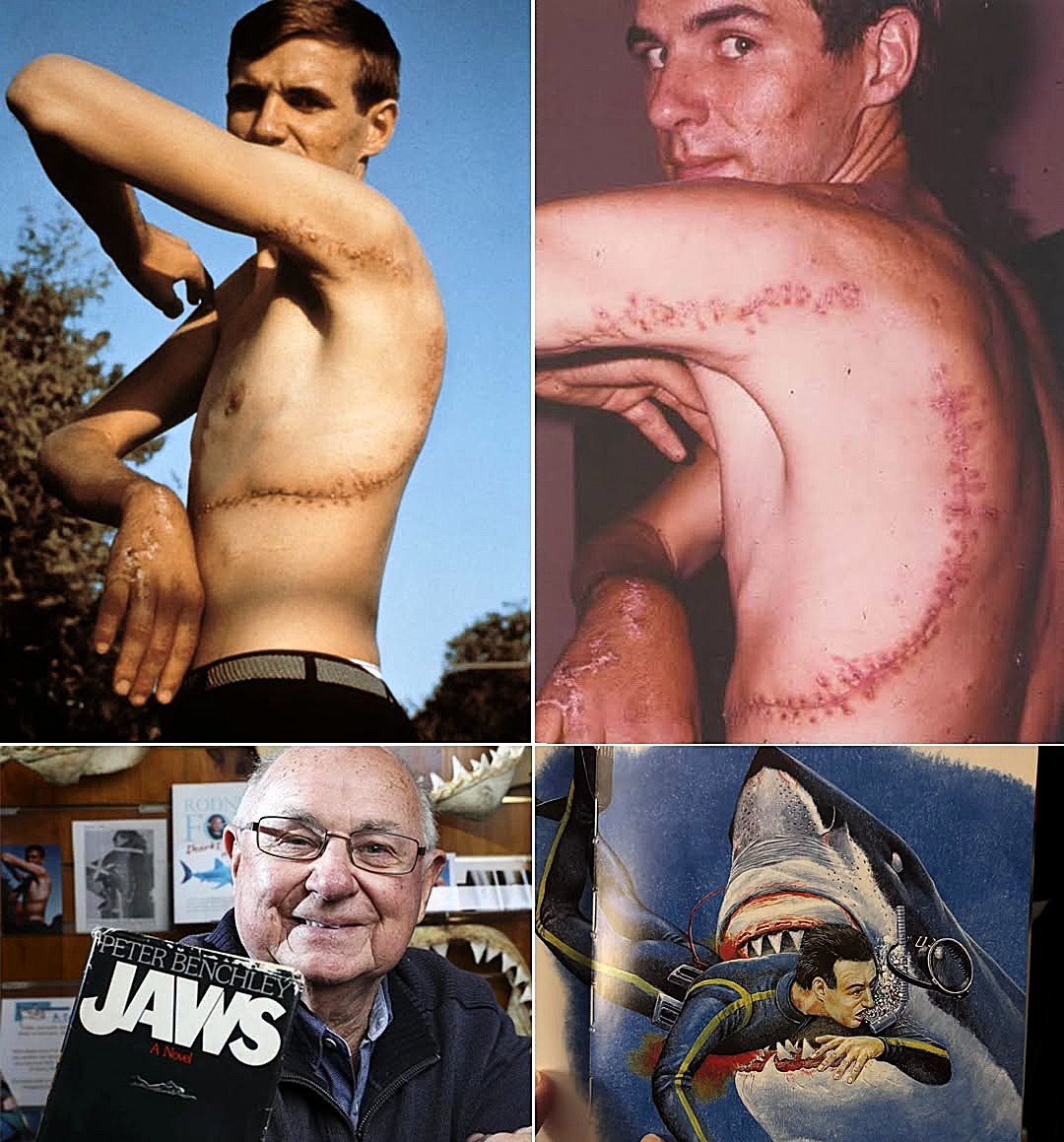
He devoted his life to understanding it.
And eventually, protecting it. 🦈❤️
On December 8, 1963, 23-year-old Rodney Fox entered the waters off Aldinga Beach in South Australia. He was competing in a spearfishing championship and had no idea that the next few minutes would change his life forever.
Rodney was preparing to spear a fish when something enormous slammed into him.
The impact was so violent that, for a moment, he thought he had been struck by a submarine.
Then he realized the terrifying truth.
He was inside the jaws of a great white shark.
There was almost no time to think.
Rodney fought back instinctively, desperately trying to reach the shark’s eyes. Somehow, the animal released him.
But the nightmare wasn’t over.
The shark came back.
Rodney pushed against its enormous body, and in the struggle, his right hand was forced directly into the shark’s mouth.
Eventually, he managed to reach the surface.
The water around him had turned red.
He was severely injured, bleeding and fighting to stay conscious.
Then the shark returned for another attack.
This time, it grabbed the float attached to Rodney’s speared fish. Because the float was connected to him, Rodney was suddenly pulled underwater.
He was being dragged down, unable to escape.
For a terrifying moment, Rodney believed he was going to drown.
Then, almost miraculously, the line broke.
A nearby boat rushed toward him and pulled him from the water.
What rescuers saw was horrific.
Rodney had suffered devastating injuries. Every rib on his left side was broken. His lung had collapsed. His hand was badly damaged, and his wounds were so extensive that doctors needed hundreds of stitches to close them.
A fragment of the shark’s tooth was even left embedded in his wrist.
He had survived an encounter that could easily have ended with his death.
For many people, that would have been the end of their relationship with the ocean.
They might never have wanted to see another shark again.
Rodney went back.
One year after the attack, he returned to competitive spearfishing.
And remarkably, he performed at an elite level, top-scoring in three of the four events at the Australian championships.
But while Rodney returned to the water, something inside him had changed.
He no longer wanted simply to survive sharks.
He wanted to understand them.
The animal that had nearly killed him had become something he was determined to study.
Rodney eventually developed an idea inspired by seeing captive animals at Adelaide Zoo.
Instead of forcing wild animals into cages for humans to observe, why not create a way for humans to enter their environment safely?
That idea helped lead to the development of shark cages designed for underwater observation.
Rodney went on to spend decades around great white sharks, helping researchers, photographers, filmmakers and other observers experience these powerful animals in their natural environment.
He also became one of Australia’s most recognizable advocates for shark conservation.
His story is extraordinary not simply because he survived.
It is extraordinary because of what he chose to do with that survival.
The great white shark gave Rodney every reason to spend his life afraid of it.
Instead, he spent his life trying to replace fear with knowledge.
He didn’t pretend the animal wasn’t dangerous.
He understood exactly how dangerous it could be.
But he also came to understand that a wild animal is more than a single terrifying encounter.
There is a difference between respecting an animal’s power and believing that it deserves to be destroyed because we are afraid of it.
Rodney Fox could have dedicated his life to revenge.
He chose understanding.
He could have walked away from the ocean forever.
He returned.
And perhaps most remarkably of all, the man who came within moments of dying because of a great white shark became someone who spent decades helping people see these animals differently.
His story leaves behind a powerful question:
What would you do if the animal that nearly took your life became the animal you believed was worth protecting? 🦈❤️