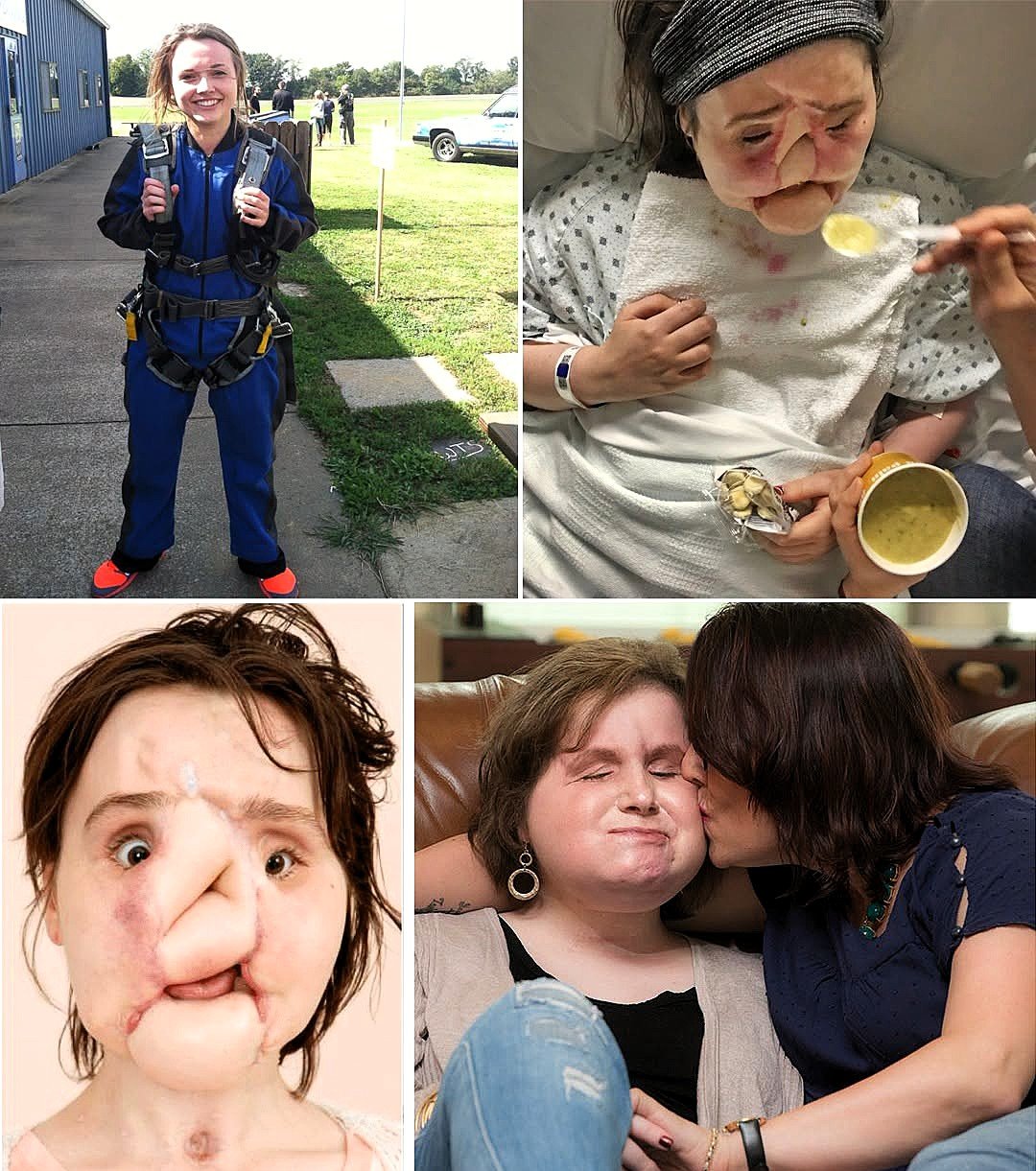
A gunshot injury destroyed much of her face, leaving her with injuries so severe that even the simplest parts of everyday life became almost impossible.
She lost her nose, much of her mouth and jaw, part of her forehead, and most of her eyesight.
But Katie survived.
And survival was only the beginning.
Doctors performed operation after operation to stabilize her condition and reconstruct as much of her face as possible. For years, surgeons worked to repair the damage.
But eventually, they reached a point where conventional reconstruction could only do so much.
Katie needed something extraordinary.
She needed a face transplant.
For Katie, the possibility of receiving a new face was both medically complicated and deeply personal. A face isn’t simply skin and bone. It is the part of ourselves the world sees first—and the part we recognize every time we look into a mirror.
Then, in 2017, an extraordinary opportunity became possible.
A donor had been identified.
Her name was Adrea Schneider, a 31-year-old woman whose family made the decision to donate her organs after her death. Among those donations was her face.
That decision would give Katie a second chance at something doctors once weren’t sure she could ever have again.
On May 4, a huge surgical team at Cleveland Clinic began one of the most complex operations of Katie’s life.
The surgery lasted approximately 31 hours.
Surgeons transplanted an extensive amount of tissue, including Katie’s new forehead, eyelids, nose, cheeks, upper jaw, part of her lower jaw, teeth, facial muscles, nerves and skin.
It was an extraordinary medical undertaking.
Katie was only 21 years old.
She became the youngest person in the United States to receive a face transplant.
But when the operation ended, her journey was far from over.
A transplant could give Katie the physical structures she needed.
It couldn’t instantly teach her how to live with them.
Recovery required patience, therapy and countless hours of practice.
She had to relearn functions many people perform without thinking.
Speaking.
Eating.
Moving her lips.
Closing her eyes.
Learning to control facial muscles.
And eventually, learning to smile again.
There was another challenge that couldn’t be measured in hours of surgery or physical therapy.
Katie had to become comfortable with her reflection.
For most of her life, she had known one face as her own. Suddenly, the face looking back at her in the mirror was different.
It belonged to her now, but accepting that reality took time.
More than a year after the transplant, doctors reported that Katie could close her eyes, wrinkle her nose and begin forming a smile.
And Katie found a simple way to describe the complicated process of accepting her new appearance:
“This is my face. Now it’s my face.”
Those words capture something deeper than a medical procedure.
A face transplant doesn’t simply change how someone looks.
It can change how they experience themselves.
Katie had to learn that her identity was not erased by what happened to her. Her new face became part of the person she already was—the person who had survived, endured years of treatment and continued moving forward.
Her journey later became the subject of an extensive National Geographic story, which explored not only the remarkable medical achievement but also the emotional questions surrounding identity, recovery and rebuilding a life after catastrophic injury.
Katie’s story isn’t simply about receiving a new face.
It’s about everything that came afterward.
The physical therapy.
The uncertainty.
The awkward first attempts at everyday movements.
The unfamiliar reflection.
The gradual return of abilities that once seemed ordinary.
And the slow realization that a new appearance does not mean becoming a different person.
Katie didn’t wake up one morning and instantly feel at home in her new face.
She had to grow into it.
She had to make it part of her life.
And perhaps that is one of the most remarkable parts of her journey.
The surgery gave Katie an extraordinary opportunity.
But healing—physically and emotionally—was something she had to build day by day.
Her story reminds us that reconstruction isn’t always about restoring exactly what was lost.
Sometimes, it’s about learning to move forward with what comes next.
Katie lost much of the face she had known since childhood.
But she didn’t lose the person behind it.
And little by little, through recovery, therapy and time, she began to see the face in the mirror not as someone else’s face, but as her own.
A new face.
A new chapter.
Still Katie.
Read Next
- For years, Carly’s family knew something was wrong. She was only a toddler, but her body wasn’t developing the way doctors expected. There were tests, appointments, questions and explanations that never quite seemed to fit.
- They Were Told Their Baby Might Not Survive Birth — He Lived for Seven Years
- Davide Morana: The “Second Life” He Built After Surviving a Deadly Infection