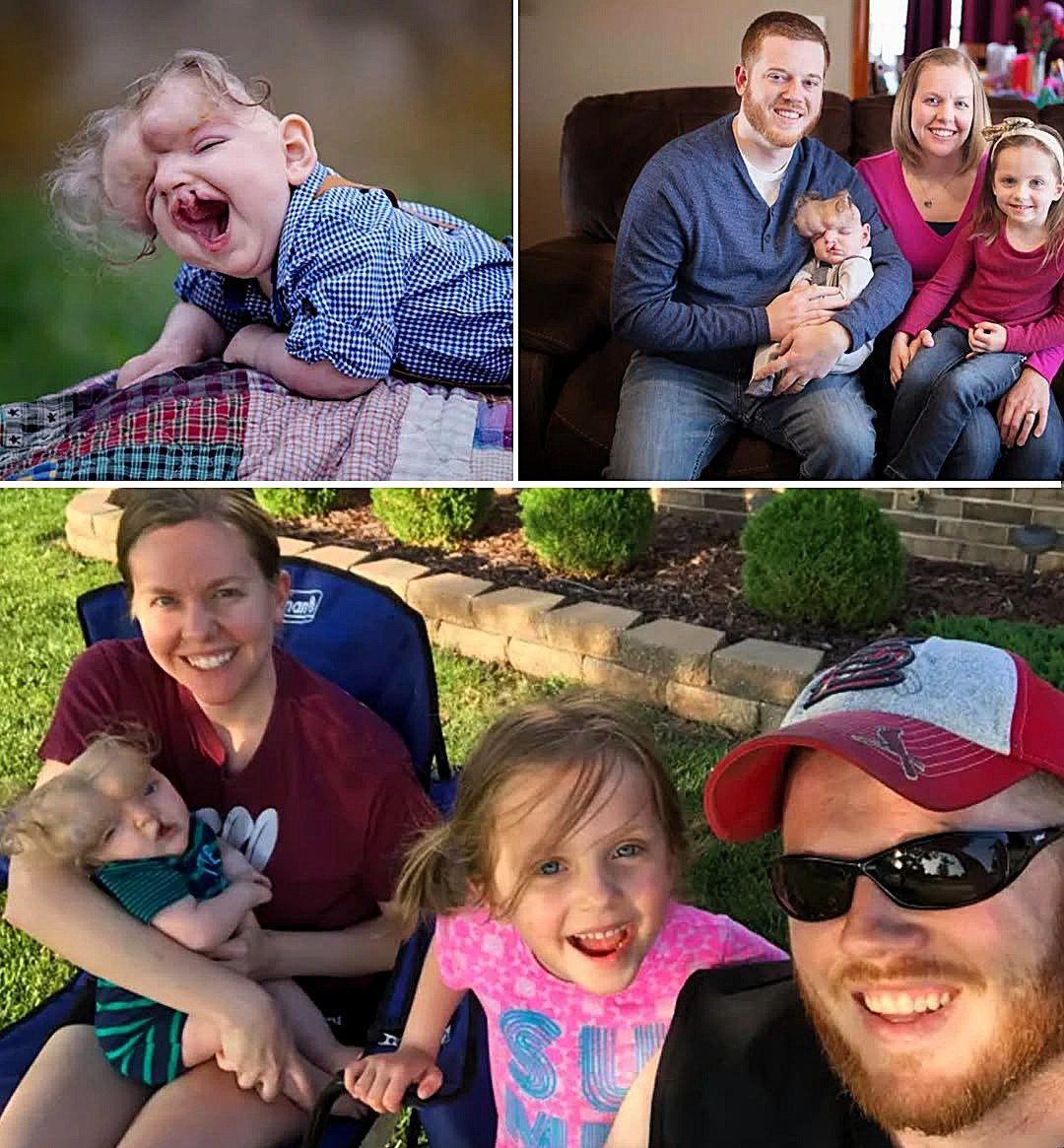

There are some moments in a parent’s life that divide everything into a “before” and an “after.”
For Tom and Jessie Masterson, that moment came during a pregnancy ultrasound when they were expecting nothing more than another routine checkup.
Until then, everything had seemed normal.
They were preparing for the arrival of their baby and imagining the ordinary things expectant parents dream about—holding their newborn for the first time, hearing his cry, bringing him home and watching him grow.
But during the 20-week ultrasound, doctors struggled to get a clear image of the baby’s head.
Four weeks later, Tom and Jessie returned for another scan, still hoping it would simply provide some answers.
Instead, a fetal medicine specialist walked into the room.
The atmosphere changed immediately.
The doctors explained that something was seriously wrong with their unborn son’s development. His brain and skull were not developing normally, and the medical team could not yet determine exactly what condition they were dealing with.
But they could tell the parents something devastating.
Their baby might not survive.
The news was so overwhelming that Tom fainted.
Eventually, further testing in St. Louis gave the family an answer. Their unborn son had an extraordinarily rare condition known as acalvaria, a congenital disorder in which major bones of the skull fail to develop normally.
For Tom and Jessie, learning the name of the condition did not make the situation easier.
The prognosis was frightening.
Doctors explained that babies with severe forms of the condition often do not survive pregnancy, and those who are born alive may have extremely short lives.
The family was faced with an impossible decision.
They could end the pregnancy.
Or they could continue, knowing there was a very real possibility that their son might die before birth, during delivery, or shortly afterward.
There was no easy answer.
There was no guarantee.
There was only a choice between two painful paths.
Tom and Jessie chose to continue the pregnancy.
They chose to meet their son, no matter how long they might have with him.
For the next 17 weeks, Jessie carried her baby while the family tried to prepare emotionally for an outcome no parent should ever have to imagine.
They knew they might be preparing for a goodbye before they had even been given the chance to say hello.
Then, on September 13, 2017, their son was born.
His name was Owen.
And he was alive.
The little boy doctors had feared might not survive delivery had made it into the world.
Owen’s skull had not developed normally, and his brain was missing the typical protection provided by the bones of the skull. His medical needs were significant, and his family understood that caring for him would require extraordinary attention.
But something else became clear.
Owen was still here.
And he had a personality all his own.
He could not move independently or communicate through spoken words, but according to his family, he smiled. He laughed. He responded to the people he loved.
Those moments mattered.
Every smile was precious.
Every laugh was something his parents had once been told they might never hear.
The family learned to celebrate the small things that can so easily be overlooked.
A look.
A smile.
A laugh.
A moment of connection.
A quiet day at home.
For most families, these moments might seem ordinary.
For Owen’s parents, they were extraordinary gifts.
His condition meant that his life required specialized care, protection and therapy. His family had to remain constantly aware of the vulnerability of his brain and the unique challenges he faced.
Yet Owen continued to surprise them.
The weeks became months.
The months became years.
And the child who had been given such a devastating prognosis continued growing.
Then another chapter began.
In July 2021, Tom and Jessie welcomed another son into their family.
His name was Judah.
Owen was nearly four years old.
Instead of only remembering the baby they had once feared losing, his parents were now able to watch him experience something they had never expected to see—life with a younger brother.
They watched Owen smile and laugh around Judah.
There were no guarantees about how long Owen’s life would be, but for that moment, he was simply a big brother.
That ordinary family scene carried extraordinary meaning.
Years earlier, his parents had been preparing themselves for the possibility that Owen might not even survive long enough to leave the hospital.
Now he was interacting with his baby brother.
The future they had once been afraid to imagine was happening in front of them.
Owen continued reaching milestones that seemed almost impossible when compared with the warnings his parents had received before his birth.
One birthday became two.
Then three.
Then four.
Five.
Six.
And eventually, seven.
Seven years.
Seven years filled with moments that his parents had once been told might never exist.
There were difficult days, medical challenges and countless hours of care. But there were also smiles, laughter, family memories and the simple comfort of having Owen beside them.
His life was not defined only by his diagnosis.
He was a son.
A brother.
A beloved member of a family.
And for seven years, he gave the people around him countless reasons to keep celebrating.
Owen died on September 13, 2024—the very same date on which he had entered the world seven years earlier.
His life had come to an end, but the meaning of those seven years did not disappear with him.
For Tom and Jessie, September 13 would forever carry two memories at once.
It was the day they met their son.
And it became the day they had to say goodbye.
Seven years earlier, they had been told their baby might not survive birth.
They had prepared themselves for the possibility of holding him only briefly.
Instead, they brought him home.
They watched him grow.
They celebrated birthdays.
They watched him become a big brother.
They heard him laugh.
They saw him smile.
They experienced thousands of ordinary moments that, under different circumstances, might never have happened.
Owen’s story is not simply about a rare medical condition or a prognosis that turned out to be unexpectedly long.
It is about the immeasurable value of time.
Sometimes, when a family is told that their future may be painfully short, every day takes on a different meaning.
A morning together becomes precious.
A smile becomes a memory to hold onto.
A birthday becomes something extraordinary.
A child’s laugh becomes a sound that parents never want to forget.
Owen’s seven years could never erase the heartbreak his family experienced. But they gave them something they once feared they would never have: time with their son.
And perhaps that is one of the most powerful parts of his story.
Doctors could describe probabilities.
They could explain medical risks.
They could prepare a family for the possibility of loss.
But nobody could fully predict the individual life that Owen would go on to live.
He arrived in this world against expectations.
He stayed far longer than anyone had imagined.
And for seven years, he was loved, cared for and surrounded by the people who wanted nothing more than to give him every moment they could.
His life may have been shorter than most.
But to the family who loved him, seven years were seven years of memories they never would have traded away.
And sometimes, the greatest gift isn’t knowing how long someone will stay.
It’s getting to love them for every moment they do.
Read Next
- In 2018, photographs of Selena Gomez in a bikini began spreading across the internet. Almost immediately, people started commenting on her body.
- Loren Schauers’ incredible survival story: overcoming tragedy with love and determination
- She Refused to Leave the Rescue Van — Then Her Unmoving Stare Sent a Volunteer Back Into the Drainage Pipe