He no longer had his arms.
He no longer had his legs.
And for a young man who had been studying, playing sports and imagining an ordinary future, the reality was almost impossible to understand. ❤️
In 2009, Pedro was living in Brazil when a sudden bacterial meningitis infection turned into a life-threatening emergency.
The illness progressed with terrifying speed.
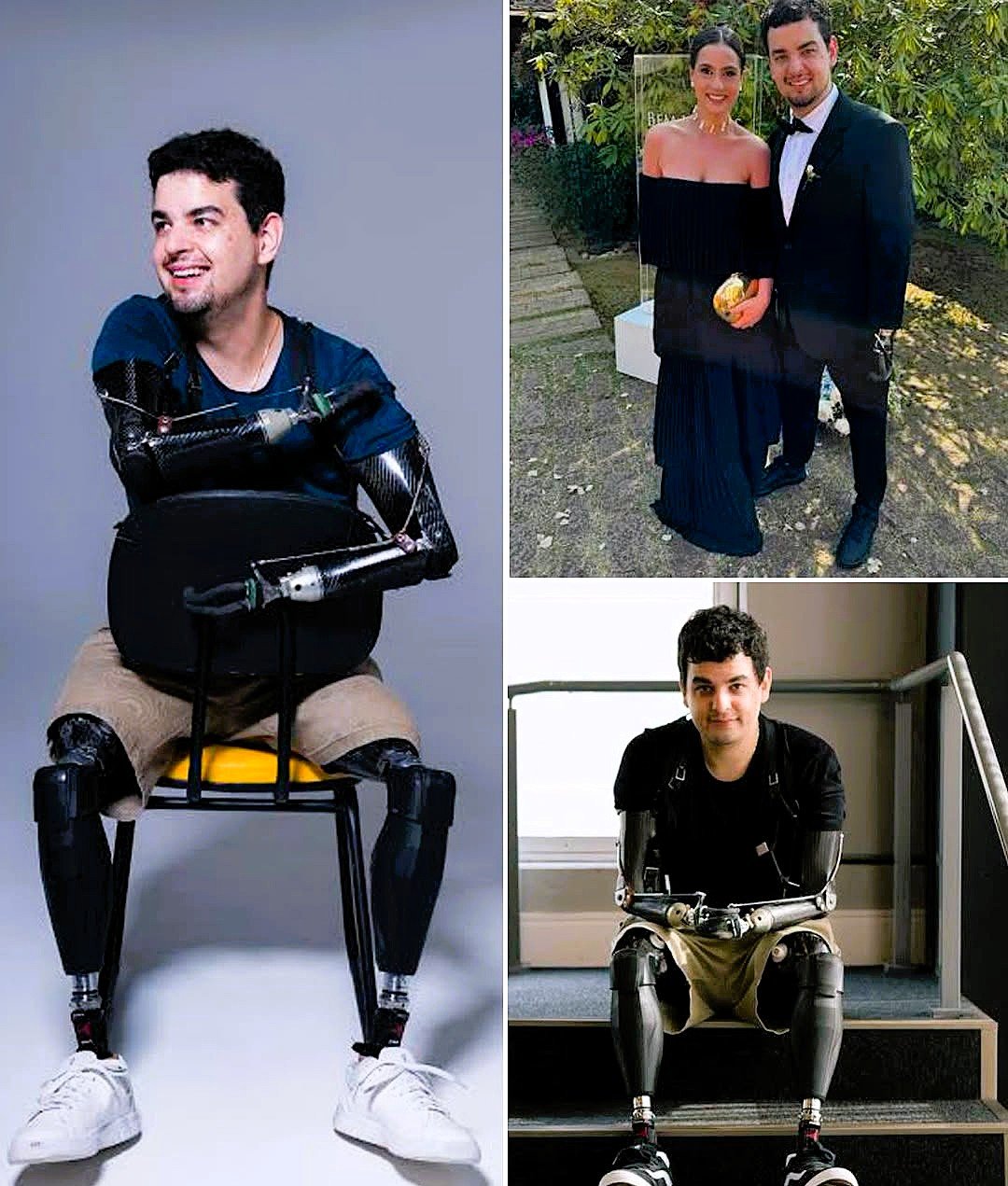
Doctors fought to save his life, but the infection caused devastating damage to his body. To survive, Pedro ultimately had to undergo amputations of both arms above the elbows and both legs above the knees.
He spent nearly six months in the hospital.
When he was finally able to return home, surviving was only the beginning.
Simple things that most people never think twice about had suddenly become enormous challenges. Sitting up could be difficult. Moving from one place to another required assistance. Everyday tasks that had once happened automatically now depended on other people.
Pedro used a wheelchair and needed help with much of his daily life.
And there was another problem.
Doctors warned him that the extensive damage to his skin and the level of his amputations could make fitting and using prosthetic limbs particularly difficult.
For a young man who had once been thinking about school, sports and his future, independence seemed very far away. 💔
Then something happened that would change the direction of his life.
About ten months after leaving the hospital, Pedro traveled to Oklahoma in the United States.
There, at Hanger Clinic, he encountered something he desperately needed to see.
Possibility.
Pedro trained alongside military veterans who had lost limbs during service in Iraq and Afghanistan.
They weren’t simply people wearing prostheses.
They were people adapting.
They were walking.
They were learning new ways to perform everyday tasks.
They were living lives that continued beyond their injuries.
Pedro watched them and realized something important:
Losing his limbs had changed his life, but it did not necessarily have to define the rest of it.
For the first time since his illness, independence didn’t seem like an impossible dream.
It seemed like something he could work toward.
So he began learning.
Step by step, movement by movement, Pedro learned how to use four prosthetic limbs.
The process wasn’t easy. It required patience, training, physical effort and countless moments of frustration.
But eventually, something extraordinary happened.
The young man who had once depended on a wheelchair began walking with prostheses.
He eventually left the wheelchair behind.
His journey didn’t end there.
Pedro later moved to Florida, continued his education and eventually graduated with a degree in economics.
But while building his own future, he never forgot the people and experiences that helped him rebuild his life.
He realized that rehabilitation wasn’t only about advanced technology or artificial limbs.
It was also about connection.
It was about meeting someone who understood the fear.
Someone who had already faced the same questions.
Someone who could look at you and say, without words, “Your life isn’t over.”
That lesson eventually inspired Pedro to help create something of his own.
In 2021, he helped establish Da Vinci Clinic in Brazil, a center designed to bring different forms of amputee rehabilitation together.
The clinic combines custom prosthetic solutions, physiotherapy and support for people adjusting to life after amputation.
Instead of forcing patients to navigate every part of rehabilitation separately, the goal is to create a place where they can receive comprehensive support while working toward greater independence.
Today, the clinic’s two locations help hundreds of people each year.
And Pedro isn’t stopping there.
He is also working toward creating an institute focused on expanding access to prosthetic technology and advocating for the rights and needs of amputees.
Think about the journey.
At 18, Pedro was fighting simply to survive.
Then he had to learn how to live without four limbs.
He had to relearn movement.
He had to rebuild his independence.
He had to imagine a future that looked completely different from the one he had planned.
And somewhere along the way, the person who once needed help became someone determined to help others.
Pedro’s story is not simply about prosthetic limbs.
It is about what can happen when someone who has lost almost everything is given the opportunity to see what remains possible.
Sometimes, the most powerful part of rehabilitation isn’t the technology itself.
It’s meeting someone who has already walked the road ahead of you.
Someone who proves that a different life can still be a meaningful life.
Pedro once feared that losing his arms and legs meant losing his future.
Years later, he is helping other amputees build theirs.
And perhaps that is one of the most remarkable transformations of all: turning the experience that once broke your world into something that helps rebuild someone else’s. ❤️