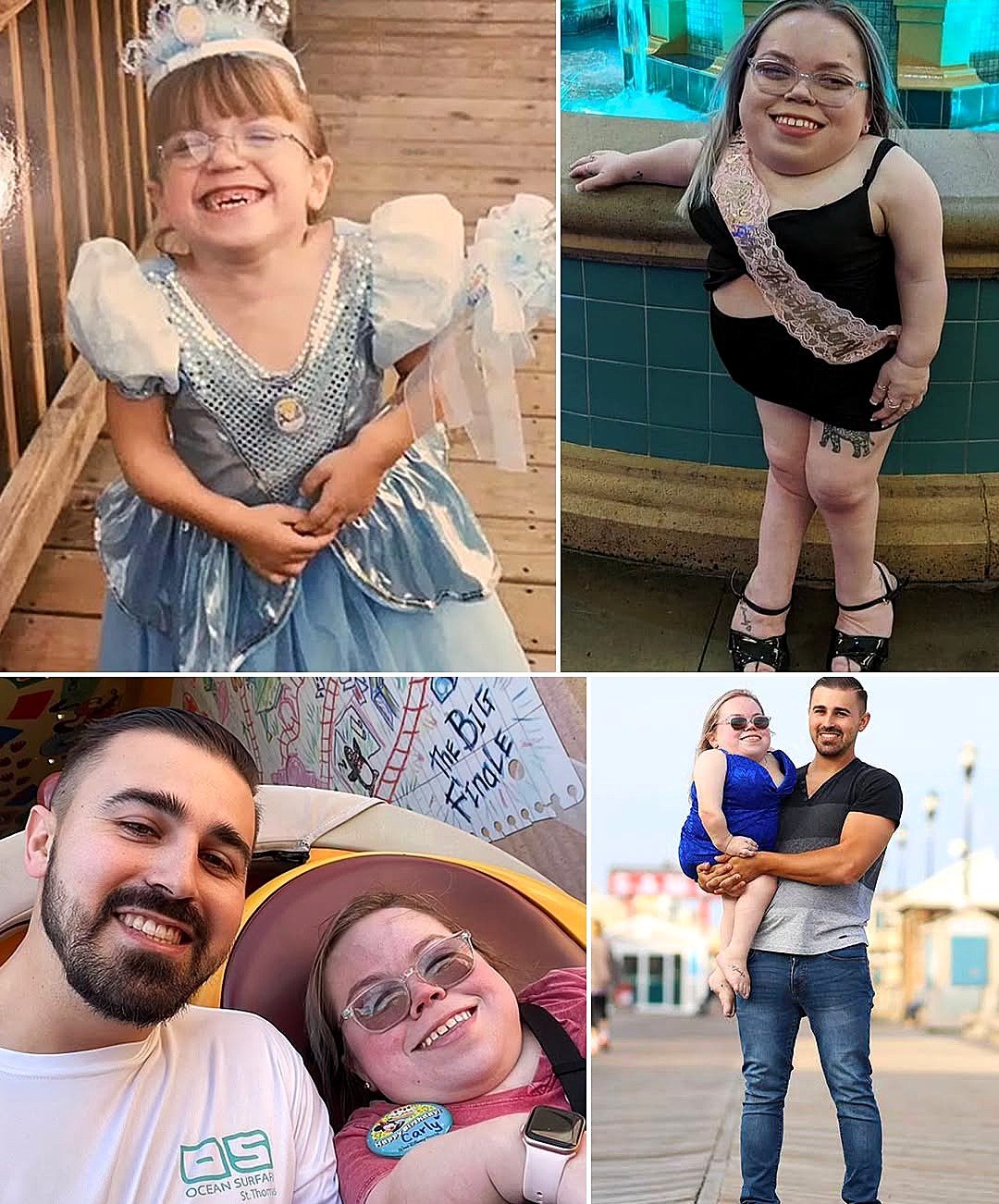
Her family kept searching for an answer.
Then, one day, a local doctor came across a small paragraph in a medical textbook.
It described a condition so rare that most people would never encounter it.
Morquio syndrome Type A.
Suddenly, the pieces began to fit.
Carly was around a year and a half old when she was diagnosed with the genetic disorder, which affects the development of bones and cartilage. The condition can lead to serious problems involving the spine, hips, joints and mobility.
For her family, finally having a name for what Carly was experiencing brought something they had desperately needed: an explanation.
But a diagnosis doesn’t make the challenges disappear.
It simply tells you what you’re fighting.
As Carly grew older, so did the medical challenges surrounding her condition.
Her care eventually brought her to Nemours Children’s Hospital in Delaware, where she was treated by Dr. William Mackenzie, a specialist in skeletal dysplasia.
By the time Carly was around eight years old, her hips had become a major source of trouble.
They were unstable, painful and interfering with the ordinary things a child should be able to enjoy.
Dr. Mackenzie explained that he wanted to create a kind of shelf around her hips to help keep them stable.
Carly was still just a little girl.
So when she heard the explanation, she imagined something completely different.
In her young mind, doctors were going to put an actual shelf inside her body.
She pictured wood.
Glue.
Maybe even nails.
🥹
The real procedure was far more complicated than the picture in her head, but the result was something Carly desperately needed.
Her hips became more stable.
And much of her pain improved.
For Carly, surgery wasn’t simply about correcting something inside her body.
It gave her more freedom to participate in the world around her.
And Carly wasn’t interested in spending her childhood sitting on the sidelines.
She wanted to do what other kids did.
She wanted to be part of a team.
She wanted to cheer.
So she joined cheerleading.
There were limitations.
She couldn’t tumble.
She couldn’t be a flyer.
There were things her body simply couldn’t safely do.
But there was something she could do.
She could belong.
And that’s exactly what Carly did.
She found her place on the team without pretending that her condition didn’t exist.
She simply refused to let her limitations decide whether she was allowed to participate.
Her medical journey didn’t end with one surgery.
There were more procedures.
More appointments.
More difficult conversations.
More moments when her body demanded attention.
Over time, however, something else happened.
The doctors and nurses who cared for Carly became familiar faces. They watched her grow, supported her through procedures and saw the person behind the diagnosis.
They became something that every child facing a complicated medical journey needs:
A trusted support system.
Carly’s life has never been completely free of challenges.
Morquio syndrome has affected the way she moves, the activities she can safely participate in and the decisions she has had to make throughout her life.
But Carly has also learned something that she now wants other families to understand.
A medical condition deserves to be taken seriously.
The limitations are real.
The risks are real.
The appointments and surgeries are real.
But a child is so much more than the list of things they cannot do.
Parents don’t have to pretend that every activity is possible.
Instead, they can help their children find the version that is.
Maybe they can’t tumble.
Maybe they can’t fly.
Maybe they need adaptations, extra planning or a different role.
But different doesn’t have to mean excluded.
And limitation doesn’t have to mean the end of participation.
Carly’s story is a reminder that children living with rare conditions still want the same things other children want.
They want friends.
They want hobbies.
They want laughter.
They want to belong.
They want to discover what they’re capable of.
And sometimes, they need the adults around them to look beyond the diagnosis and ask a different question.
Not, “What can’t you do?”
But:
“How can we help you do what you love?”
Carly never needed anyone to tell her that Morquio syndrome wasn’t real.
She knew it was.
She lived with it.
She underwent surgeries because of it.
She faced pain and restrictions because of it.
What she needed was for people to understand that it wasn’t the whole story.
A diagnosis can explain why someone’s path looks different.
It can help doctors provide the right care.
It can help families understand what lies ahead.
But it doesn’t get to decide someone’s dreams.
Carly’s story isn’t about pretending limitations don’t exist.
It’s about refusing to let those limitations become the only thing anyone sees.
Because sometimes the most powerful form of support isn’t telling a child that they can do everything.
It’s helping them discover what they can do—and making sure they know they still have a place in the world. ❤️