
There are moments in life when failure feels so overwhelming that quitting seems easier than trying again.
One loss can hurt.
Two can make you question yourself.
Ten can make you wonder whether you were ever meant to succeed.
But what happens when you lose 35 times?
For Kyle Maynard, the answer was simple.
He kept going.
Long before he became known for climbing mountains without prosthetic limbs, Kyle was a young wrestler learning one painful lesson after another. Match after match ended in defeat. Thirty-five consecutive losses came before he finally experienced his first victory.
For many people, 35 losses might have been the end of the story.
For Kyle, they became the beginning.
Kyle was born with a rare congenital condition that resulted in his arms ending near his elbows and his legs ending near his knees. He entered the world with physical limitations that could have easily shaped the way others viewed his future.
But his parents made an important decision.
They would love him. They would support him. They would help him when he genuinely needed help.
But they would not automatically do everything for him.
Instead, they encouraged Kyle to discover how he could accomplish things for himself.
That philosophy followed him throughout childhood.
Rather than constantly asking what Kyle could not do, his family encouraged him to figure out how he could do it differently.
And Kyle embraced that challenge.
He learned to move through the world using the body he had. He played football. He trained in wrestling. He lifted weights. Eventually, he even entered mixed martial arts.
Nothing came with an easy instruction manual.
Every activity required adaptation.
Every obstacle required experimentation.
Every failure became another opportunity to find a different method.
And then Kyle decided to attempt something that would challenge even experienced climbers.
Mount Kilimanjaro.
Rising approximately 5,895 meters above sea level, Mount Kilimanjaro is the highest mountain in Africa.
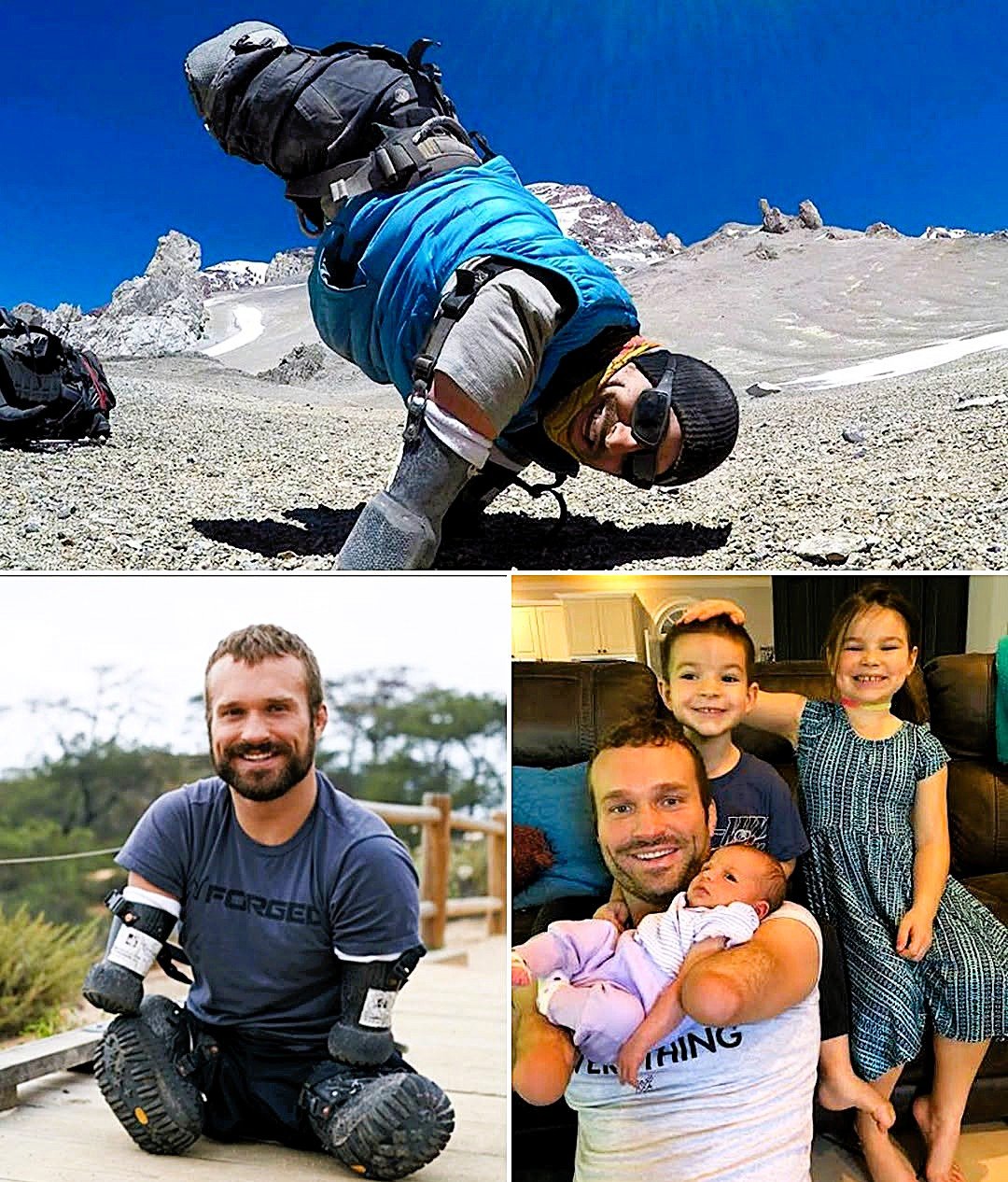
Kyle wasn’t going to climb it with prosthetic legs.
He wasn’t going to walk toward the summit.
He was going to crawl.
The idea sounded extraordinary because it was.
But Kyle had already learned something throughout his life: sometimes the question isn’t whether something can be done in the conventional way.
The question is whether there is another way.
Preparing for Kilimanjaro meant discovering that way.
The mountain would expose his body to sharp rocks, rough terrain, cold temperatures and thousands upon thousands of repetitive movements.
Early training and equipment were far from glamorous. Protective solutions included towels, pieces of mountain-bike tires and Gorilla Tape, used to protect vulnerable areas of his body from the relentless friction of crawling.
Eventually, more specialized equipment was developed to help protect him against the harsh terrain.
But no equipment could do the climbing for him.
Kyle still had to make every movement.
In January 2012, the expedition began.
Day after day, Kyle moved upward.
He crawled across uneven ground.
He pushed himself over rocks.
He continued through increasingly thin mountain air.
While other climbers could rely on their legs to carry them forward, Kyle had to use his upper body and modified crawling techniques to advance.
Every meter demanded effort.
Every hour demanded patience.
And every day brought him closer to a summit that had once seemed almost impossible.
Then, after ten days of climbing, Kyle reached Uhuru Peak.
He had made it.
At the summit of Kilimanjaro, he had accomplished something extraordinary: becoming the first quadruple amputee to reach the summit without prosthetics, relying on his own physical effort to make the journey.
But reaching the top wasn’t only about Kyle.
The expedition, known as Mission Kilimanjaro, also brought attention to people facing challenges of their own, including military veterans dealing with injuries and trauma.
The journey became about resilience, teamwork and helping others.
Before the expedition, the group also delivered medical supplies valued at approximately $25,000 to a Tanzanian school serving children with disabilities.
Kyle carried another deeply personal responsibility with him.
At the request of his family, he brought the ashes of fallen U.S. soldier Pfc. John Corey Johnson to the summit.
So when Kyle finally reached the top of Africa, he wasn’t carrying only the weight of his own journey.
He was carrying someone else’s memory too.
And somehow, even after accomplishing what most people could barely imagine, Kyle wasn’t finished.
Four years later, in 2016, he took on another enormous challenge.
Aconcagua.
Located in Argentina, Aconcagua rises to approximately 6,961 meters and is the highest mountain outside Asia.
Once again, Kyle attempted the climb without prosthetics.
Once again, he relied on his own determination and adapted techniques to move upward.
And once again, he reached the summit.
But perhaps the most powerful part of Kyle Maynard’s story isn’t either mountain.
It isn’t the altitude.
It isn’t the records.
It isn’t even the photographs taken at the top.
It’s what happened when he was still a child.
His parents could have spent years protecting him from every difficult experience.
They could have constantly stepped in.
They could have told him that certain things were impossible because his body was different.
Instead, they gave him something much more valuable.
They taught him to try.
To experiment.
To fail.
And to try again.
That lesson followed him from a wrestling mat where he lost 35 consecutive matches to some of the highest mountains on Earth.
Imagine walking into a wrestling match after losing 20 times.
Then 25.
Then 30.
Then 35.
Most people would understand if you decided enough was enough.
But Kyle returned to the mat.
Eventually, he won.
That victory wasn’t simply a victory over another wrestler.
It represented something much larger.
It proved that a string of failures did not have to become a person’s identity.
Years later, that same mentality carried him up Kilimanjaro.
When the mountain became painful, he continued.
When the terrain became difficult, he adapted.
When conventional methods weren’t available, he created another way.
And when the summit finally appeared, he kept moving until he reached it.
Kyle’s story doesn’t mean failure is easy.
It isn’t.
Failure can be humiliating.
It can be exhausting.
It can make people question their abilities and their dreams.
But failure doesn’t always tell you that you should stop.
Sometimes it is simply telling you that the current method isn’t working.
Try differently.
Learn something.
Adjust.
Get back up.
Try again.
Kyle Maynard’s journey from a young wrestler with 35 straight losses to the summits of Kilimanjaro and Aconcagua is a powerful reminder that progress doesn’t always look like walking forward.
Sometimes it looks like crawling.
Sometimes it looks like falling.
Sometimes it looks like losing again and again.
But as long as you keep moving, the story isn’t finished.
Kyle didn’t change the circumstances he was born into.
He changed what he believed he could do within them.
And perhaps that is the question worth carrying with us when life puts an impossible-looking challenge in front of us.
Not, “Why can’t I do this?”
But:
“How can I do it?”
Because somewhere between the first failure and the thirty-fifth, between the bottom of the mountain and the summit, there may be an answer waiting for the person who refuses to stop looking.
❤️
Read Next
- After Seven Years, Luna Finally Sees a New Reflection
- Sometimes, a photograph captures much more than a moment. Sometimes, it captures a bond so powerful that thousands of strangers stop scrolling, look a little closer, and decide that two lives are worth saving.
- At first glance, you might think something went wrong with the photograph