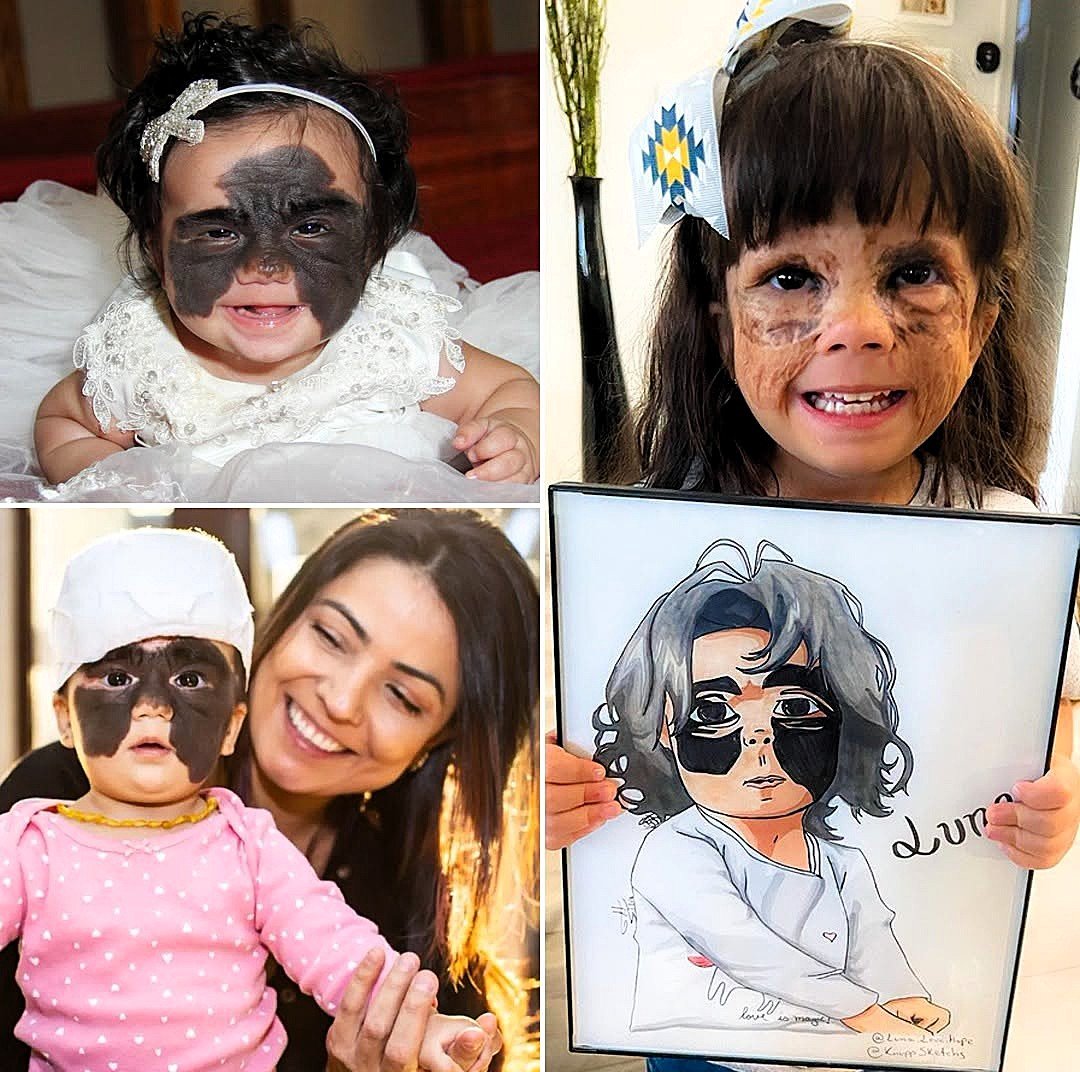
When Luna Tavares-Fenner was born, a large dark birthmark covered much of her face.
To the world, it became the first thing people noticed.
To her mother, Carolina, it was never simply a mark on her daughter’s skin. It was something that came with uncertainty, medical concerns, countless appointments and a future filled with questions.
Luna was born in Florida in March 2019 with a giant congenital melanocytic nevus, a rare condition caused by an unusually high concentration of pigment-producing cells in the skin.
The nevus extended across much of her face, including her forehead, nose, eyelids and cheeks. As photographs of the little girl spread online, strangers began calling her the “Batman girl” because of the dark pattern across her face.
But behind those viral images was a little girl who was simply growing up.
And a mother determined to give her every possible chance at a healthier future.
Large congenital nevi can carry medical concerns, including an increased risk of melanoma, so Carolina began searching for treatment while Luna was still very young.
Eventually, their search led them overseas.
Beginning in 2019, Luna underwent a long series of treatments and reconstructive procedures in Russia. What followed was not one operation, but years of medical care.
There were photodynamic treatments.
There were skin grafts.
There were reconstructive surgeries.
And there were long stretches of recovery.
Some procedures left Luna with facial bandages. At times, her family had to deal with infections and wait patiently for delicate areas of skin to heal before doctors could continue.
For a child, that kind of journey could easily feel overwhelming.
But Luna found ways to make the hospital world feel a little more familiar.
She often brought her dolls with her to medical appointments. According to her doctor, Luna would even ask him to place tiny bandages on her dolls’ faces.
Perhaps, in her own childhood way, she was making the frightening parts of treatment easier to understand.
While adults talked about procedures, grafts and reconstruction, Luna still had dolls to care for.
And she still had a childhood to live.
As the years passed, Luna gradually began noticing the changes in her own face.
One moment in particular stayed with her family.
Looking at herself, Luna reportedly said:
“My black mark is gone. I’m a princess.”
For her mother, those words carried far more meaning than a simple child’s observation.
They represented how much had already changed.
But Luna’s journey was not finished.
In 2024, another important chapter began in St. Petersburg. This stage of treatment focused heavily on scars left behind by earlier procedures.
Surgeons used tissue expanders beneath healthy areas of skin. Gradually, the skin was stretched so that it could later be used to reconstruct areas affected by scarring.
It was another process that demanded patience.
The treatment continued through 2025 and into 2026.
Then came July 22, 2026.
At seven years old, Luna underwent what doctors described as the final major operation in her reconstruction journey.
Surgeons removed remaining areas of the nevus and scar tissue and reconstructed portions of her forehead, central face and left eyelid.
After years of procedures, another major stage had finally come to an end.
Doctors say the principal surgical reconstruction of Luna’s face is now complete, although smaller cosmetic procedures may still be considered as she grows and her face naturally changes.
Seven years.
That is almost Luna’s entire life.
While many children remember their early years through family vacations, birthday parties, favorite toys and school photographs, Luna’s childhood memories also include hospital rooms, long journeys, medical appointments, facial bandages and recovery periods.
Yet her story is not only about surgery.
It is also about a little girl who kept playing.
A child who brought her dolls to the hospital.
A daughter whose mother refused to stop searching for answers.
And a family that continued moving forward, one procedure at a time.
For years, millions of people knew Luna because of the dark pattern covering her face. Photographs made the birthmark the most recognizable part of her appearance.
But Luna has always been more than the mark people saw first.
She is a daughter.
She is a child.
She is someone who has grown up while undergoing a medical journey most adults would struggle to imagine.
Now, at seven years old, she is entering a different chapter.
The face she has known since birth has changed dramatically. The reflection in the mirror is becoming increasingly different from the one she grew up seeing.
And perhaps the most beautiful part is that Luna’s story was never really about making her look like someone else.
It was about giving her the opportunity to move forward with her life.
The surgeries may have changed her appearance.
But they did not create the little girl underneath it.
She was there all along—behind the bandages, behind the scars, behind the birthmark that made strangers look twice.
And now, after seven years of treatment, Luna can look at herself and see something beyond the mark that once defined her in the eyes of others.
She can simply see Luna.
A little girl growing up.
A daughter loved fiercely by her mother.
And, in her own words, a princess.