She wondered whether the photographers would even notice her.
Not because she wanted fame.
Not because she needed attention.
But because, for much of her life, people had noticed her face before they noticed her.
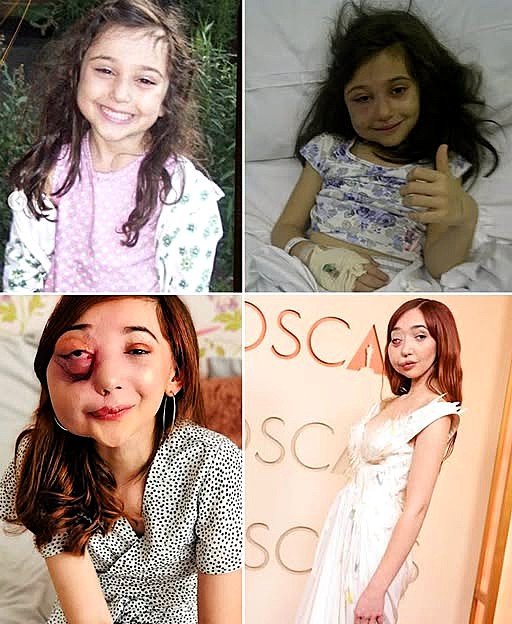
Then, on March 15, 2026, the 21-year-old British creator and advocate walked onto one of the most famous red carpets in the world—the 98th Academy Awards in Hollywood. ✨
And suddenly, the cameras were there.
The lights were there.
The photographers were there.
And Nikki was exactly where she belonged.
For Nikki, however, the night was about far more than designer clothes, celebrities or flashing cameras.
Her story began when she was just six years old.
She started experiencing unusual swelling and visible changes on one side of her face. After medical evaluations, she was diagnosed with a high-flow craniofacial arteriovenous malformation, commonly known as an AVM—a rare condition involving abnormal connections between blood vessels.
Growing up, Nikki’s life became intertwined with hospitals and treatment.
She has undergone nearly 100 major procedures and experienced hundreds of hospital visits.
While many children were simply growing up and discovering who they were, Nikki was also learning how to live with a medical condition that made her appearance immediately noticeable to strangers.
People stared.
People asked questions.
And sometimes, people saw the difference before they saw the person.
But Nikki refused to let that become the whole story of her life.
Instead, she picked up a camera.
She began sharing videos about makeup, fashion, school, everyday experiences and her life with AVM.
What started as a way of expressing herself eventually became something much bigger.
Millions of people began watching.
Nikki became a television presenter, author and advocate. She used her platform to raise awareness about arteriovenous malformations and to support efforts helping others affected by the condition.
Her face, once something that made her feel different, became part of a message much larger than herself.
Then came the invitation to the Oscars.
It should have been nothing but exciting.
And it was.
But Nikki later spoke about feeling anxious and experiencing imposter syndrome before walking the red carpet.
She wondered whether the photographers would look her way.
Would they see her?
Would she really belong among the world’s biggest stars?
Those questions reveal something important about how powerful social expectations can be.
For someone who has spent years being reminded that she looks different, entering a space built around beauty, fashion and celebrity can carry an emotional weight that outsiders may never fully understand.
But Nikki walked out anyway.
She didn’t hide.
She didn’t wait until she looked like everyone else.
She simply stepped forward as herself.
And the cameras followed.
For many people watching, that moment represented something bigger than one young woman attending an awards ceremony.
Nikki has spoken about how meaningful visibility can be for the facial-difference community.
For years, visible differences have often been treated as something people should stare at, pity, avoid or attempt to conceal.
But representation can quietly challenge those assumptions.
When someone with a visible difference appears on a stage watched by millions, they aren’t suddenly becoming worthy because they’re famous.
They were already worthy.
The visibility simply gives more people an opportunity to recognize it.
Nikki’s Oscars appearance didn’t erase her AVM.
It didn’t erase the surgeries, hospital visits, uncertainty or difficult moments she experienced growing up.
And it didn’t need to.
Her condition was never something that had to disappear before she could deserve a place in the room.
She walked that red carpet with the same face she had spent years learning to accept.
The same face that doctors had treated.
The same face strangers had stared at.
The same face she eventually chose to show millions of people online.
And this time, the world wasn’t simply looking at a facial difference.
It was looking at Nikki Lilly.
A young woman who turned a deeply personal challenge into advocacy, creativity and connection.
Perhaps that’s the most powerful part of her Oscars story.
Beauty didn’t have to mean changing herself.
Belonging didn’t require looking like everyone else.
Sometimes, representation begins with something as simple as being visible—and refusing to apologize for being seen.
❤️
Nikki’s journey raises an important question: Can seeing more people with visible differences celebrated in spaces like the Oscars help society expand its understanding of beauty, confidence and belonging?