She was worried the photographers might look right past her.
Not because she wasn’t dressed for the occasion.
Not because she didn’t belong.
But because Nikki had spent much of her life being noticed for the difference in her face—and she wondered whether, on one of Hollywood’s biggest nights, people would see her before they saw her condition.
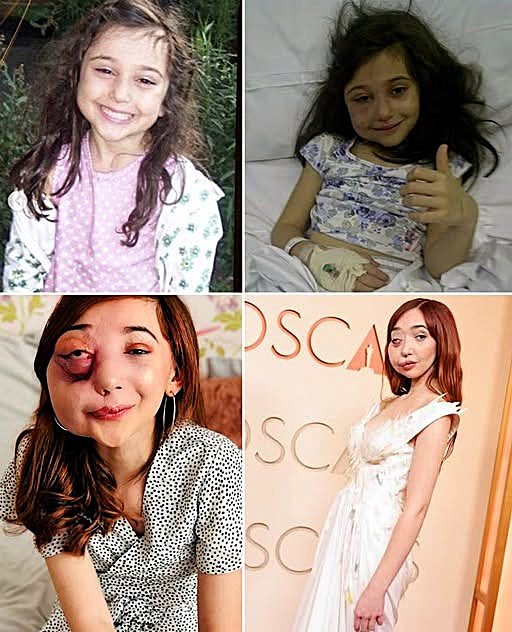
Then, on March 15, 2026, the 21-year-old British creator and advocate stepped onto the red carpet at the 98th Academy Awards in Hollywood.
And suddenly, there were cameras everywhere.
For Nikki, it wasn’t simply a glamorous celebrity appearance.
It was the culmination of a journey that had begun when she was just six years old.
That was when Nikki started experiencing unusual swelling and visible changes on one side of her face. After years of medical appointments and uncertainty, doctors diagnosed her with a high-flow craniofacial arteriovenous malformation, commonly known as an AVM—a rare condition involving abnormal connections between blood vessels.
Her childhood became filled with hospitals, specialists and procedures.
Treatment wasn’t something she experienced once and left behind.
It became part of growing up.
Over the years, Nikki underwent nearly 100 major procedures and made hundreds of hospital visits.
She had to grow up while learning to live with a facial difference that strangers could notice almost immediately.
And strangers don’t always know how to respond to something they don’t understand.
Some people stared.
Others asked uncomfortable questions.
Some simply didn’t know where to look.
But Nikki eventually decided that instead of hiding from those reactions, she would face them head-on.
She picked up a camera.
And she started showing the world her life.
Through videos about makeup, fashion, school, everyday experiences and her medical journey, Nikki allowed millions of people to see something beyond a diagnosis.
They saw a young woman laughing.
Creating.
Learning.
Dressing up.
Being herself.
Her platform grew, and Nikki became much more than an online creator. She became a television presenter, author and passionate advocate, using her visibility to raise awareness and support for people living with AVMs and other facial differences.
But becoming comfortable in front of millions of people doesn’t mean fear disappears.
Even after years in the public eye, the Oscars red carpet felt different.
This wasn’t just another appearance.
It was one of the most photographed places in the world.
Nikki later spoke about experiencing anxiety and imposter syndrome before stepping onto the carpet.
She wondered whether photographers would notice her.
Whether she truly belonged among some of the world’s biggest stars.
Those thoughts are powerful because they reveal something many people with visible differences quietly experience.
Even after accomplishing extraordinary things, they can still wonder whether the world has made room for them.
But Nikki walked forward anyway.
She didn’t need her face to look different.
She didn’t need to hide the scars, the swelling or the evidence of everything she had endured.
She simply needed to be there.
And she was.
Under the flashing cameras of Hollywood, Nikki’s presence became something much bigger than a fashion moment.
For years, people had looked at her face and immediately noticed that she was different.
At the Oscars, millions of people saw that same face surrounded by cameras, beautiful gowns, famous actors and one of the world’s most celebrated entertainment events.
And nothing about Nikki had to disappear for her to belong.
That may be one of the most powerful messages of her journey.
Representation isn’t always about changing the person being represented.
Sometimes, it’s about changing the way everyone else looks at them.
A child growing up with a facial difference can see Nikki on a screen and realize that their future doesn’t have to be defined by other people’s reactions.
They can dream about television.
Fashion.
Film.
Public speaking.
Or simply living an ordinary life without feeling the need to apologize for how they look.
Nikki’s story doesn’t erase the difficult parts of her childhood or the years of medical treatment she has endured.
Instead, it shows what can happen when someone refuses to let those experiences become the entire definition of who they are.
She walked onto the Oscars red carpet worried that photographers might overlook her.
Instead, she became part of the picture.
And perhaps that’s what makes the moment so meaningful.
Not because Nikki was finally accepted into a world of beauty.
But because she showed that beauty never belonged to only one kind of face in the first place.
Sometimes changing the world begins with something as simple as being visible.
And Nikki Lilly chose to be seen.
Do you think seeing more people with visible differences at major events like the Oscars can help society develop a broader and more compassionate idea of beauty?
Read Next
- The Blind Dog Thought His Owner Would Return—So He Kept Waiting Until His Body Could No Longer Hold On
- He Came to the Shelter With Old Towels — And Left With a Dog
- A dog does not need words to prove how much he loves his family. Sometimes, all it takes is one moment. One moment when danger appears. One moment when fear takes over