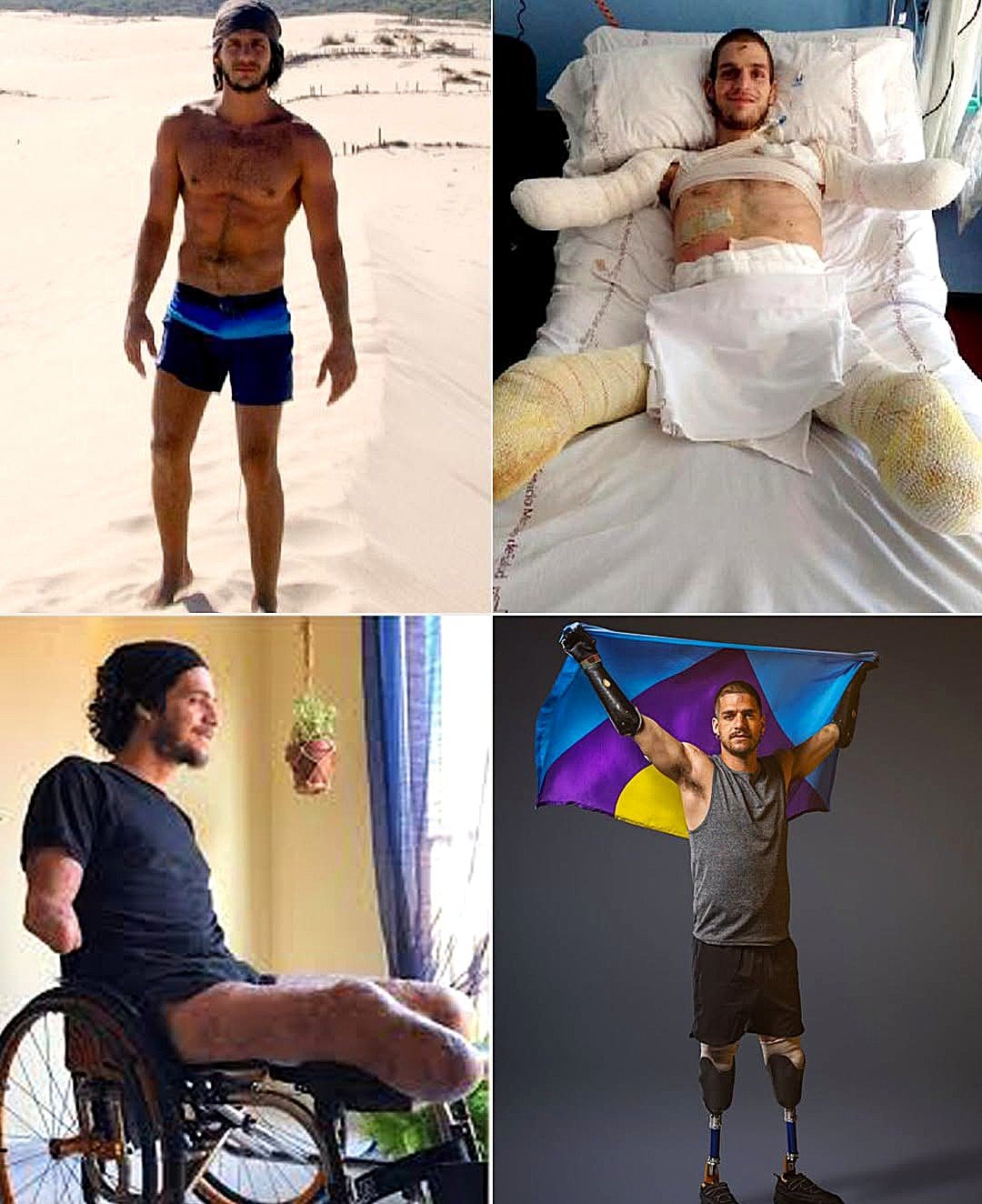
At just 24 years old, Davide Morana went to the emergency room because he knew something was seriously wrong.
At first, however, there was little indication of the nightmare that was about to unfold.
His medical tests appeared normal, and doctors believed he was suffering from something that looked like the flu. He was sent home.
But within only a few hours, Davide’s condition changed dramatically.
His fever became dangerously high. He began experiencing severe vomiting, and a frightening purple rash started spreading across his body. What initially appeared to be an ordinary illness was actually something far more dangerous.
Davide was fighting a rapidly progressing meningococcal infection.
The infection had entered his bloodstream and triggered a devastating condition known as meningococcal septicemia. His body was suddenly in a race against time.
When Davide returned to the hospital, doctors realized just how critical his situation had become.
He was eventually placed into an induced coma while medical teams worked desperately to keep him alive.
The infection had caused catastrophic damage to his body. The blood supply to his extremities had been severely affected, leaving doctors with an impossible series of decisions.
Davide survived.
But survival came at an extraordinary cost.
Doctors ultimately had to amputate all four of his limbs.
When Davide finally woke up, the world he remembered was gone.
At only 24 years old, he had to face a reality that most people could never imagine. Simple things that once required no thought—standing, walking, getting dressed, moving around his home and taking care of himself—had suddenly become enormous challenges.
He had survived an illness that could have taken his life.
Now he had to figure out how to live it.
Davide later recalled being told that his condition had been so severe that approximately 93 percent of people in a similar situation would not survive.
For many people, hearing such a statistic might have become a source of fear or despair.
For Davide, it became something else.
It became a reminder of just how extraordinary his survival was.
Instead of allowing his losses to define him, he decided to focus on what he could still build.
That decision marked the beginning of what he describes as his “second life.”
Learning Everything Again
Recovery was not quick.
Prosthetic limbs did not magically restore the life Davide had before his illness. They were tools that required patience, practice and enormous physical effort.
Walking became something he had to learn again.
Moving independently became a skill.
Even ordinary daily activities required concentration, strength and determination.
Rehabilitation could be exhausting. There were moments of frustration, physical pain and setbacks. Progress that might have seemed insignificant to someone else could represent a major victory for Davide.
A step forward was literally a step forward.
Over time, however, Davide began to discover that his body was capable of much more than he initially imagined.
He started embracing physical activity and eventually became involved in sport.
The same man who had once been fighting simply to survive was now challenging himself physically.
Sport became more than exercise.
It became part of his recovery.
It gave Davide another reason to push his limits, another way to regain independence and another opportunity to demonstrate that losing his limbs had not meant losing his future.
He eventually became a para-athlete, motivational speaker and advocate for meningitis awareness.
His story also allowed him to reach people far beyond the rehabilitation center.
Instead of keeping his experience private, Davide began speaking publicly about what happened to him and using his platform to educate others about meningococcal disease.
Turning Survival Into a Mission
Davide’s experience gave him a powerful understanding of how quickly a seemingly ordinary illness can become life-threatening.
His illness had progressed with frightening speed.
One moment, he was a young man experiencing symptoms that appeared manageable.
Hours later, he was fighting for his life.
That reality became an important part of the message he wanted others to understand.
Meningitis and meningococcal disease can develop rapidly, and awareness of warning signs can be critically important.
In 2023, Davide also helped create the Meningitis Flag, a global symbol intended to bring together people affected by meningitis and help promote awareness and prevention.
For Davide, advocacy was not simply about talking about a disease.
It was about turning one of the darkest experiences of his life into something that could potentially help others.
His story became a reminder that surviving a serious illness is sometimes only the beginning of another difficult journey.
A Different Definition of Strength
Davide could have spent the rest of his life thinking about everything the infection had taken from him.
Instead, he began asking a different question:
What can I do with the life I still have?
That change in perspective became one of the most important parts of his recovery.
He had lost all four limbs.
But he had not lost his determination.
He had lost his old routine.
But he could create a new one.
He had lost the ability to do many things automatically.
But he could learn how to do them differently.
And perhaps most importantly, he had survived.
Davide’s journey demonstrates that resilience does not necessarily mean pretending that something terrible never happened.
It means acknowledging the loss while refusing to allow that loss to become the end of the story.
His rehabilitation was not about returning to exactly who he had been before 2018.
It was about discovering who he could become afterward.
That distinction matters.
Sometimes rebuilding a life does not mean recreating the past.
Sometimes it means creating a future that looks completely different.
His “Second Life”
Davide refers to everything after 2018 as his “second life.”
The phrase carries a powerful meaning.
His first life was the life he knew before the infection—the ordinary routines, physical independence and plans of a young man in his twenties.
His second life began when he survived something that could easily have killed him.
It was a life filled with challenges he had never expected to face.
But it was also a life filled with possibilities he might never have discovered otherwise.
Through sport, public speaking and advocacy, Davide transformed his personal tragedy into a source of inspiration for others.
He became living proof that a person can experience an unimaginable loss and still find purpose.
His story is not simply about prosthetic limbs.
It is not simply about illness.
And it is not simply about survival.
It is about what happens after survival.
Because staying alive is one battle.
Learning how to live again can be another.
Davide Morana faced both.
Today, his journey continues to remind people that strength can take many forms. Sometimes strength is fighting through a medical emergency when your body is failing. Sometimes it is getting out of bed for rehabilitation when progress feels painfully slow. Sometimes it is taking one difficult step with a prosthetic limb. And sometimes strength is simply deciding that your circumstances will not determine the rest of your life.
Davide lost four limbs, but he refused to lose his sense of possibility.
His experience changed his life forever.
Yet he chose to make that change meaningful.
His “second life” is a testament to resilience, courage and the extraordinary human ability to rebuild after devastation.
And perhaps the most powerful lesson from his story is this:
Survival is not always the finish line.
Sometimes, it is the starting point of a completely new life.