Inside an animal shelter, there are countless moments that most people never get to see.
Dogs wait behind kennel doors, watching strangers walk past. Some bark for attention. Others remain silent, hoping that someone will stop. Some arrive after being abandoned, while others have spent months waiting for a family to choose them.
But every once in a while, a single photograph captures something that words struggle to explain.
That is what makes the heartbreaking image of these two shelter dogs so powerful.
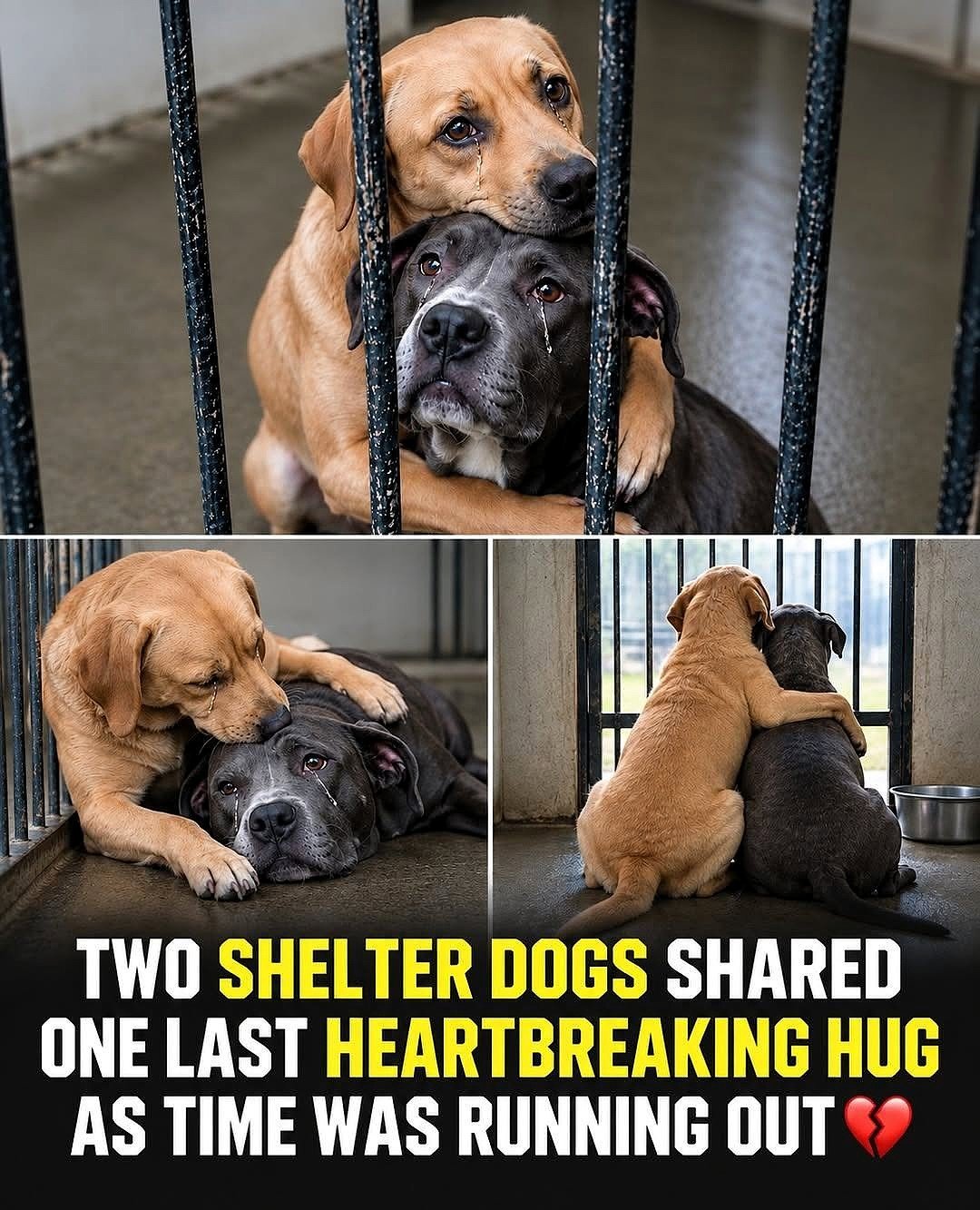
Behind metal bars, two dogs can be seen holding onto each other. The lighter-colored dog rests gently over the darker dog, wrapping its front legs around its companion. Their eyes appear filled with sadness, and tears can be seen running down their faces.
The photograph has been shared widely with a heartbreaking message: two shelter dogs sharing what appeared to be one last embrace as their time was running out.
Whether or not anyone can know exactly what the dogs were thinking in that moment, the image tells a story that touches one of the most painful realities facing shelter animals—the uncertainty of waiting for someone to choose them.
A Shelter Can Be a Frightening Place
For a dog accustomed to living with people, arriving at a shelter can be confusing and frightening.
Suddenly, familiar surroundings disappear.
There may be unfamiliar smells, strange voices, barking from neighboring kennels and people constantly moving around.
Even friendly dogs can become anxious under those circumstances.
They do not understand why they are there.
They cannot understand how long they will have to wait.
And most importantly, they cannot understand why the people they once trusted are no longer beside them.
For dogs who arrive together, having a familiar companion can provide some comfort.
They may sleep beside each other.
They may share whatever little comfort their kennel provides.
And when everything around them feels unfamiliar, the presence of another dog can become a source of reassurance.
That is what makes the photograph so difficult to look at.
The two dogs appear to be doing exactly what frightened animals sometimes do—they are staying close to the one familiar friend they have.
One Dog Reaches for the Other
In the photograph, the lighter-colored dog appears to place its body over the darker dog.
Its front leg rests across its companion as if offering a hug.
The darker dog looks toward the camera while remaining underneath its friend.
Their bodies are pressed closely together.
It almost looks as though neither wants to let go.
Another photograph shows the pair lying together on the shelter floor, with the lighter dog resting its head against the darker dog’s body.
A third image shows them sitting together near a window, both facing outward.
There is something deeply emotional about that final scene.
Outside the shelter is an entire world.
People are walking around.
Cars are passing.
Families are going about their daily lives.
But inside the kennel, two dogs are simply sitting together.
Waiting.
Perhaps hoping.
Perhaps simply finding comfort in each other.
The Heartbreak of Being Overlooked
Thousands of dogs enter animal shelters every year.
Some are adopted within days.
Others wait much longer.
The reasons are often unfair.
A dog may be older.
It may be shy.
It may not have the appearance people are searching for.
It may have medical needs.
Or it may simply have been unlucky enough to arrive at a shelter when there were too many other animals competing for attention.
For bonded dogs, the situation can be even more complicated.
Separating two animals that have relied on each other for comfort can be incredibly difficult.
They may have spent much of their lives together.
They may sleep together, eat together and depend on each other when they become frightened.
The thought of them being separated can make an already painful situation even more heartbreaking.
That is why images like this often strike such a strong emotional response.
People see more than two dogs behind bars.
They see companionship.
They see loyalty.
And they see two vulnerable animals trying to comfort each other in a place where they desperately need someone to comfort them.
A Hug Without Words
Dogs cannot tell us their stories.
They cannot explain where they came from.
They cannot tell us whether someone abandoned them or whether they became lost.
They cannot explain how many nights they spent outside before reaching the shelter.
And they cannot tell us what they fear will happen next.
But they communicate in other ways.
A dog leans against another dog.
A paw reaches out.
A head rests on a companion.
A frightened animal stays close to someone it trusts.
These small gestures can communicate more than words ever could.
In this photograph, the lighter dog appears to hold onto the darker dog.
It is a simple gesture, but it has become the defining image of their story.
It reminds viewers that shelter animals are capable of deep bonds and that their emotional lives matter.
Was It Really Their “Last Hug”?
The image is often presented online as the dogs’ “final hug” or as a moment when their time was running out.
However, without reliable information identifying the shelter, the dogs, the date or what happened to them afterward, the exact circumstances behind the photograph cannot be independently confirmed.
That detail matters.
A heartbreaking image can inspire compassion, but it is important not to turn an emotional photograph into facts that have not been verified.
What is clear from the photograph is that the dogs appear closely bonded and that the moment captures the emotional vulnerability of animals waiting inside a shelter.
And that alone is powerful enough.
Because whether the photograph represented their final moments together or simply one quiet moment of companionship, it reminds us of how many shelter animals depend on human kindness.
Every Shelter Dog Deserves a Chance
Behind every kennel door is an individual animal.
Some are playful.
Some are energetic.
Some are nervous.
Some are older and calmer.
Some need patience before they feel comfortable around people.
But almost all of them are waiting for the same thing—a safe place to call home.
The two dogs in this photograph represent something bigger than their own story.
They represent the animals who spend their days waiting for someone to notice them.
They represent dogs who may have been abandoned but still trust humans.
They represent companions who have nothing except each other while they wait for a better future.
And perhaps most importantly, they remind us that adoption is about more than bringing a pet home.
It can mean giving an animal another chapter.
A warm bed.
Regular meals.
A safe place.
A family.
And the chance to stop waiting behind a kennel door.
A Moment the Internet Will Not Forget
The photograph of these two dogs has touched people because it captures a universal emotion: the fear of losing someone you love.
Their bodies are pressed together.
One dog appears to protectively hold the other.
Their eyes look toward the camera.
And for a moment, the metal bars disappear from the story.
What remains is simply two animals refusing to face uncertainty alone.
We may never know exactly what happened before or after the photograph was taken.
We may never know what these dogs experienced before entering the shelter.
But their image leaves behind an important message.
No animal should have to spend its life wondering whether someone will choose it.
If you have ever adopted a shelter animal, you know that behind those frightened eyes can be an extraordinary companion waiting for a chance.
And if this photograph makes you stop and think about the animals still waiting in shelters today, perhaps that is its most meaningful legacy.
Because somewhere, right now, another dog may be sitting behind another kennel door.
Waiting.
Watching.
Hoping someone will stop.
And perhaps all that dog needs is one person to say:
“You’re coming home with me.”