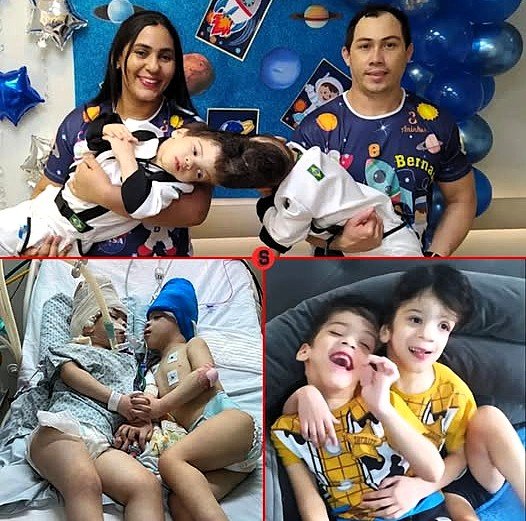
For nearly four years, Bernardo and Arthur Lima experienced the world in a way few people ever could.
The two Brazilian brothers were born conjoined at the head, connected by a rare and extraordinarily complicated medical condition that caused them to share portions of their brain and an important vein responsible for blood circulation.
From the moment they were born, their lives were inseparable—literally.
But their family dreamed of something that once seemed almost impossible: giving each child the chance to live independently.
That dream eventually led to one of the most remarkable separation surgeries ever attempted.
The brothers were born with a condition known as craniopagus conjoining, in which twins are physically connected at the skull. Their case was particularly challenging because their brains and blood vessels were closely connected.
Separating them was not simply a matter of dividing bone and tissue. Doctors had to determine exactly how the children’s brains were connected, how blood was flowing between them, and how they could safely reconstruct each child’s skull after separation.
Even a small mistake could have been fatal.
A Medical Challenge Unlike Any Other
When doctors first evaluated Bernardo and Arthur, they faced an enormous challenge.
The brothers shared important neurological structures and an essential vein. This meant that separating one child from the other could potentially disrupt blood flow to the brain.
There was also the possibility of severe neurological damage, major blood loss, infection, or death.
Because of the complexity of their anatomy, the medical team could not simply rely on conventional surgical preparation.
They needed to understand the twins’ anatomy in extraordinary detail.
That is where technology played a major role.
Doctors created detailed digital reconstructions of the children’s heads and brains. Using virtual reality, surgeons were able to enter a digital representation of the twins’ anatomy and examine the structures from different angles.
The virtual environment allowed the team to rehearse difficult parts of the procedure before entering the operating room.
For such a high-risk operation, preparation was everything.
The surgeons needed to understand not only where the twins were connected, but also how separating one structure could affect the other child.
Years of Preparation
The operation did not happen overnight.
It was the result of years of medical planning, imaging, consultation, and multiple procedures.
Before the final separation, the brothers underwent several surgeries designed to prepare their bodies for the eventual operation.
In total, the medical team carried out seven complex surgeries.
Each procedure brought the twins one step closer to the possibility of living independently.
The final intervention was the most difficult.
It lasted more than 27 hours.
During that extraordinary operation, surgeons carefully separated the children’s connected skulls and brain structures while working to preserve vital blood flow.
The procedure required an enormous level of precision.
A surgical team could not simply focus on one child. Every decision had to account for the condition of both brothers simultaneously.
The slightest change could affect one or both of them.
Virtual Reality Became Part of the Operating Plan
One of the most remarkable aspects of the case was the use of virtual reality.
Rather than entering the operating room with only traditional medical images, the surgical team used three-dimensional digital models to study the brothers’ anatomy.
The technology allowed doctors to simulate the procedure before performing it.
Surgeons could virtually examine the areas where the children’s brains and blood vessels were connected. They could also discuss possible complications and develop strategies for dealing with them.
In a surgery where there was almost no room for error, this kind of preparation offered an invaluable advantage.
The team could practice the operation digitally before attempting the real thing.
It was a powerful example of how modern technology can complement surgical skill and medical experience.
The Moment Everything Changed
Eventually, after months and years of preparation, the brothers reached the moment their family had been hoping for.
The final separation surgery took more than 27 hours.
For the medical team, it was a test of endurance, concentration, and precision.
For Bernardo and Arthur, it was the moment their lives would fundamentally change.
There was no guarantee that either child would survive.
Even if the separation was technically successful, the risks would continue afterward. Their brains had spent their entire lives connected, and their bodies would need time to adjust to their new circumstances.
But against those enormous odds, both brothers survived.
The operation was considered a remarkable medical achievement.
A New Life Begins
Surviving the surgery was only the beginning.
The brothers then entered an extensive rehabilitation process.
After spending almost four years physically connected, they had to learn how to live separately.
Rehabilitation was essential for helping them adapt to their new circumstances and develop greater independence.
Their journey was not expected to be easy.
Major surgery can be followed by months or even years of recovery, and neurological rehabilitation can require patience, consistency, and support.
But the successful separation gave Bernardo and Arthur something they had never experienced before—the possibility of growing up as two separate individuals.
They could now begin developing their own identities, experiences, and futures.
A Story of Medicine, Technology, and Hope
The story of Bernardo and Arthur Lima is remarkable not only because of the rarity of their condition, but because of what it demonstrates about modern medicine.
Their successful separation required the combination of highly specialized surgery, advanced medical imaging, careful planning, technology, and an enormous amount of teamwork.
Virtual reality was not used as a replacement for surgeons. Instead, it became a tool that allowed the medical team to better understand the complex anatomy they would encounter.
The brothers’ case also highlights how far reconstructive and neurological surgery has progressed.
Conditions that once seemed almost impossible to treat can sometimes be approached through years of preparation and increasingly sophisticated medical techniques.
Most importantly, however, their story is about two children who were given a chance at a different future.
For almost four years, Bernardo and Arthur had experienced life physically connected to one another.
After seven major procedures and a final operation lasting more than 27 hours, they finally had the opportunity to begin that next chapter separately.
Their survival was not the end of the journey.
It was the beginning.
Their recovery and rehabilitation would take time, patience, and continued medical support. But the successful operation opened a door that had once seemed nearly impossible to reach.
Two brothers who entered the world connected at the head were given the chance to leave the operating room as individuals.
And behind that extraordinary medical achievement was something just as powerful: years of determination, careful preparation, technological innovation, and hope.
Bernardo and Arthur’s story serves as a reminder that some of medicine’s greatest breakthroughs happen when doctors are willing to confront challenges that once seemed impossible.
Their journey is a testament to human resilience—and to the possibility of a new beginning, even when the odds appear overwhelmingly against it.
Read Next
- For years, Carly’s family knew something was wrong. She was only a toddler, but her body wasn’t developing the way doctors expected. There were tests, appointments, questions and explanations that never quite seemed to fit.
- He Never Stopped Talking to Her: The Husband Who Stayed When Everything Changed ❤️
- The Voice People Once Mocked Became the Voice That Encourages Others