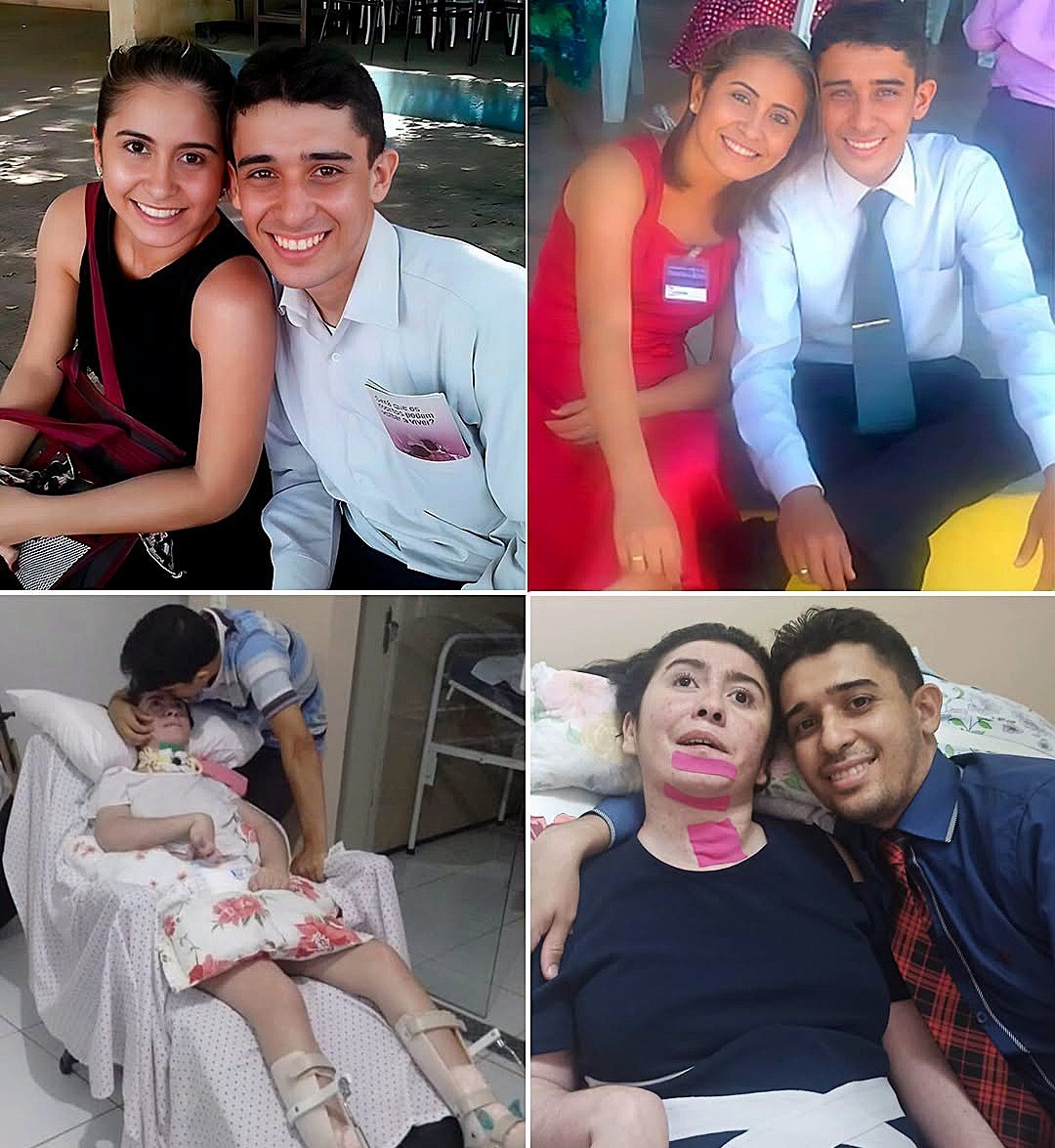
In 2018, David Alexandre Cesar and his wife, Bruna, were simply looking forward to their future together.
They had plans.
They had memories.
They had a life they were building side by side.
But on January 28 of that year, an ordinary moment at home became the beginning of a completely different life.
David and Bruna were watching a movie together when, without warning, Bruna suffered a seizure.
She was only 24 years old.
Within moments, the situation became critical. Bruna went into cardiorespiratory arrest, and emergency responders began working desperately to bring her back.
For roughly 25 minutes, they fought to restore her heartbeat.
Eventually, they succeeded.
But the crisis was not over.
After Bruna was taken to the hospital, she suffered another cardiac arrest. The repeated interruptions to her oxygen supply caused devastating damage to her brain.
The doctors eventually gave David news that no husband could ever be prepared to hear.
They believed Bruna would remain in a persistent vegetative state.
The woman David knew—the woman who had laughed with him, talked with him, shared plans with him and built memories beside him—could no longer communicate in the way she once had.
And yet, David refused to disappear from her life.
For the next 18 months, Bruna remained in the hospital.
Eighteen months is a long time.
Long enough for life outside the hospital to keep moving.
Long enough for jobs to disappear, bills to accumulate and routines to change.
But for David, one thing remained constant.
He kept coming back.
He visited her.
He talked to her.
He stayed beside her.
And when Bruna was finally able to return home in August 2019, David did something that would completely reshape his own life.
He turned part of their home into a place where Bruna could receive the care she needed.
Their home was no longer simply a home.
It became a place of therapy, recovery, feeding, bathing and constant supervision.
David learned to manage the everyday tasks that Bruna could no longer do for herself.
He helped feed her.
He helped bathe her.
He assisted with therapy.
He stayed close during the long hours when nothing seemed to change.
There were no guarantees.
No promise that Bruna would eventually return to the person she had once been.
Still, David continued.
During the day, his attention was focused almost entirely on Bruna.
At night, when his mother or mother-in-law was able to stay with her, David would leave the house and work as a rideshare driver.
His previous administrative job had disappeared during the long period of Bruna’s hospitalization.
Now he had to find another way to pay for the growing expenses of their new life.
And those expenses were significant.
By 2020, David said the family’s monthly costs had reached approximately R$7,000.
Medical care, therapy, food, equipment and the many other necessities of caring for someone with severe neurological damage placed enormous pressure on the family.
So David began sharing their story online.
He wasn’t simply looking for sympathy.
He needed practical support.
People who heard about Bruna and David began offering help, contributing what they could and following their journey.
But perhaps the most remarkable part of the story wasn’t the financial assistance.
It was the hope David continued to find in the smallest changes.
Bruna eventually began breathing without mechanical assistance.
She showed movement in parts of her body.
At times, her facial expressions appeared to change in ways that her family interpreted as signs of emotion or awareness.
For doctors, caregivers and loved ones, those moments could be difficult to interpret.
But for David, they were reasons to keep believing that every day with Bruna mattered.
So he continued talking to her.
Every day.
He would tell her about their past.
He reminded her of the wedding they had shared.
He talked about places they had visited together.
He brought up memories from the years before everything changed.
He spoke to her about ordinary things, too—the kind of everyday conversations that couples often take for granted.
Because although Bruna could no longer answer him in the way she once had, David didn’t believe that meant she should stop being spoken to.
He didn’t know exactly how much she understood.
He didn’t know what she could hear.
He didn’t know what was happening inside her mind.
But he knew one thing.
She was still Bruna.
And that was enough for him to keep talking.
People watching their story online sometimes told David that Bruna needed him.
His response revealed something deeper about what their relationship had become.
He said:
“The truth is that I need her.”
Those words changed the way many people understood his commitment.
David wasn’t describing himself as a hero.
He wasn’t saying that caring for Bruna was easy.
It wasn’t.
Their life was nothing like the future they had imagined in 2018.
There were probably difficult mornings, exhausting nights, financial worries and moments when uncertainty became overwhelming.
But love, in David’s case, was no longer about sharing the same plans or having the same kind of life they once expected.
It had become something much quieter.
Something measured in presence.
In patience.
In showing up again tomorrow.
Years after the afternoon that changed everything, David continued caring for Bruna.
He continued helping her through the routines that had once been unimaginable.
He continued speaking to her.
He continued remembering the woman she had been while loving the woman who was still there.
Their story is not a simple story about a miracle.
It is not a story with an easy ending.
It is a story about what happens when a person’s life changes in an instant—and another person chooses not to walk away.
David and Bruna once imagined a future filled with ordinary moments.
Movies.
Conversations.
Trips.
Family memories.
A shared home.
They lost much of the future they thought they would have.
But David chose to hold on to something that remained.
Bruna was still the person he had loved since before the accident.
And for him, that was enough reason to keep showing up.
Sometimes love is not measured by grand gestures.
Sometimes it is simply sitting beside someone when there is nothing you can fix.
Sometimes it is feeding them when they cannot feed themselves.
Sometimes it is working through the night to pay the bills.
Sometimes it is telling the same old stories because you don’t know whether the person listening can hear you—but you refuse to stop trying.
And sometimes, love is simply saying:
“I’m still here.”
David’s story leaves us with a difficult question.
If the person you loved could no longer speak back to you, no longer walk beside you, and no longer share the life you once imagined together…
Would you still sit beside them and talk about the memories you made together? ❤️
Read Next
- She Was Given Just a 15% Chance of Survival—But Lauren Manning Refused to Give Up
- They Called Her a “Monster” for Treating Her Baby—But They Never Saw the Whole Story
- When rescuers first found Porky wandering alone, it was difficult to imagine how long the tiny senior Chihuahua mix had been struggling on his own.