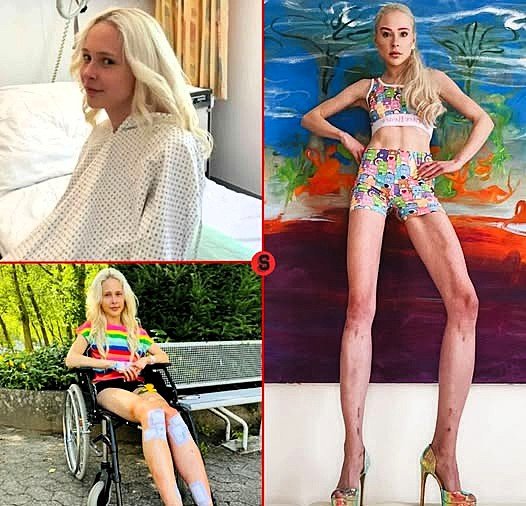

For years, height had been presented to her as something that could define beauty, confidence, and even success.
But for German model Theresia Fischer, the desire to become taller eventually became something far more serious. What began as a pursuit of a different appearance led her into a series of extremely painful operations, an enormous financial cost, and a psychological struggle she later described with deep regret.
Fischer, who became widely recognized after appearing on Germany’s Next Top Model, underwent several extraordinary limb-lengthening procedures in an attempt to increase her height.
The surgeries were not simple cosmetic treatments.
Her leg bones were surgically cut, and telescopic rods were inserted so that the bones could gradually be lengthened during the healing process. The procedures involved her femurs and tibias, meaning the bones of both the upper and lower legs were subjected to a long and demanding process of reconstruction.
According to Fischer, the entire ordeal ultimately cost more than $160,000.
The physical pain was only part of the story.
A Decision That Changed Her Life
Limb-lengthening surgery is one of the most demanding forms of orthopedic reconstruction. In the procedure, surgeons deliberately cut a bone and stabilize it with specialized devices. Over time, the two sections of bone are gradually separated, allowing new bone to form in the space.
Although the technique can be medically useful for people with significant limb-length discrepancies or certain skeletal conditions, using it for cosmetic height increase is a much more controversial decision.
For Fischer, the motivation was deeply personal.
She wanted to become taller, and over time, the pressure surrounding her appearance became increasingly intense. Looking back, she said that her decision was heavily influenced by psychological manipulation and pressure from a former partner.
What she once viewed as a way to improve herself eventually became something she regretted.
The model later spoke publicly about the experience, explaining that she had been subjected to intense emotional influence that contributed to her decision to undergo the surgeries.
Her revelations transformed the story from one about cosmetic enhancement into a much deeper warning about emotional control.
The Price Was More Than Financial
The reported $160,000-plus price tag alone is staggering.
But the financial cost was only one part of what Fischer endured.
Limb-lengthening procedures can require months of recovery, extensive physical therapy, repeated medical appointments, and significant restrictions on everyday movement. Patients may experience pain, difficulty walking, muscle tightness, nerve problems, joint complications, and other risks.
For someone choosing the procedure for cosmetic reasons, those challenges can become particularly difficult because the treatment is not simply a short operation followed by a quick recovery.
It is a prolonged process.
The body must gradually adapt as the bones become longer.
For Fischer, that process became a major chapter of her life.
The procedures allowed her to gain several centimeters in height, but the physical transformation came at a tremendous personal cost.
And eventually, she began questioning why she had felt compelled to change herself so dramatically in the first place.
From Confidence to Regret
The most striking part of Fischer’s story is not simply how much taller she became.
It is what she later said about the reasons behind the transformation.
People often imagine cosmetic procedures as decisions made freely and independently. But Fischer’s experience highlights a more complicated reality.
Sometimes, a person’s decision to alter their appearance can be influenced by someone else’s expectations, criticism, manipulation, or emotional pressure.
When that happens, the desire for change may not come entirely from within.
Fischer has described her former relationship as an important factor in her decision to undergo the extreme surgeries. In hindsight, she came to see the experience differently.
What once appeared to be a solution to an insecurity became a source of physical suffering and emotional regret.
Her story therefore raises a larger question: How far should someone go to change their body when the desire for that change is being shaped by another person’s expectations?
The Hidden Risks of Extreme Aesthetic Procedures
Fischer’s experience also draws attention to the risks associated with extreme cosmetic interventions.
Unlike many conventional cosmetic procedures, limb-lengthening surgery fundamentally alters the structure of the body. Bones must be surgically divided, and the healing process must be carefully managed.
Even when everything goes according to plan, recovery can be lengthy and demanding.
There is also an important psychological dimension.
When someone undergoes a painful procedure because they believe they are not attractive, tall, thin, or otherwise “good enough,” the physical transformation does not necessarily resolve the underlying insecurity.
In some cases, the problem may never have been the body itself.
It may have been the way the person was being made to see their body.
That distinction is an important lesson from Fischer’s experience.
A Story About More Than Height
Today, her story is often discussed not simply because of the extraordinary surgeries she underwent, but because of what she says happened emotionally behind them.
Her experience demonstrates how powerful psychological pressure can become when it is connected to appearance and self-worth.
Someone who repeatedly hears that they need to change may eventually begin believing it.
And when that belief becomes strong enough, even an extraordinarily painful medical procedure can begin to seem like a reasonable solution.
Fischer’s later regret shows why decisions involving major body modifications should be approached carefully, with independent medical advice and, when necessary, psychological support.
No person’s value should depend entirely on their height, appearance, or ability to satisfy another person’s expectations.
A Painful Lesson
Theresia Fischer wanted to become taller.
She achieved that goal.
But the journey forced her to confront a much more difficult question: Why did she feel that she needed to change herself so drastically in the first place?
Her experience is a reminder that physical transformation does not always bring emotional fulfillment.
Sometimes, the most important change is not changing the body at all.
It is recognizing manipulation, rebuilding self-confidence, and understanding that a person’s worth does not depend on meeting someone else’s definition of beauty.
Fischer’s story is ultimately a cautionary one—not only about the physical dangers of extreme aesthetic surgery, but also about the invisible power that emotional pressure can have over major decisions.
What happened to her serves as a reminder to anyone considering an extreme procedure: before changing your body, it is worth asking whether the decision truly comes from you.