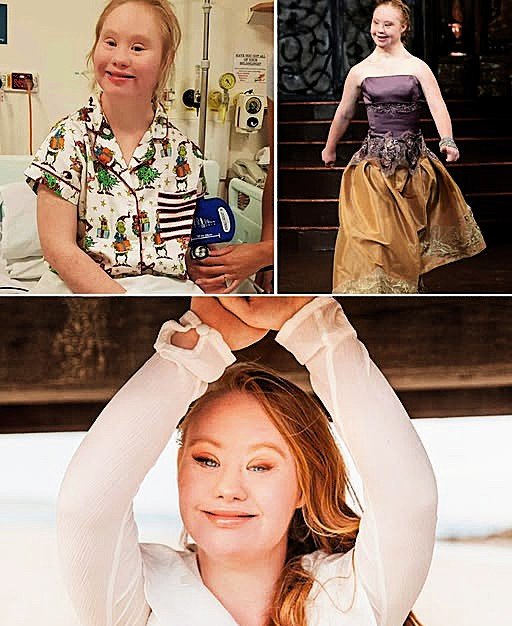
At 18 years old, Madeline Stuart looked at the world of fashion and saw something she wanted.
She wanted to be part of it.
There was just one problem.
The fashion industry had rarely made room for someone with Down syndrome.
But Madeline wasn’t asking whether people like her were supposed to become models.
She simply told her mother that she wanted to try.
And her mother listened.
Madeline grew up in Brisbane, Australia, where she loved dancing, swimming and staying active. Like many teenagers, she also became increasingly conscious of her health and fitness.
She had struggled with her weight, and eventually decided she wanted to make a change—not because she needed to fit someone else’s idea of beauty, but because she wanted to feel healthier and keep doing the activities she loved.
Over approximately 18 months, she lost around 40 pounds.
But something else was changing too.
Her confidence was growing.
Then came the moment that would alter the direction of her life.
Madeline attended a fashion show with her mother, Rosanne.
As the models walked down the runway, Madeline watched them carefully.
Then she made her feelings known.
She wanted to do that, too.
She wanted to walk the runway.
For some people, the request might have sounded unrealistic.
Rosanne didn’t treat it that way.
Instead of telling her daughter that the industry wasn’t ready for her, she helped Madeline take the first step.
She arranged a professional photo shoot.
In 2015, when Madeline was 18, photographs from that shoot were shared online alongside images documenting her fitness transformation.
What happened next was far beyond what either of them expected.
The photographs spread rapidly.
Millions of people saw them.
But the attention wasn’t simply about a young woman who had changed her lifestyle.
People were seeing something they weren’t accustomed to seeing in mainstream fashion—a model with Down syndrome confidently presenting herself to the world.
And suddenly, fashion professionals began paying attention.
Within roughly two months, Madeline had secured modeling contracts with fashion brands.
Then came the opportunity that would place her on one of the industry’s biggest stages.
New York Fashion Week.
In September 2015, Madeline walked the runway in New York.
Photographers captured her.
Designers watched.
And audiences saw a young woman who had once been told, implicitly or explicitly, that certain spaces might not be meant for her.
Now she was standing in one.
But New York wasn’t the end.
It was the beginning.
Madeline continued appearing at fashion events around the world, including shows in Paris, London, Dubai and China. She appeared in major publications and developed an international modeling career.
The girl who had once watched models from the audience was now becoming one herself.
And perhaps the most important part of her journey wasn’t simply that she became successful.
It was what she wanted that success to mean.
Madeline became an advocate for greater inclusion and visibility for people with Down syndrome.
She wanted people to become accustomed to seeing individuals with disabilities in fashion, media and other public spaces.
Not as a novelty.
Not as an exception.
But simply as people who belong there.
Her journey challenged an assumption that had existed for years: that there was a particular appearance a person needed to have before they could be considered beautiful, fashionable or successful.
Madeline didn’t need to become someone else.
She didn’t need to hide her Down syndrome.
She walked onto the runway as herself.
And that mattered.
Because sometimes the biggest barrier isn’t a person’s ability.
It’s the expectation surrounding them.
When society decides beforehand who belongs in a particular room, many talented people never even get the opportunity to walk through the door.
Madeline’s story began with something incredibly simple.
A teenager watched a fashion show.
She saw the models.
And she told her mother, I want to do that.
Her mother could have focused on all the reasons it might not happen.
Instead, she helped her daughter find out what was possible.
And Madeline took it from there.
Her story doesn’t suggest that every dream will automatically come true.
It shows something more important:
Sometimes, a person needs an opportunity before anyone can discover what they are capable of.
Madeline didn’t wait for the fashion industry to decide whether she belonged.
She stepped onto the runway and showed them.
Today, her journey remains a reminder that representation can begin with one person refusing to accept that a door is permanently closed.
And perhaps the question her story leaves us with is the simplest—and hardest—to answer:
How many dreams never get tested because someone decides, before the person even tries, that they don’t belong? ❤️