Sometimes, a home is more than four walls, a roof and a place to sleep.
Sometimes, a home can become a bridge between the life someone once knew and the life they are learning to live.
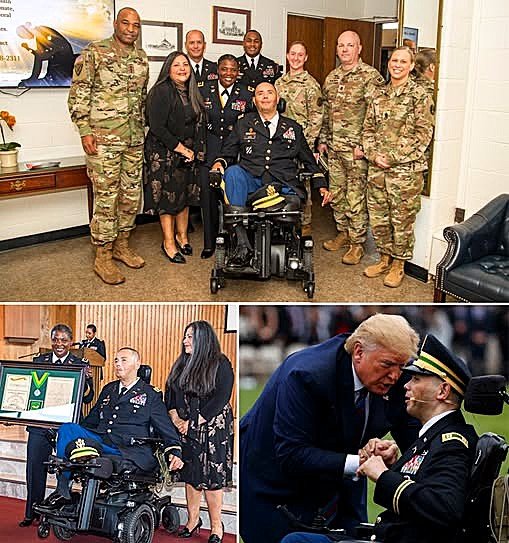
For Capt. Luis Avila, that kind of home became a reality years after an explosion in Afghanistan changed nearly every part of his life.
On December 27, 2011, Luis was serving in Afghanistan during what was his fifth combat tour. Then, in a moment that lasted only seconds, an improvised explosive device exploded nearby.
Three soldiers serving alongside him were killed.
Luis survived.
But surviving the blast came with injuries that would alter the rest of his life.
The explosion cost him his left leg. He suffered two strokes and two heart attacks, and his body experienced a devastating loss of oxygen that resulted in anoxic brain damage.
The injuries left him almost completely paralyzed.
For a soldier who had spent years serving his country, everyday movements that most people rarely think about suddenly became enormous challenges.
Getting from one room to another.
Opening a door.
Using a bathroom.
Moving safely through his own home.
Even the simplest routines could require assistance.
And while Luis faced the physical consequences of his injuries, his wife, Claudia, and their three sons were also beginning a completely different chapter of their lives.
Their family life became intertwined with hospitals, surgeries, rehabilitation appointments and years of therapy.
Luis spent extensive time receiving treatment, including rehabilitation at Walter Reed.
Recovery was not a straight road.
There were no simple solutions that could return everything to the way it had been before that December day.
But eventually, another possibility entered the family’s life.
The Gary Sinise Foundation learned about Luis and his family’s situation.
Rather than simply making a few modifications to an ordinary house, the foundation set out to create something specifically designed around the way Luis now lived.
The result was a specially built, mortgage-free home in Chevy Chase, Maryland.
It wasn’t simply a house with a ramp added to the front.
The entire design considered accessibility from the beginning.
The home featured wide spaces that allowed Luis’s wheelchair to move more easily. It included an elevator, automatic doors and accessible bathrooms.
Technology was also incorporated into the design.
Using a tablet, Luis could control different parts of the house, giving him another measure of independence in an environment that had been created specifically for him.
For most families, these might sound like impressive conveniences.
For Luis and Claudia, they represented something much deeper.
Freedom.
The ability to move through the place where you live without constantly depending on another person can mean everything when severe paralysis has taken away so much independence.
For Claudia, the house wasn’t simply about expensive equipment or modern technology.
It was about giving her husband back a piece of autonomy.
She described the home as a “road to freedom,” because Luis would be able to move around his own house with considerably less assistance.
That idea carried enormous emotional weight.
A home is supposed to be the place where a person feels most comfortable and secure.
For someone living with severe mobility limitations, however, an ordinary home can sometimes become filled with barriers.
A narrow doorway can become an obstacle.
A staircase can become impossible.
A bathroom can become dangerous.
A heavy door can become something that requires another person’s help.
The new house was designed to remove as many of those barriers as possible.
And after years in which so much of Luis’s life had been dictated by medical treatment and physical limitations, having a place designed around his needs offered something different.
It offered possibility.
Then came Veterans Day in November 2016.
Five years after the explosion that had changed his life, Luis and his family stood before their new home.
Gary Sinise personally joined them for the dedication and the moment when the family received the keys.
For the family, those keys represented far more than ownership of a house.
They represented years of perseverance.
They represented the countless hours spent in hospitals and rehabilitation.
They represented the adjustments Claudia and their children had made as their family learned to navigate a completely different reality.
And they represented a future that could be lived with a little more independence.
The house could not erase the memories of Afghanistan.
It could not restore Luis’s lost leg.
It could not reverse the strokes, heart attacks or brain damage.
It could not return the family to the life they had before the explosion.
But it could change what came next.
That distinction matters.
Sometimes helping someone doesn’t mean fixing the past.
Sometimes it means making tomorrow easier to face.
For Luis, the house became a place where accessibility was not an afterthought. It was part of the foundation.
The automatic doors, elevator, accessible bathrooms, wide spaces and technology were all created with one purpose: helping him live more independently.
And perhaps the most powerful part of the story was Luis’s own message.
At the dedication, he encouraged others with three simple ideas:
“Stay strong, and never quit.”
Those words carried a special meaning coming from someone whose life had been transformed by unimaginable circumstances.
Luis’s journey was no longer about returning to the person he had been before the explosion.
It was about discovering what was still possible.
For Claudia and their sons, the new home also meant something deeply personal.
It offered a place where caring for Luis could become less physically demanding and where the family could spend more time simply being a family.
A home cannot heal every wound.
But sometimes, thoughtful design can remove obstacles that don’t need to exist.
Sometimes, a doorway wide enough for a wheelchair can mean independence.
Sometimes, an automatic door can mean dignity.
Sometimes, a bathroom designed for accessibility can mean safety.
And sometimes, receiving the keys to a new home can feel like receiving something even greater—a chance to move forward.
Luis’s story is ultimately not just about an explosion, an injury or a house.
It is about what happens afterward.
It is about a family adjusting to a new reality.
It is about the years of rehabilitation and patience that rarely make headlines.
And it is about creating an environment where a person can still exercise as much independence as their circumstances allow.
The house in Chevy Chase could never change the past.
But it could make the future more accessible.
For Capt. Luis Avila, that may have been the greatest gift of all.
Because sometimes freedom doesn’t mean being able to do everything you once could.
Sometimes freedom means having the tools, space and support to do as much as you can—on your own terms.
And for Luis, opening the door to that new chapter began with a set of keys and a home built specifically for the life he was now living.
If you could design a home for someone living with severe mobility limitations, which feature would you consider most important—automatic doors, an elevator, accessible bathrooms, smart-home technology, or something else?
Read Next
- She Walked Into a Burning House—Six Times, Because Her Six Children Were Still Inside
- The same feet that Dejana Bačko uses to create beautiful paintings also carried her to the top of the world in para taekwondo.
- Three Days Before Their Son’s Story Went Viral, Gabriel’s Family Could Barely Afford Milk