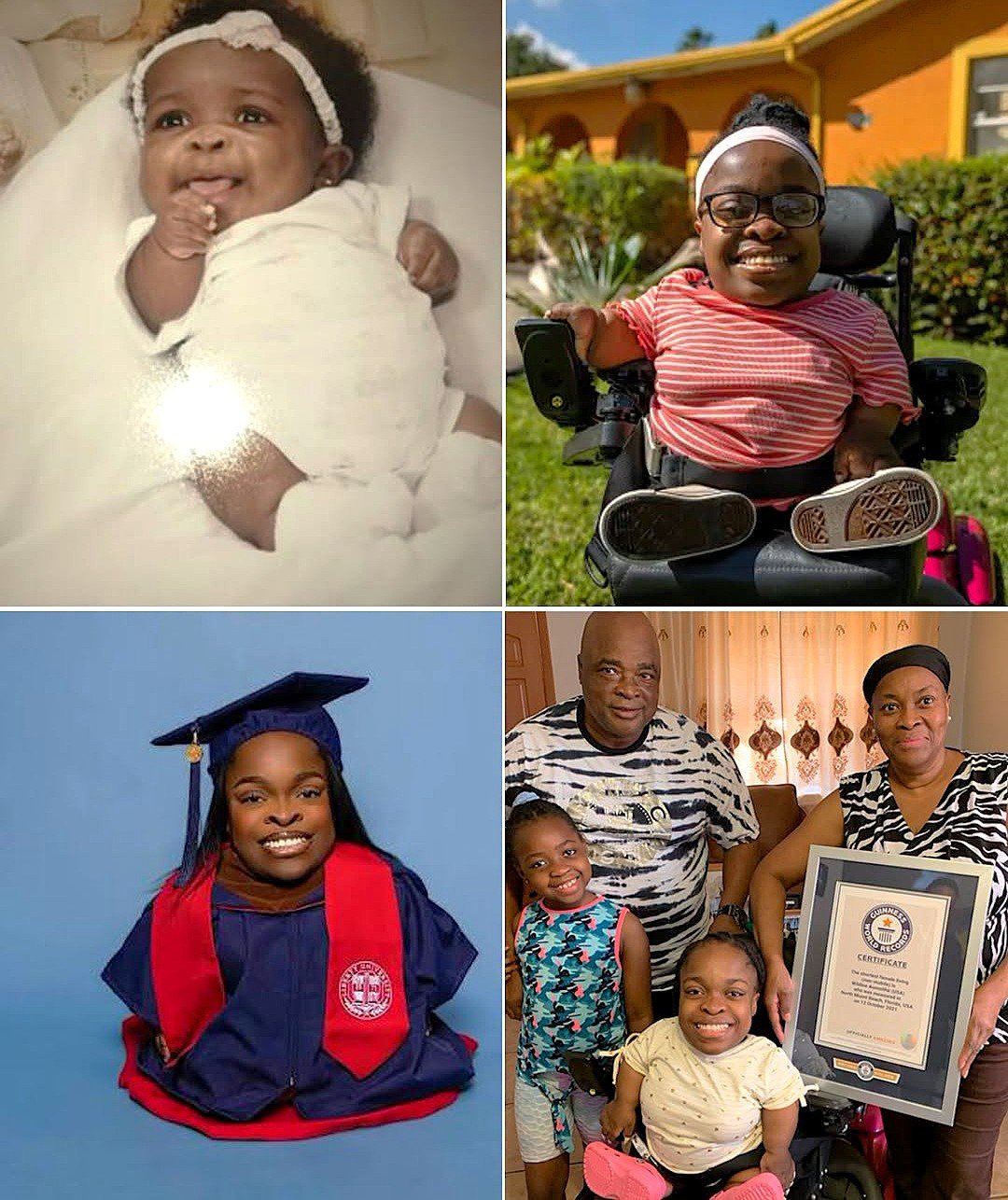
Doctors once feared that Wildine Aumoithe might not survive her first 24 hours of life. But years later, the Haitian American woman from Florida reached a milestone that once seemed uncertain: she graduated from university, pursued her passion for art, and began building a business of her own.
In May 2026, Wildine celebrated her graduation from Liberty University with a degree in graphic design. For her, the achievement represented much more than completing four years of education. It reflected years of determination, personal growth, and the courage to pursue a future shaped by her own dreams rather than other people’s expectations.
Wildine stands just 72 centimeters tall, approximately 28 inches, and lives with SADDAN dysplasia, an extremely rare genetic condition that affects skeletal development. She cannot walk and uses a motorized wheelchair to move around and navigate daily life.
Yet her story is not simply about living with a rare condition. It is about a woman who has continued to discover her abilities, express her creativity, and create opportunities for herself in a world that does not always make room for people who look different.
A Difficult Beginning and a Mother’s Unwavering Love
Wildine’s journey began with enormous uncertainty.
According to the account she shared with Guinness World Records, doctors warned her family that she might not survive her first 24 hours. Her condition presented serious challenges from the very beginning, leaving her loved ones facing questions no family wants to confront.
Despite those early fears, Wildine survived.
She spent her first six months in hospice care before eventually returning home to her family. There, her mother, Wilda, became her primary caregiver and one of the most important people in her life.
The relationship between mother and daughter grew into something especially meaningful. Wildine has described her mother as her best friend, someone whose love and support helped her navigate the challenges of growing up with a rare genetic condition.
Having a supportive family can make a tremendous difference when a child faces medical uncertainty and physical limitations. For Wildine, her mother’s presence provided a foundation from which she could begin exploring the world and developing her own identity.
As she grew older, however, she encountered challenges that extended beyond her medical condition.
Learning to Be Seen for More Than Her Appearance
Wildine soon realized that people often noticed her physical appearance before anything else.
Strangers stared at her in public, and those experiences made her increasingly aware of how quickly people can form assumptions about someone who looks different.
For many people with visible disabilities or rare conditions, these encounters can become an exhausting part of everyday life. A simple trip outside the home may attract unwanted attention, curious looks, or questions from people who do not understand their experiences.
Wildine decided to respond by telling her own story.
She began sharing aspects of her everyday life on YouTube, allowing viewers to see more than her height or medical condition. Through her videos, people could learn about her personality, interests, experiences, and ambitions directly from her.
Rather than allowing strangers’ assumptions to define her, she created an opportunity for people to understand her on her own terms.
Her approach offered an important lesson: people should not have to explain or defend their existence simply because they look different. At the same time, sharing personal experiences can help challenge misconceptions and encourage more thoughtful conversations about disability and inclusion.
Wildine’s online presence became another way for her to connect with people beyond the limits of her immediate surroundings.
Breaking Records and Entering the Fashion World
In 2021, Guinness World Records recognized Wildine as the world’s shortest living woman in the non-mobile category.
The recognition brought attention to her unusual stature and the rare condition that affects her life. But her ambitions extended beyond holding a record.
She wanted to explore opportunities that allowed her to express herself creatively and challenge traditional ideas about who belongs in public spaces.
In 2023, Wildine took another important step when she appeared at New York Fashion Week as part of the Runway of Dreams show.
The event featured adaptive clothing and models with disabilities, highlighting the importance of making fashion accessible to people with different bodies and mobility needs.
For Wildine, participating in the show represented an opportunity to be part of an industry that has historically presented a narrow image of beauty.
Fashion has enormous cultural influence. The models featured in advertisements, runway shows, and brand campaigns help shape public perceptions of attractiveness, confidence, and style. When those images repeatedly exclude people with disabilities, they can reinforce the idea that certain bodies do not belong.
Adaptive fashion challenges that assumption by recognizing that clothing should serve people with different physical needs while allowing them to express their individual identities.
Wildine’s participation also earned her another Guinness World Records title: the world’s shortest professional model.
Her appearance demonstrated that professional modelling does not have to be restricted to a single height, body type, or physical ability.
People with disabilities can be models, artists, entrepreneurs, students, and leaders. Their identities and ambitions are not limited to their medical conditions.
Finding Her Passion in Art and Design
Wildine’s journey toward higher education involved discovering what she genuinely wanted to do with her future.
She had initially considered studying pharmacy, but her interests eventually led her in a different direction.
Art and creativity offered something that resonated more deeply with her. Graphic design allowed her to explore visual communication, develop ideas, and turn creative concepts into meaningful work.
She chose to pursue that passion at Liberty University.
Over four years of study, Wildine worked toward completing her degree while continuing to navigate the challenges associated with her condition and mobility needs.
University life requires commitment, time management, and perseverance. For students with disabilities, it may also involve additional planning around accessibility, transportation, and physical environments.
Wildine’s graduation in May 2026 marked the culmination of that effort.
Rather than allowing other people’s expectations to determine what she could accomplish, she pursued an education that aligned with her interests and long-term goals.
Her achievement is a reminder that young people deserve the freedom to discover their own talents. A medical diagnosis may influence the support someone needs, but it should not automatically determine the limits of their education or career.
Turning a Dream Into a Business
Graduating from university was not the end of Wildine’s creative journey. It was the beginning of another chapter.
After completing her graphic design degree, she launched The Wild Creative Co., taking a step toward building a professional future around her creativity.
Starting a business requires more than talent. It involves developing ideas, finding clients, communicating with customers, managing projects, and learning how to turn creative skills into sustainable work.
For Wildine, entrepreneurship provides an opportunity to shape her own path and put her education into practice.
Her calendar now includes creative projects, modelling opportunities, and plans for the future.
Each of these pursuits reflects a different side of her identity. She is a graduate, a designer, a business owner, a model, and a woman who has chosen to share her experiences with others.
None of those roles cancels out the challenges she faces. Instead, they demonstrate that a person’s life can contain difficulties, accomplishments, ambitions, and joy at the same time.
Her story also highlights why accessible education and employment opportunities matter. When institutions and workplaces are designed to accommodate people with different needs, more individuals can contribute their skills and pursue careers on their own terms.
Inclusion is not simply about offering encouragement. It is also about creating practical opportunities for people to participate.
A Bigger Conversation About Fashion and Inclusion
Wildine’s experiences raise an important question for the fashion industry: who gets to be represented?
For decades, mainstream fashion has often relied on limited standards of height, body shape, and physical appearance. Although the industry has made progress toward greater diversity, people with disabilities still face barriers to representation and access.
Fashion brands can take meaningful steps to change that.
They can feature models with different disabilities in mainstream campaigns, rather than including them only in occasional diversity-focused projects. They can develop adaptive clothing with practical features such as magnetic fastenings, seated-friendly designs, and alternatives to difficult closures.
Brands can also involve disabled people in the design process, listen to their feedback, and ensure that accessibility is considered from the beginning rather than treated as an afterthought.
Most importantly, representation should be authentic. People with disabilities should have opportunities to participate as professionals and creative contributors, not simply appear in campaigns designed to make a brand look inclusive.
Wildine’s journey from a child whose survival was uncertain to a university graduate and aspiring entrepreneur shows why those opportunities matter.
Her accomplishments do not mean that every obstacle has disappeared. They demonstrate that people deserve the chance to pursue their ambitions regardless of the challenges they face.
Wildine has expressed that belief in a simple statement: “Height is just a number.”
Those words carry a message that extends beyond physical stature. A person’s measurements cannot fully describe their imagination, determination, skills, or potential.
Wildine’s story began with doctors questioning whether she would survive her first day. Today, she is building a future in which her creativity and ambitions have room to grow.
Her journey is a powerful reminder that people should be given opportunities to show the world who they are, rather than being judged by what others see at first glance.
What would you like to see fashion brands do to make their clothing, campaigns, and runways more inclusive for people with disabilities?