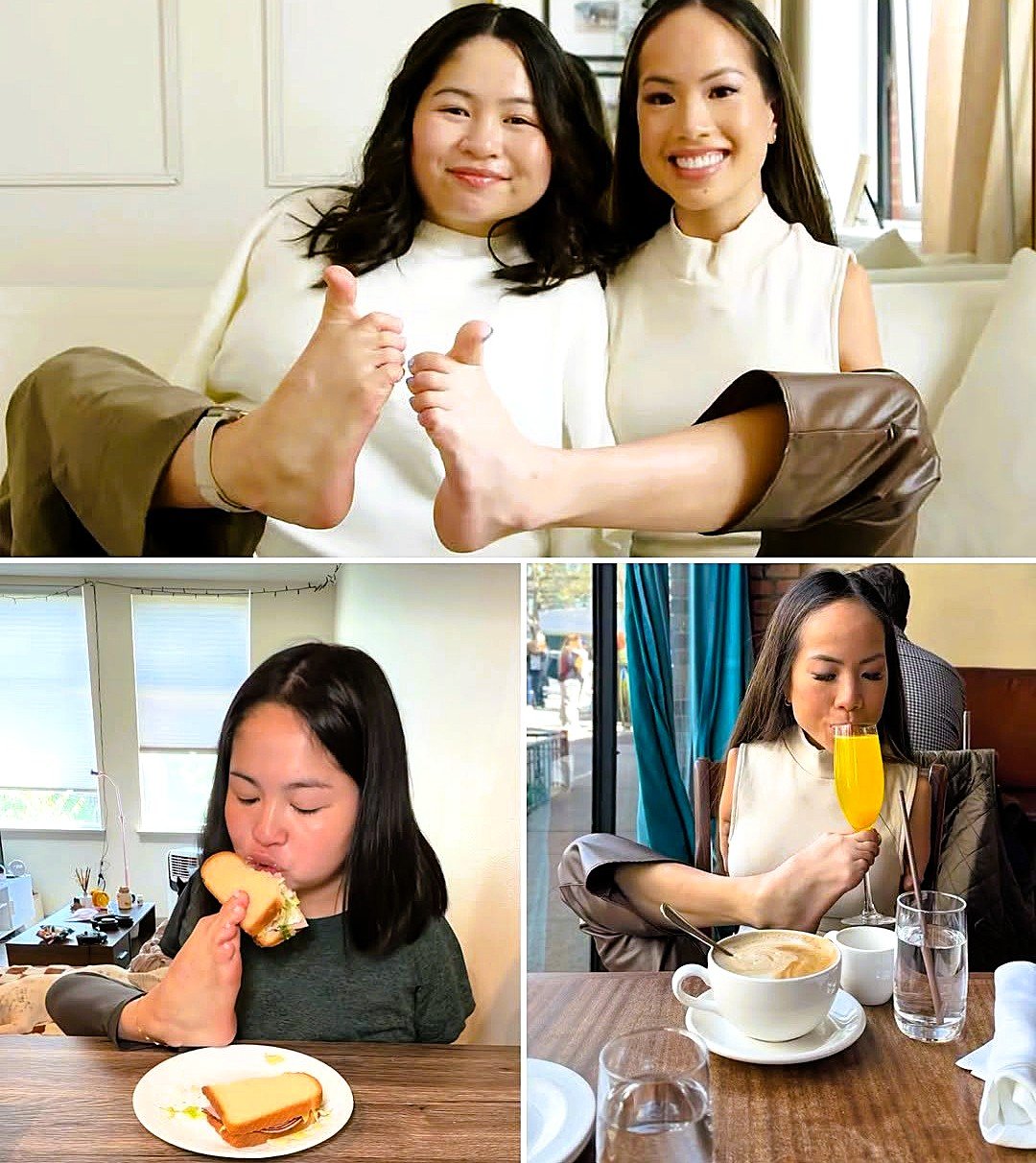
For Teresa and Anna, using their feet to do things most people do with their hands has simply become part of everyday life.
Brushing their teeth. Getting dressed. Eating a meal. Picking something up. Handling the small tasks that fill an ordinary day.
They learned to do these things not because life gave them an easy path, but because they were encouraged to find their own way forward.
The sisters were both born without arms and were adopted when they were young by the same mother. From the beginning, their mother refused to see them through a lens of limitation.
She saw two children who were capable of learning.
And she treated them that way.
Instead of constantly doing things for them, she encouraged Teresa and Anna to experiment, adapt and discover what worked best for themselves. That belief became one of the most important gifts she could have given them: independence.
Over time, ordinary tasks became familiar routines.
They learned how to use their feet with remarkable coordination. They discovered that there wasn’t always one “right” way to accomplish something. Sometimes Teresa found one method while Anna found another. Their bodies might be similar in one important way, but they each developed their own relationship with the world around them.
And perhaps that is one of the most beautiful parts of their story.
They never needed to be identical to understand one another.
Having a sister who shares such a deeply personal experience can offer a kind of comfort that is difficult to explain. There are moments when no explanation is necessary. A glance can be enough. A shared experience can say more than a long conversation ever could.
They know what it feels like to enter a room and immediately notice people looking.
They know what it feels like when someone’s eyes stay on them too long.
They know the difference between someone being curious and someone being cruel.
For Teresa, unwanted attention can sometimes make her feel like a “walking zoo exhibit.”
Imagine simply trying to buy something, meet a friend, walk down the street or enjoy an ordinary afternoon—and realizing that strangers are watching you as though you are something to be examined.
The hardest part isn’t always what people see.
Sometimes, it’s how they choose to react to what they see.
A disability can become the first thing strangers notice, but it should never become the only thing they see.
Teresa and Anna have personalities, opinions, friendships, dreams, frustrations, humor and countless ordinary moments that have nothing to do with the absence of their arms.
They talk about clothes.
They spend time with family.
They visit one another.
They laugh with friends.
They experience the same small joys and annoyances that make up everyday life.
And through social media, they have chosen to show those moments honestly. Their posts aren’t simply about teaching people how they accomplish physical tasks. They are also about challenging the assumptions that strangers sometimes make before knowing them.
Because being different doesn’t mean being incapable.
Needing to do something differently doesn’t mean doing it less well.
And having a visible disability doesn’t mean someone wants to become the center of attention everywhere they go.
Teresa and Anna have spent their lives learning how to navigate a world that wasn’t necessarily designed with their bodies in mind.
But perhaps the world can learn something from them, too.
It can learn that accessibility is more than ramps and equipment. It can learn that inclusion is also about attitude.
It can learn that curiosity doesn’t have to become staring.
That surprise doesn’t have to become judgment.
And that a stranger doesn’t need to know someone’s entire story before offering them the same simple respect they would offer anyone else.
A friendly smile.
A normal conversation.
A simple hello.
Sometimes, that’s all it takes.
Teresa and Anna don’t need people to feel sorry for them. They don’t need strangers to pretend their differences don’t exist.
They simply want to be seen as whole human beings.
Sisters.
Friends.
Women with their own personalities and dreams.
People who have learned to live confidently in their own bodies.
Their story isn’t really about what they don’t have.
It’s about everything they have learned to do, everything they have overcome, and the life they continue to build on their own terms.
And maybe the next time we see someone whose body looks different from ours, we can remember that there is probably far more to their story than the first thing we notice.
Instead of staring, perhaps we can simply say hello.
Because sometimes the most meaningful way to make someone feel included is to treat them like they belong—which, of course, they always did.
💬 What would change if we responded to visible differences with kindness instead of staring?