Sometimes, the most powerful acts of kindness happen when people have almost nothing left to give.
In 1995, a nine-year-old girl named Edoh arrived at a hospital ship in Togo with her family. They had traveled roughly 500 kilometers because they had nowhere else to turn. Edoh was carrying an illness that had slowly taken over her face, her ability to eat, and eventually her ability to breathe.
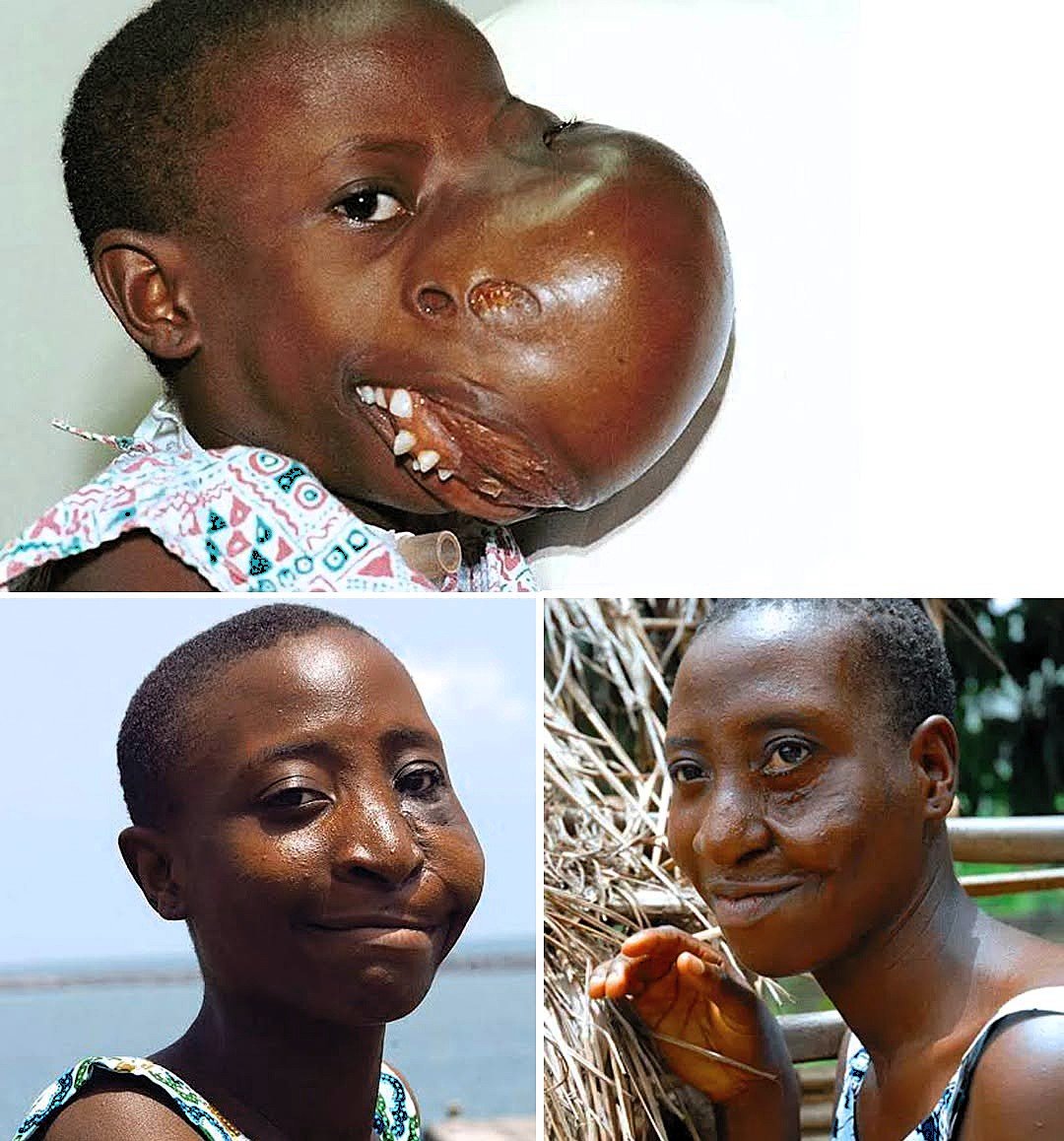
A large tumor had grown across the left side of her face. It had pushed one of her eyes out of its normal position and made even simple things, like eating, increasingly difficult. Most frightening of all, the growing mass was beginning to close her airway.
For Edoh and her parents, the journey to the hospital ship was a journey fueled by desperation and hope.
The ship, Anastasis, operated by Mercy Ships, was providing medical care to people who otherwise had little or no access to specialized treatment. By the time Edoh and her family arrived, thousands of people were already waiting for medical help.
Many of them had traveled enormous distances themselves. Many were sick. Many had spent years waiting for an opportunity to receive treatment.
Then Edoh began struggling to breathe.
She was only nine years old, and her condition had become an emergency.
Her father knew his daughter could not simply wait in the crowd.
So he lifted her above his head.
What happened next became one of the most unforgettable moments surrounding Edoh’s journey.
People in the crowd began passing the little girl from one person to another. Hands reached upward to support her. She was carefully carried over the heads of strangers, moving closer and closer to the medical team.
These were people who had come to the hospital ship because they needed help too.
Yet when they saw a frightened child who could barely breathe, they put their own needs aside.
No one needed to tell them what to do.
They simply helped.
Edoh was passed forward until she reached the gate. There, a Mercy Ships volunteer received her and carried her into medical care.
In that moment, the crowd became more than a group of patients waiting for treatment. They became a chain of compassion, carrying a little girl toward the help she desperately needed.
Inside the medical team, doctors immediately understood how serious her condition was.
The tumor was an ameloblastoma, a rare type of growth that is generally benign but can become extremely destructive as it expands. Although it does not typically spread like a malignant cancer, an ameloblastoma can invade surrounding bone and tissue and cause devastating physical damage.
For Edoh, the tumor had grown so large that it had become life-threatening.
Surgeon Gary Parker and the medical team had to act quickly.
Before they could safely address the tumor itself, they needed to make sure Edoh could breathe.
An emergency tracheostomy was performed to create an airway and help her breathe.
The operation to remove the massive tumor would be complicated and dangerous. It required careful surgical work and an enormous amount of dedication from the medical team.
There was also another critical need: blood.
During the procedure, crew members donated blood to help give Edoh a chance to survive the operation.
Every part of her treatment seemed to involve someone giving something of themselves.
The strangers in the crowd gave their time and strength.
The volunteer gave her a safe pair of arms.
The medical team gave their skill and courage.
The crew gave their blood.
And Edoh fought.
After a long and difficult medical journey, the little girl who had arrived struggling for every breath survived.
But her story did not end in that operating room.
Years later, Edoh returned for additional treatment.
The medical team had not forgotten her.
Neither had the people who had witnessed her arrival.
But this time, the child they remembered was changing.
Edoh was growing older. She was no longer simply the frightened nine-year-old girl being carried above a desperate crowd. She was beginning to look toward the future.
She had dreams.
She wanted an education.
And perhaps most beautifully of all, she dreamed of becoming a nurse herself.
It is difficult not to see the meaning in that dream.
At one point in her life, Edoh had needed strangers to carry her toward the people who could save her life. She had been unable to breathe properly, unable to wait, and unable to reach medical care on her own.
Years later, she was imagining a future in which she could be the person helping someone else.
Her story is not simply about a rare tumor or a complicated operation.
It is about what can happen when ordinary people recognize that another human being needs help.
Everyone in that crowd had their own story.
They had their own pain.
They had their own reasons for traveling to that hospital ship.
Some may have waited for days or longer. Some may have feared that they would never receive the treatment they desperately needed.
And yet, when they saw Edoh struggling to breathe, they did not say, “I was here first.”
They did not turn away.
They did not decide that their own problems mattered more.
Instead, they lifted her up.
Hand after hand, they carried her forward.
That simple act may have lasted only a few moments, but its meaning has lasted for decades.
Edoh’s survival was made possible by medicine, surgery, blood donations and tremendous medical expertise. But before any of those things could happen, there was something else she needed.
She needed someone to help her reach the doctors.
And strangers did exactly that.
Her story reminds us that compassion does not always require money, special skills or extraordinary resources. Sometimes, it begins with simply noticing that someone is struggling and deciding to help.
Those people in the crowd could not perform surgery.
They could not remove the tumor.
They could not provide the medical treatment Edoh needed.
But they could lift her.
So they did.
And perhaps that is one of the most beautiful lessons hidden inside Edoh’s story: sometimes, we do not need to be able to solve someone’s entire problem.
Sometimes, we only need to help them take the next step.
For Edoh, that next step was toward the doctors.
And because a crowd of strangers chose to lift her instead of looking away, she was given the chance to take many more steps afterward.
A frightened little girl arrived at the hospital struggling to breathe.
She left with something far more precious than medical treatment.
She left with a future.
And years later, that future included a dream of becoming a nurse — perhaps one day helping another frightened person the way strangers once helped her.
There are moments in life when humanity is measured not by what we say, but by what we do when nobody is asking us to help.
On that day in Togo, a crowd of people who were waiting for help saw a little girl who needed it first.
They lifted her above their heads.
And together, they carried her toward hope.