
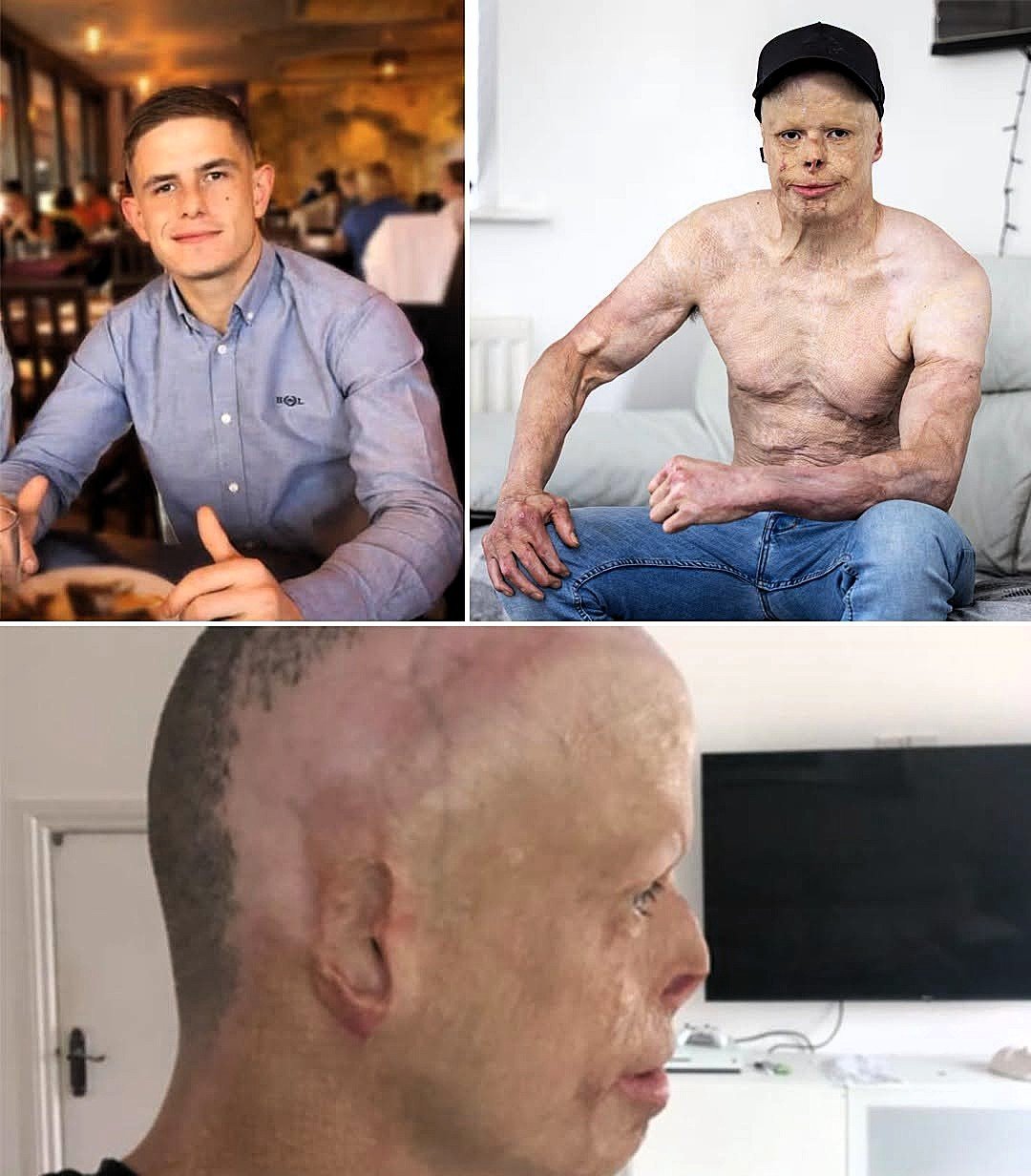
On November 24, 2020, Darren Harris entered an abandoned building in Wolverhampton, England, believing he was looking for nothing more than scrap metal.
It was the kind of decision that might have seemed ordinary during a difficult time.
The country was in lockdown. Money was tight. Darren was struggling financially and trying to find a way to get by. The building he entered was scheduled to be demolished, and he believed the electricity had already been disconnected.
But it hadn’t.
Inside the empty building was an electrical switchboard carrying an enormous 11,000 volts.
Darren didn’t know it was still live.
Then, in a single moment, everything changed.
When Darren touched the electrical equipment, a massive electrical shock tore through his body. The force knocked him unconscious and left him with devastating burns across much of his upper body.
His face, arms, chest and abdomen were severely injured.
The burns were so deep that parts of his forearms were damaged down to the bone.
For a few moments, there was no way of knowing whether Darren would survive.
Yet somehow, he woke up.
And what happened next would become one of the most remarkable parts of his survival story.
Despite the unimaginable pain and confusion, Darren managed to make his way out of the building.
When he saw an ambulance approaching, he ran into the road and desperately tried to flag it down.
The emergency crew immediately began treating him.
At first, even they could not fully understand just how serious his injuries were.
Darren had suffered third-degree burns over approximately 47 percent of his body.
The electrical injury had caused catastrophic damage.
He eventually lost his left thumb, both ears and the tip of his nose. His kidneys stopped functioning properly. His lungs were badly affected. His body was repeatedly attacked by severe infections, and he developed sepsis several times.
The man who had walked into that building looking for scrap metal was suddenly fighting simply to stay alive.
Darren spent 27 days in a coma.
For his loved ones, those weeks must have felt endless.
Every day brought uncertainty. Every medical update carried the possibility of devastating news.
But Darren kept fighting.
When he eventually woke from his coma, his journey was nowhere near over.
He would spend months in hospital undergoing treatment and facing procedures that most people could never imagine.
Doctors and surgeons had to remove severely damaged tissue from his face, stomach and arms. Skin was taken from his legs and used to reconstruct parts of his body that had been destroyed by the electrical burns.
Over the years that followed, Darren underwent around 23 operations.
Each procedure was another step toward rebuilding a body that had been changed in seconds.
But physical recovery was only one part of what Darren had to overcome.
There was also the psychological battle.
Waking up after weeks in a coma and seeing a face and body that looked completely different from the person he remembered was an enormous emotional challenge.
Simple things that many people take for granted became difficult.
Moving his hands.
Using his body normally.
Looking in the mirror.
Going outside.
Returning to work.
Learning to live with scars that would remain with him for the rest of his life.
Darren has spoken openly about how difficult that process was. Surviving the accident did not mean life immediately returned to normal. In many ways, survival was only the beginning of another long journey.
But Darren refused to allow the accident to define the rest of his life.
Slowly, painfully and patiently, he began rebuilding.
He worked to regain movement and strength. He adapted to the changes in his body. He pushed himself through rehabilitation and continued fighting for independence.
Eventually, he achieved something that once might have seemed impossible.
He returned to full-time work as a scaffolder.
He went back to the gym.
And then he decided to do something that showed just how dramatically his outlook on life had changed.
He went skydiving.
Darren completed the skydive to raise money for a charity supporting people affected by serious burns.
For someone who had once been fighting for his life in a hospital bed, standing at the edge of an aircraft and preparing to jump was more than a fundraising event.
It was a statement.
He was still here.
He was still capable of experiencing life.
And he wasn’t going to spend the rest of it being defined by what had happened to him.
Four years after the accident, Darren had the opportunity to reunite with members of the ambulance crew who had treated him on that terrible day.
The reunion carried an emotional significance that was difficult to put into words.
They had seen him at perhaps the lowest point of his life.
They had arrived when his body had suffered catastrophic electrical injuries and when his survival was anything but certain.
Years later, they were able to meet the man he had become.
One of the doctors involved in his treatment reportedly explained just how extraordinary Darren’s survival was. With an electrical injury of that magnitude, medical professionals would normally expect the outcome to be far worse. Some patients might never leave the hospital.
Darren did.
And he didn’t simply survive.
He began living again.
There are still challenges.
His injuries have left permanent effects, and he continues to face reconstructive procedures. The scars of that November day are not something he can simply leave behind.
But perhaps the greatest transformation happened inside him.
The accident changed his understanding of life.
Things that once seemed routine can look completely different after someone comes close to death.
A morning at work.
A trip to the gym.
A conversation with someone you love.
A walk outside.
The ability to use your hands.
The chance to wake up another day.
After experiencing something so devastating, ordinary moments can become extraordinary.
Darren’s story is therefore not simply about an electrical accident.
It is about what happens after the worst moment imaginable.
It is about rebuilding when the person staring back from the mirror looks different.
It is about finding courage when recovery takes years instead of weeks.
It is about accepting that some wounds may never completely disappear while still choosing to move forward.
Most importantly, it is about refusing to mistake survival for the end of the story.
Darren has described his survival as a second chance.
And perhaps that is exactly what it became.
On that November day in 2020, 11,000 volts nearly took his life.
Instead, Darren walked away with injuries that changed him forever—but also with a renewed determination to make something meaningful out of the life he was given back.
He is still facing surgeries.
He is still living with permanent injuries.
He is still rebuilding.
But he is here.
And after everything he has endured, Darren’s message is simple and powerful: life can change in a single second, but that does not mean your story has to end there.
Sometimes, surviving is only the first step.
The real victory is finding the strength to live again.