
For Leah Carrick, strangers often notice something else first.
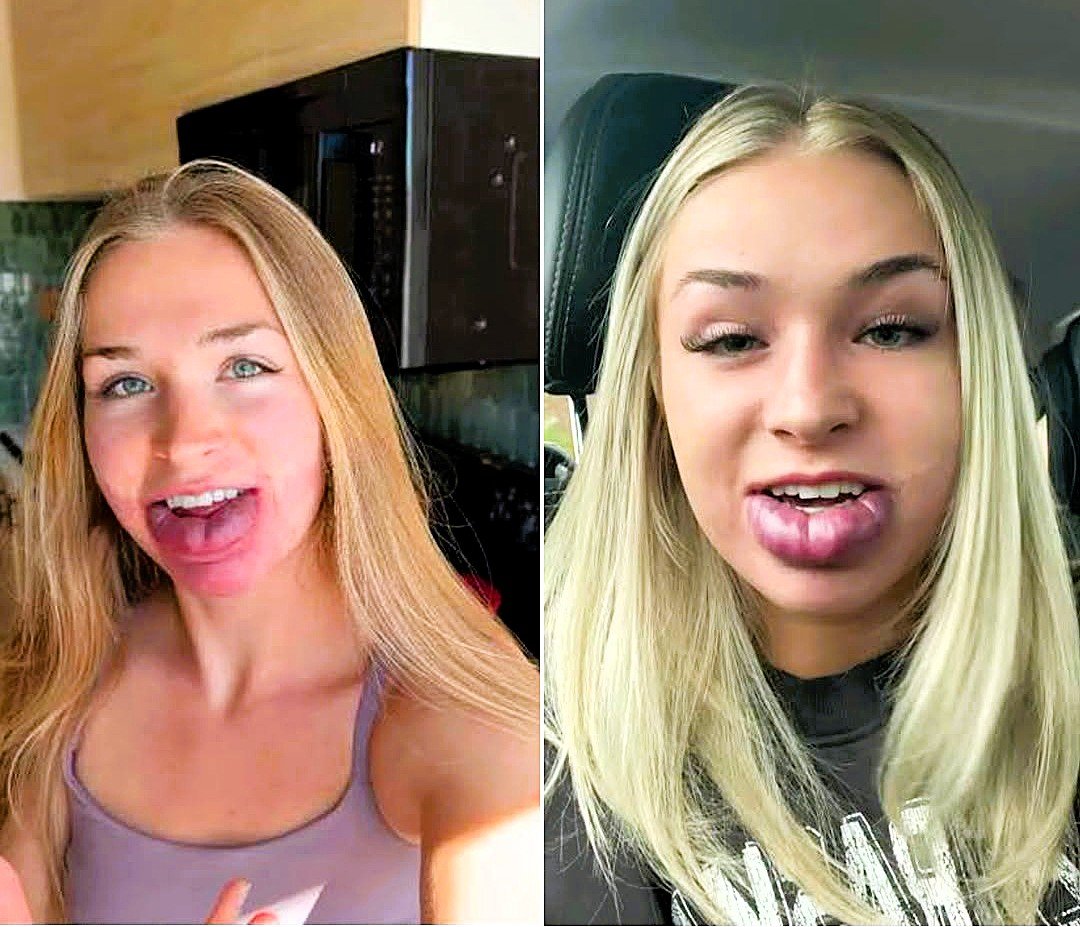
They notice her lower lip.
And almost immediately, some feel entitled to explain it.
At just 22 years old, Leah has spent much of her life dealing with people who stare at her face, ask uncomfortable questions, make assumptions about her health, or confidently offer diagnoses despite knowing absolutely nothing about her medical history.
Her response is simple.
Please stop.
Leah is a young Canadian mother raising two children, building an ordinary life and sharing pieces of that life on social media. She talks about motherhood, beauty, routines, family and the everyday experiences that make up her world.
But because of a vascular birthmark inside her mouth, her appearance has also become something strangers feel unusually comfortable discussing.
Leah was born with the birthmark, and as she grew older, it affected the appearance of her lower lip. What may be immediately noticeable to someone meeting her for the first time has never been the entirety of who she is.
It is simply something she has lived with since birth.
Over the years, the birthmark changed.
Leah says it became particularly noticeable during her pregnancies. As the growth became more prominent, she eventually decided to undergo procedures to reduce the size of her lower lip.
She has had more than three surgeries.
During those procedures, doctors removed portions of excess tissue in an effort to reduce the size of the affected area.
But the story did not end there.
Some of the tissue eventually returned.
So Leah found herself going through the process again and again.
For someone unfamiliar with vascular birthmarks, the appearance can understandably lead to questions. But Leah says the condition does not cause her pain, and it does not stop her from speaking normally.
The physical condition, she says, is not what has caused the greatest difficulty.
The reactions from other people have often been much harder.
Imagine going through an ordinary day while knowing that people may stare at your face.
Imagine uploading a simple video about your morning, your children or something completely unrelated to your appearance, only to find the comments filled with strangers asking what happened to you.
Some people try to diagnose her.
Others ask whether she plans to have it removed.
Some assume she must be unhappy with the way she looks.
And others speak about her appearance as if she isn’t even there.
But Leah has gradually learned not to let those reactions define her.
Instead, she keeps showing up.
She keeps making videos.
She keeps taking pictures.
She keeps living her life.
And perhaps most importantly, she refuses to make her birthmark the center of her identity.
Her social media presence is not built around hiding.
It is built around living.
She shares moments with her children. She talks about beauty and everyday routines. She posts about normal experiences that have nothing to do with her medical history.
Sometimes, however, she chooses to talk about her birthmark.
When she does, she uses the opportunity to explain what she knows and correct the assumptions people make about her.
She reminds viewers that she already has doctors.
She doesn’t need a stranger watching a few seconds of a video to diagnose her.
That simple message has resonated with many people.
Because behind every unusual physical feature is a person with a history, feelings, relationships, dreams and a life that cannot be understood from a photograph or a short video.
Leah’s experience also highlights something uncomfortable about social media.
The internet has made it incredibly easy for people to comment on strangers as though there are no consequences.
A person sees something unfamiliar and immediately reaches for an explanation.
They ask questions without considering whether the question is appropriate.
They make medical assumptions without knowing the person’s diagnosis.
Sometimes they even tell someone how they should feel about their own body.
But Leah has shown that there is another way to respond.
She can acknowledge the part of herself that people notice without allowing it to become the definition of who she is.
She has even considered undergoing additional procedures in the future.
But that doesn’t mean changing her appearance is the most important goal in her life.
She is a mother.
She is a daughter.
She is a woman building her own life.
She is someone who has interests, responsibilities, hopes and ordinary days that have nothing to do with a vascular birthmark.
And that distinction matters.
One of the most meaningful parts of Leah’s journey has been hearing from people who share similar experiences.
After seeing her online, some people living with vascular birthmarks have reached out to her.
For some of them, seeing Leah was the first time they had encountered someone who looked similar to them.
That connection means something.
Because feeling different can become especially difficult when you believe you are the only person in the world who looks like you.
Then, suddenly, a video appears on your screen.
There is someone else.
Someone living her life.
Someone raising children.
Someone laughing, getting ready for the day, taking pictures and appearing on camera without trying to hide.
And that visibility can provide something that medical explanations alone cannot:
Reassurance.
Leah’s story is not simply about a birthmark.
It is about the way society reacts to people who look different.
It is about the pressure placed on people to explain their bodies.
It is about the assumption that every visible difference must be something that needs to be fixed.
And it is about learning that curiosity does not automatically give us permission to cross someone’s boundaries.
Leah has found a simple way to describe herself.
Her social media bio says:
“Just a normal girl living a normal life.”
There is something powerful in those words.
Because she is not asking people to pretend they cannot see her birthmark.
She is asking them to understand that they can see it without making it the only thing they see.
She has even borrowed a familiar line from Hannah Montana to express the same idea.
There is an ordinary person behind the appearance.
There is a whole life behind the face.
There are children who see their mother not as a medical condition, but simply as Mom.
There are people who love her, laugh with her and know her for far more than the feature strangers notice first.
And perhaps that is the lesson Leah hopes people will take from her story.
You do not need to understand everything about someone’s appearance to treat them with kindness.
You do not need to diagnose them.
You do not need to tell them what they should change.
And you certainly do not need to turn their body into a public discussion simply because you find it unfamiliar.
Sometimes, the most respectful thing you can do is simply allow another person to exist.
Leah’s birthmark is visible.
She knows that.
She has lived with it her entire life.
But it is only one part of her.
It does not tell you whether she is a good mother.
It does not tell you what makes her laugh.
It does not tell you what she dreams about.
It does not tell you what kind of person she is.
And it certainly does not tell you her entire story.
For years, strangers looked at Leah and tried to explain what they saw.
Now, she is showing them something much more important.
She is showing them herself.
Not as a diagnosis.
Not as a before-and-after story.
Not as something that needs to be fixed.
Just as Leah.
A young mother.
A woman living an ordinary life.
And a person who deserves to be seen as a whole human being before anyone decides what her face means.