For most people, suddenly losing the ability to walk would completely change the course of their lives.
For Ted Rummel, it threatened to take away something even more deeply connected to who he was: his career as an orthopedic surgeon.
Before his illness, Ted was performing roughly 1,000 surgeries every year. His hands were his livelihood. The operating room was where years of education, experience, concentration and skill came together.
Then, in 2009, doctors discovered something dangerous inside his spinal cord.
It was a cavernous hemangioma, a vascular abnormality buried deep within the spinal cord. Because of its difficult location, attempting to remove it could potentially cause paralysis.
For the time being, doctors decided the safest option was to leave it alone and monitor it.
Ted continued working.
For approximately 11 months, he lived with the knowledge that a potentially devastating lesion was inside his spine. He continued treating patients and performing surgery, apparently unaware of just how dramatically his life was about to change.
Then came September 2010.
The hemangioma began bleeding.
Within only four days, numbness and weakness rapidly moved through Ted’s lower body. What began as a frightening physical change progressed until he was completely paralyzed from the waist down.
The surgeon who had spent his career helping other people regain movement suddenly found himself unable to move his own legs.
After Ted became medically stable, doctors performed surgery to remove the lesion. But although the bleeding could be addressed, the damage to his spinal cord could not be reversed.
Ted would not simply recover and return to the life he had known.
He had to learn an entirely different way of living.
He spent two months in rehabilitation, learning how to navigate everyday life from a wheelchair. Tasks that had once required no thought suddenly demanded planning, patience and adaptation.
But perhaps the most difficult question wasn’t about how he would live.
It was whether he would ever work again.
Surgery had been more than a job for Ted. It was something he had spent years mastering. His career had become part of his identity, and suddenly the physical requirements of the operating room seemed impossible.
Yet there was one thing his injury had not taken away.
His hands still worked.
His knowledge was still there.
His experience was still there.
And his desire to operate had not disappeared.
Instead of asking whether he could return to the operating room exactly as before, Ted began asking a different question:
What would have to change so that he could return?
That shift in thinking became crucial.
After receiving medical clearance, Ted began retraining for surgery from his wheelchair. When he eventually returned to the operating room for his first procedure, another surgeon stood by in case he needed assistance.
He didn’t.
Ted was back doing the work he knew.
He went on to perform procedures involving the hands, elbows, knees, ankles and feet.
But one major challenge remained.
Some orthopedic procedures, particularly shoulder surgeries, required him to work while standing. A standard wheelchair couldn’t provide the height, positioning or stability necessary for those operations.
So Ted and his team looked for another solution.
The answer was technology.
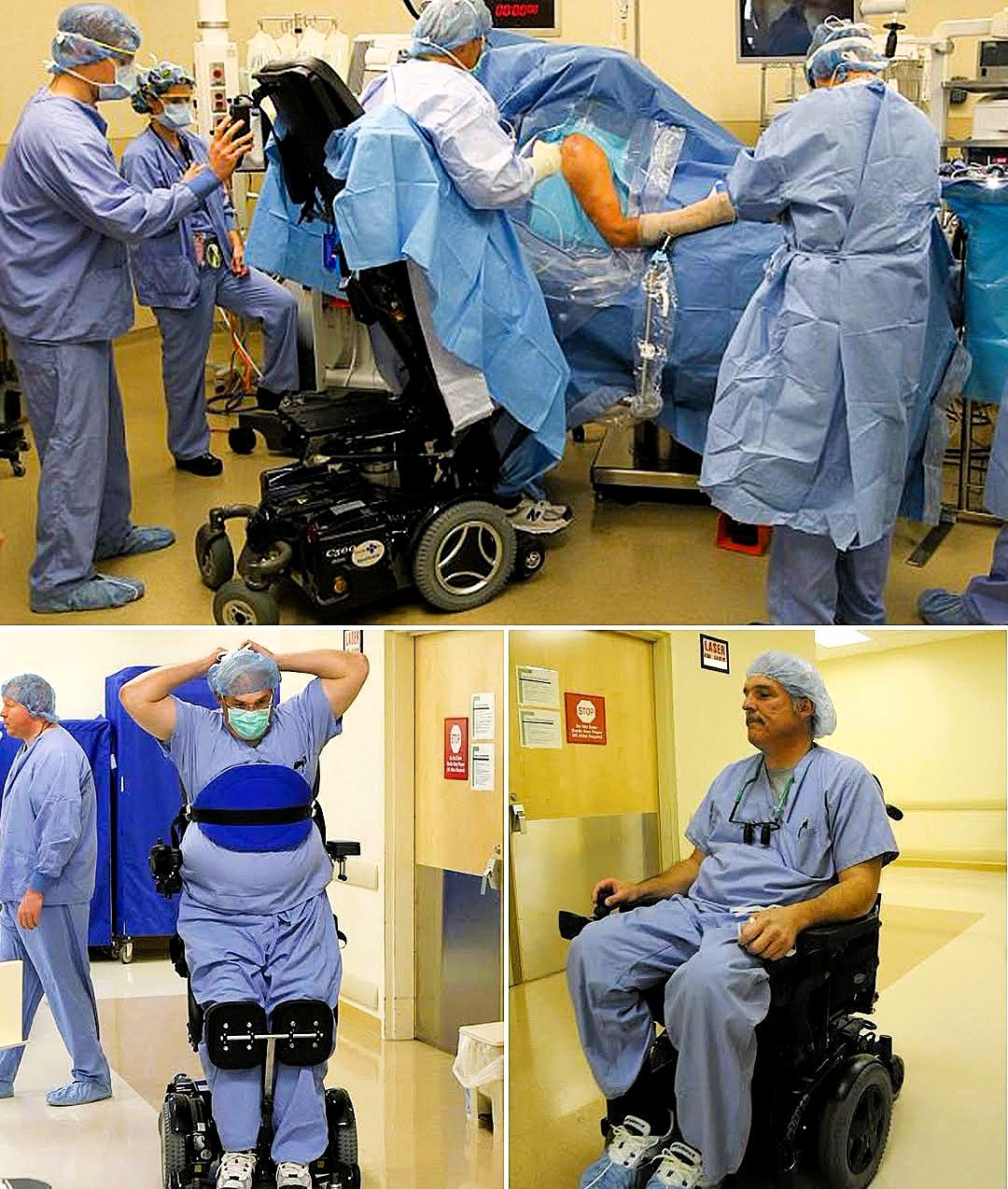
An electric standing wheelchair could raise Ted into an upright position and provide the support he needed. A restraint around his abdomen helped keep him secure while the chair positioned his body at the appropriate height for surgery.
Instead of trying to force his new body into the old system, they changed the system around him.
In December 2012, Ted used the standing wheelchair to perform shoulder surgery again.
He couldn’t stand on his own.
But he could still stand at the operating table.
He couldn’t walk into the operating room.
But he could still perform the intricate work required once he was there.
And perhaps most remarkably, becoming a patient gave Ted something he could never have learned entirely from textbooks or years of treating other people.
It gave him firsthand knowledge of what it feels like to suddenly lose independence.
He understood the fear of uncertainty.
He understood how overwhelming rehabilitation could be.
He understood what it meant to depend on other people for things that had once been effortless.
And that experience changed the way he approached his own patients.
Ted’s story isn’t really about recovering the life he had before.
He never regained the ability to walk.
Instead, he discovered that sometimes moving forward doesn’t mean restoring everything that was lost.
Sometimes it means accepting what has changed and finding a new route toward the same purpose.
His legs could no longer take him to the operating table.
So technology did.
His body could no longer perform the job in the same way.
So he adapted the environment around him.
The injury changed Ted’s life, but it didn’t erase the years of knowledge, skill and dedication stored in his hands.
He didn’t defeat paralysis by pretending nothing had happened.
He moved forward by acknowledging what had happened—and refusing to let it decide what the rest of his life would look like.
His story leaves us with a powerful question:
When the path you’ve always followed suddenly disappears, will you give up on the destination—or search for another way to get there?
Sometimes the greatest form of resilience isn’t returning to the person you were.
It’s discovering what you are still capable of becoming.