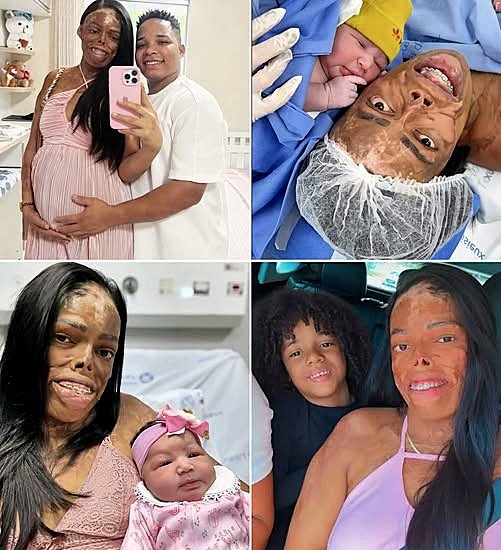
They stared at her face.
They whispered.
Some laughed.
Others made painful comments about the scars covering her skin.
But today, Josy can look into a mirror and see something far more important than the marks left behind by a childhood accident.
She sees herself.
And she knows she is beautiful.
Josy’s story began when she was just 2 years and 10 months old in Brazil.
She was playing with her cousins when an accident suddenly changed the course of her life.
Josy accidentally bumped into a stove, causing a pressure cooker filled with hot food to fall onto her.
The little girl suffered severe second- and third-degree burns across her face, arms, and other parts of her upper body.
For a child so young, the accident was only the beginning of a long and painful journey.
Hospitals became part of her childhood.
Doctors performed surgeries and skin grafts to repair the extensive injuries. Skin from her legs was used to help reconstruct damaged areas of her face.
There were procedures, treatments, recovery periods and more medical complications.
At one point, Josy developed a serious infection, adding another frightening chapter to an already difficult childhood.
Years passed, but the medical journey continued.
By the time she reached her early teenage years, Josy had experienced so many painful procedures that she eventually decided she did not want to undergo another surgery.
She had already endured enough.
But the physical pain wasn’t the only thing she had to carry.
Some of the deepest wounds were caused by people who had never experienced what she had.
At school, other children noticed her scars before they noticed the girl behind them.
They laughed at her.
They made cruel comments about her appearance.
They treated something Josy had never chosen as though it were something she should be ashamed of.
She later recalled coming home crying and struggling with the thought of continuing school.
Imagine being a child and simply wanting to belong, only to be reminded again and again that other people see you as different.
The accident had injured Josy’s skin.
But the cruelty she encountered threatened something much deeper: the way she saw herself.
And the problem wasn’t her face.
The problem was the way some people had been taught to look at someone who didn’t fit their idea of what a person should look like.
As Josy grew older, the reactions didn’t completely disappear.
Strangers sometimes stared at her in public.
People pointed.
Some laughed.
For years, she had to move through the world knowing that people might notice her scars before they noticed her personality, her kindness, her dreams or her identity as a woman, wife and mother.
But something slowly began to change.
It wasn’t her scars.
It was Josy.
Little by little, she began learning that she didn’t need to hide herself simply because other people were uncomfortable looking at her.
She began accepting the face she saw in the mirror.
Then, in 2020, something unexpected happened.
Josy shared a simple video online.
She wasn’t trying to prove anything.
She was simply having fun with her young son, Enzo.
The video spread rapidly on TikTok.
Millions of people eventually watched it, and hundreds of thousands began following Josy’s page.
But this time, something was different.
People weren’t gathering to laugh at her.
They were listening.
They were encouraging her.
They were celebrating the beautiful relationship between a mother and her son.
And many people told Josy that they thought she was beautiful.
For someone who had spent much of her childhood hearing the opposite, those reactions carried enormous emotional weight.
The internet could have become another place where strangers judged her appearance.
Instead, it became a place where Josy could tell her story on her own terms.
She could show people that the face they were looking at belonged to a woman with an entire life behind it.
A woman who had survived a devastating childhood accident.
A woman who had endured surgeries and medical treatment.
A woman who had experienced bullying.
A woman who had cried because of the cruelty of others.
A woman who became a mother.
A woman who fell in love.
A woman who eventually learned to love herself.
The attention also gave Josy an opportunity to talk about self-acceptance.
She has spoken about how the support she received online helped strengthen her confidence and allowed her to embrace the person she had become.
That doesn’t mean the past disappeared.
The scars remain.
The memories remain.
The things people said to her as a child cannot simply be erased.
But they no longer have the same power.
That may be one of the most meaningful parts of Josy’s story.
Her transformation was never about making her scars disappear.
It was about refusing to allow those scars to determine her worth.
There is an important difference.
Healing doesn’t always mean returning to the person you were before something happened.
Sometimes healing means becoming comfortable with the person you are afterward.
Josy didn’t get to choose the accident that changed her appearance.
She didn’t choose the surgeries.
She didn’t choose the painful treatments.
And she certainly didn’t choose the cruelty she encountered at school or in public.
But over time, she found something she could choose.
She could choose how she would see herself.
And today, she refuses to let other people’s judgments define her beauty.
Her life also carries an important lesson for everyone watching from the outside.
Children notice differences.
But they don’t have to be taught to turn those differences into cruelty.
They can be taught compassion instead.
They can be taught that scars are not something to laugh at.
That someone who looks different may have survived something they know nothing about.
That asking questions respectfully is better than pointing.
That kindness costs nothing.
And that beauty cannot be measured by whether someone’s face looks like everyone else’s.
Josy’s childhood might have been very different if the people around her had understood that.
Instead of laughing, someone could have sat beside her.
Instead of making comments, someone could have asked how she was feeling.
Instead of making her feel ashamed, someone could have reminded her that she was still the same child she had always been.
Today, Josy has a family of her own, including her beloved son, Enzo.
She also has a platform where she can share her experiences with people around the world.
The scars that once became targets for cruel jokes have become part of a story that reaches people who may also feel different, rejected or insecure.
And perhaps that is where the real victory lies.
Not in changing the face that others once criticized.
Not in erasing every scar.
Not in convincing every stranger to understand.
But in reaching a place where their opinions no longer determine how you see yourself.
Josy’s scars tell the story of something she survived.
They do not tell the story of how much she is worth.
They do not define her motherhood.
They do not define her marriage.
They do not define her personality.
And they certainly do not decide whether she is beautiful.
Josy has already answered that question for herself.
She looks in the mirror and sees a woman who survived.
A mother who loves her son.
A person who endured years of judgment and still chose to keep moving forward.
And, finally, she sees someone worthy of love—including her own.
Perhaps the question her story leaves behind isn’t whether Josy is beautiful.
It’s why anyone ever needed to be convinced that she was.
Because behind every scar is a story.
And sometimes, the kindest thing we can do is stop staring long enough to listen.
Read Next
- For years, Carly’s family knew something was wrong. She was only a toddler, but her body wasn’t developing the way doctors expected. There were tests, appointments, questions and explanations that never quite seemed to fit.
- He was only 17 years old. He had almost nothing of his own. No safe home. No steady income.
- Lily Was Buried Alive—But She Survived and Found the Love She Deserved