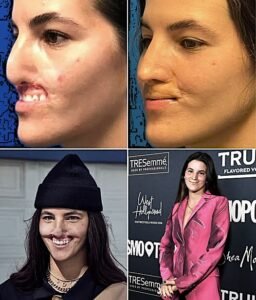
When Brooklinn Khoury woke up in a hospital bed after a devastating dog attack, she wasn’t thinking about skateboarding, modeling, or social media.
She was thinking about her face.
More specifically, she was wondering whether she would ever recognize herself again.
Brooklinn had been just 20 years old when her life changed in a matter of seconds. She was visiting family in Arizona on November 3, 2020, when a dog she already knew suddenly attacked her.
She survived the terrifying incident, but the injuries were devastating.
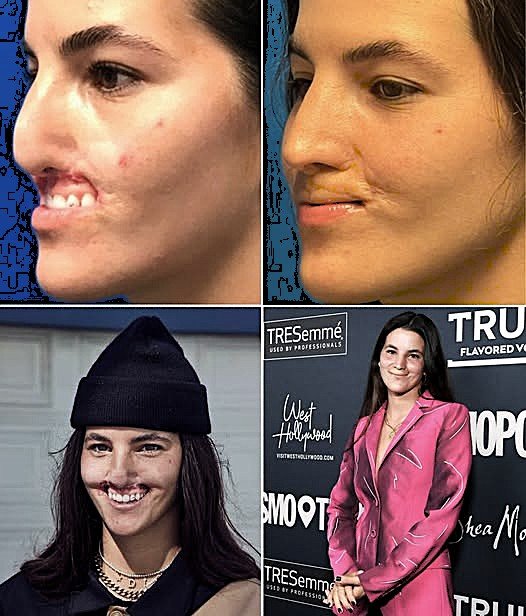
The attack destroyed her entire upper lip and damaged the area around her nose. The face she had known all her life had been dramatically changed, and doctors couldn’t simply repair it with a single operation.
For Brooklinn, the physical injuries were only one part of what followed.
There was also the emotional shock of suddenly living with a facial difference she had never expected.
From her hospital bed, she did something many people might have done in the same situation.
She searched the internet.
She wanted to find another person who had experienced something similar. Someone whose face had changed because of a serious injury. Someone who could show her what life might look like afterward.
But she couldn’t find anyone who looked like her.
There were medical photographs and stories about facial reconstruction, but Brooklinn wasn’t simply searching for medical information.
She was searching for reassurance.
She wanted to see another human being who had gone through something frightening and difficult and had eventually found a way forward.
There seemed to be no one.
That absence stayed with her.
For nearly a year, Brooklinn traveled from specialist to specialist, hoping someone could help reconstruct the damage. The process was frustrating and uncertain. Some doctors told her there was very little they could do.
Then she met UCLA plastic surgeon Dr. Nicholas Do.
Their meeting gave Brooklinn something she desperately needed: a plan.
But the plan wasn’t going to be simple.
Rebuilding the damaged areas of her face would require multiple complex operations, careful planning, patience and a great deal of healing between procedures.
The first major reconstructive surgery lasted approximately 20 hours.
Doctors used tissue from Brooklinn’s forearm to help create a new upper lip. The tissue had to be carefully connected to blood vessels in her face so that it could survive and become part of the reconstruction.
It was an extraordinary medical process, but for Brooklinn, it was also the beginning of a very long personal journey.
One surgery would not make everything normal again.
There would be more procedures.
More appointments.
More swelling.
More healing.
More moments when she would have to look into a mirror and accept that reconstruction takes time.
Later surgeries focused on different aspects of her recovery, including reshaping her nose, improving her breathing and gradually creating the structure and appearance of an upper lip.
By 2023, Brooklinn had undergone seven reconstructive surgeries.
For many people, such an experience might have been something they wanted to hide from the world.
Brooklinn chose a different path.
She showed it.
Before the accident, her social media had largely reflected the life she had been building as a skateboarder and model. Her posts showed an active young woman doing the things she loved.
After the attack, her online presence changed.
She began sharing something much more vulnerable.
She showed hospital visits.
She showed scars.
She showed swelling and healing.
She talked about difficult days and uncertain moments.
She experimented with lipstick.
She documented changes in her appearance as reconstruction slowly progressed.
And importantly, she didn’t wait until everything was finished.
She didn’t wait for the perfect photograph.
She didn’t wait until her face looked exactly the way she wanted.
She allowed people to see the process.
There was a reason for that.
Brooklinn remembered what it felt like to lie in a hospital bed and search for someone like herself.
She remembered the emptiness of not finding anyone.
And she didn’t want someone else to experience that same loneliness.
“I don’t want anyone to feel how I felt in that moment,” she later explained.
That simple idea became something much larger.
Brooklinn’s story began reaching people who had never heard of her before. Her followers weren’t simply watching a series of medical procedures.
They were watching someone learn to live through an experience she never asked for.
For people dealing with facial differences, serious injuries or major changes to their appearance, her posts offered something that medical information alone cannot always provide.
Representation.
A reminder that a person’s life doesn’t end when their appearance changes.
A reminder that confidence can be rebuilt.
A reminder that healing doesn’t always happen quickly.
And perhaps most importantly, a reminder that nobody has to go through a difficult transformation completely alone.
Brooklinn also demonstrated something important about social media.
The internet is often filled with carefully edited photographs, perfect smiles and seemingly effortless lives.
People usually see the final result.
They rarely see the hospital room, the uncertainty, the tears, the painful recovery, or the days when progress feels almost invisible.
Brooklinn chose to show those parts too.
Her journey became less about presenting a perfect transformation and more about showing what it actually means to rebuild.
There were no guarantees that every procedure would produce exactly the result she hoped for.
There were no shortcuts.
There was simply one step after another.
And with every step, she became more comfortable sharing the reality of her experience.
Eventually, the thing she had once searched for online became something she was providing to others.
Someone could now find her story and see a young woman who had survived a devastating facial injury, undergone years of reconstruction and continued moving forward.
Someone could look at her photos and think:
Maybe I can do this too.
Maybe my life isn’t over.
Maybe I can still smile.
Maybe I can still dream.
Maybe I can still become myself again—just in a different way.
That may be one of the most meaningful parts of Brooklinn’s story.
She didn’t choose what happened to her.
She didn’t choose the surgeries.
She didn’t choose the scars.
But she could choose what she did with the experience.
Instead of allowing the hardest parts of her recovery to remain hidden, she used them to create a record that could help someone else.
Her story also reminds us that reconstruction isn’t simply about restoring physical features.
It can be about restoring confidence.
Restoring identity.
Restoring the courage to be seen.
And sometimes, healing means accepting that life may not return to exactly what it was before.
It means discovering that a different version of yourself can still have a future filled with meaning.
Brooklinn once searched desperately for someone who looked like her because she needed proof that she wasn’t alone.
She couldn’t find that person.
So she became that person.
Today, someone facing their own difficult recovery can look at Brooklinn’s journey and see more than scars or surgeries.
They can see perseverance.
They can see vulnerability.
They can see possibility.
And perhaps that is the most powerful gift she could have given.
Not a promise that recovery will be easy.
Not a guarantee that everything will look exactly the same again.
But a simple message:
You are not the only one.
Sometimes, the person we wish we had during our darkest moment is the person we eventually become for someone else.