For most parents, holding their child is one of the simplest and most natural expressions of love.
You pick up your daughter.
You hold her close.
You feel her little hands around you.
It is something so ordinary that most people never stop to think about how precious it really is.
But for Abul Bajandar, from Bangladesh, being able to hold his young daughter became a dream he had to fight desperately to achieve.
And for a short time, he finally could.
Then the disease took it away again.
Abul became known around the world by the heartbreaking nickname “Tree Man” because of the unusual growths that developed across his hands and feet. But behind that nickname was not a medical curiosity or a shocking photograph.
There was a man.
A son.
A husband.
And most importantly, a father who simply wanted to live a life in which he could touch and hold his child without unbearable pain.
Abul lives with a rare genetic skin disorder called epidermodysplasia verruciformis. The condition is extraordinarily uncommon and can make a person’s skin unusually vulnerable to certain types of human papillomavirus, leading to persistent wart-like lesions and abnormal growths.
For Abul, those growths gradually became much more than a visible difference.
They became a barrier between him and everyday life.
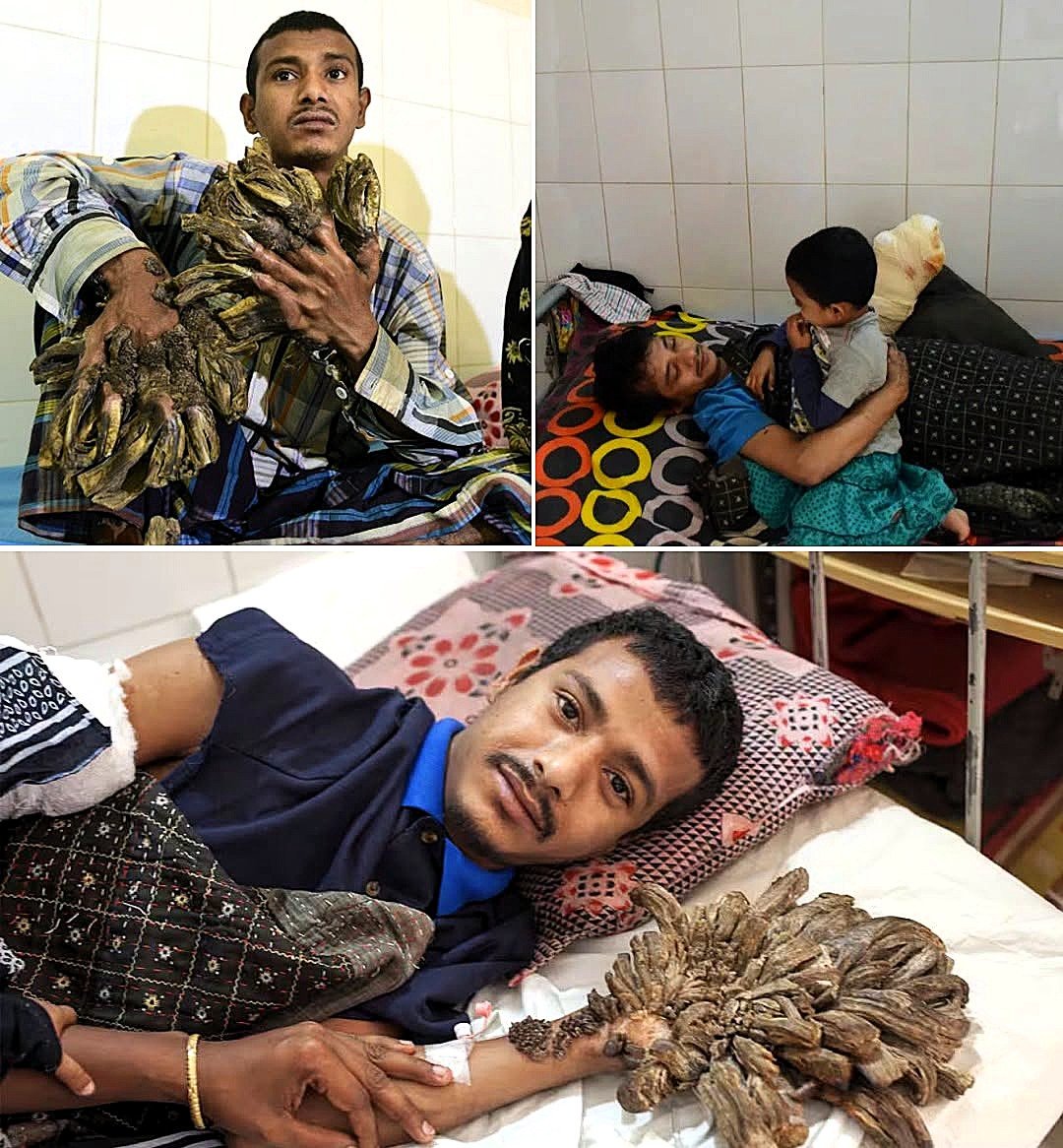
Over time, the growths on his hands and feet became larger and more extensive. His hands, which should have allowed him to work, eat, dress himself and hold his family, became increasingly difficult to use.
By 2016, his condition had become so severe that ordinary movements were almost impossible.
His hands were covered with enormous masses of growths.
The images were difficult to look at.
But what those photographs could not show was the exhaustion, frustration and pain behind them.
Abul eventually came to the attention of doctors at Dhaka Medical College Hospital, where a team began treating him without charge.
For the first time in years, there was a possibility that his hands might become usable again.
The treatment was long and difficult.
Abul underwent surgery after surgery.
Over the following years, doctors performed around 25 operations in an effort to remove the abnormal growths and restore some function to his hands and feet.
During one period of treatment, surgeons removed approximately five kilograms of growths from his body.
Five kilograms.
It was an enormous amount of tissue that had prevented him from using his hands normally.
And then something happened that seemed almost unbelievable.
Abul could use his hands again.
For him, the greatest reward was not simply being able to move his fingers.
It was being able to touch his daughter.
He could hold her.
He could wrap his arms around her.
He could experience a simple moment of fatherhood that the disease had stolen from him.
For a while, there was hope.
After years of suffering, Abul had been given a glimpse of the life he had wanted.
But the disease was not finished.
The growths began returning.
Slowly, painfully, the condition started taking back what surgery had restored.
The relief that Abul had experienced did not last.
His hands became difficult to use once again.
And the pain returned.
By June 2019, Abul’s suffering had reached a point where he made a request that reveals just how desperate his situation had become.
He asked doctors to amputate his hands.
It was not a request made casually.
It came after years of operations, pain and disappointment.
Abul reportedly told doctors that he could no longer tolerate the suffering and that he was unable to sleep at night because of the pain.
Imagine reaching a point where losing your hands seems less frightening than continuing to live with the pain inside them.
His mother described his condition as a “hellish” experience.
For a mother, watching her child suffer is almost impossible to put into words.
And for Abul, every day became another battle against a condition that seemed determined to return no matter how many times doctors tried to remove it.
Doctors did not immediately agree to his request for amputation.
Instead, they continued searching for ways to control his condition and relieve his suffering.
There was no simple solution.
There was no single operation that could guarantee the growths would never return.
That was perhaps the cruelest part of Abul’s story.
Even when surgery appeared successful, the disease could come back.
Even when he regained the use of his hands, he could lose it again.
Even when hope appeared, it could disappear.
Years later, Abul’s struggle continued.
In 2023, he returned to the hospital after the growths had again developed on his hands and feet.
By then, much of the world had already heard of the Bangladeshi man sometimes described in headlines as the “Tree Man.”
But labels like that can make a human being seem like a strange medical photograph instead of the person living inside the story.
Abul was never simply a man with unusual growths.
He was a father who wanted to hold his daughter.
He was a person who wanted to sleep without unbearable pain.
He was someone who wanted to use his hands, perform ordinary tasks and experience the basic freedoms that most of us rarely think about.
His story forces us to look differently at the things we call “normal.”
We wake up and reach for our phones.
We button our shirts.
We eat with our hands.
We open doors.
We shake someone’s hand.
We pick up our children.
We scratch an itch.
We write our names.
We carry groceries.
We hug the people we love.
Most of us do these things without giving them a second thought.
But Abul’s life shows how quickly an ordinary ability can become something priceless.
For him, the ability to close his hands around his daughter was not ordinary.
It was a victory.
It was proof that, for a moment, the disease had not won.
And perhaps that is the part of his story that deserves to be remembered most.
Not the photographs.
Not the nickname.
Not the shocking appearance of the growths.
But the image of a father finally being able to hold his child again.
There is something deeply human about that moment.
A child does not see a medical diagnosis.
A daughter does not see a rare genetic disorder.
She sees her father.
And her father sees his child.
That simple connection can mean more than any headline ever could.
Abul’s journey also reminds us that medical progress is not always a straight line. Sometimes treatment brings remarkable improvement, only for complications to return. Sometimes doctors can remove what is visible without being able to eliminate the underlying problem.
And sometimes, the greatest challenge is not finding one perfect cure, but continuing to care for a person through years of uncertainty.
Abul’s story is one of pain, but it is also a story about hope, family and the extraordinary value of ordinary human abilities.
His hands once became almost unusable.
Then doctors helped give him back something he desperately wanted.
For a brief period, he could hold his daughter again.
And even though the disease returned, that moment cannot be erased.
Perhaps that is why his story continues to affect people around the world.
Because somewhere in our lives, we all have things we take for granted.
Walking.
Seeing.
Hearing.
Writing.
Eating.
Touching.
Holding someone we love.
We rarely understand their true value until the possibility of losing them enters our lives.
Abul Bajandar’s story asks us to pause for a moment and appreciate those simple freedoms.
Because sometimes the greatest blessings are not the extraordinary things we dream about.
Sometimes they are the things our bodies allow us to do every single day without asking for anything in return.
And sometimes, something as simple as holding your child can be everything.
What everyday ability do you think you would miss the most if you suddenly could no longer do it?