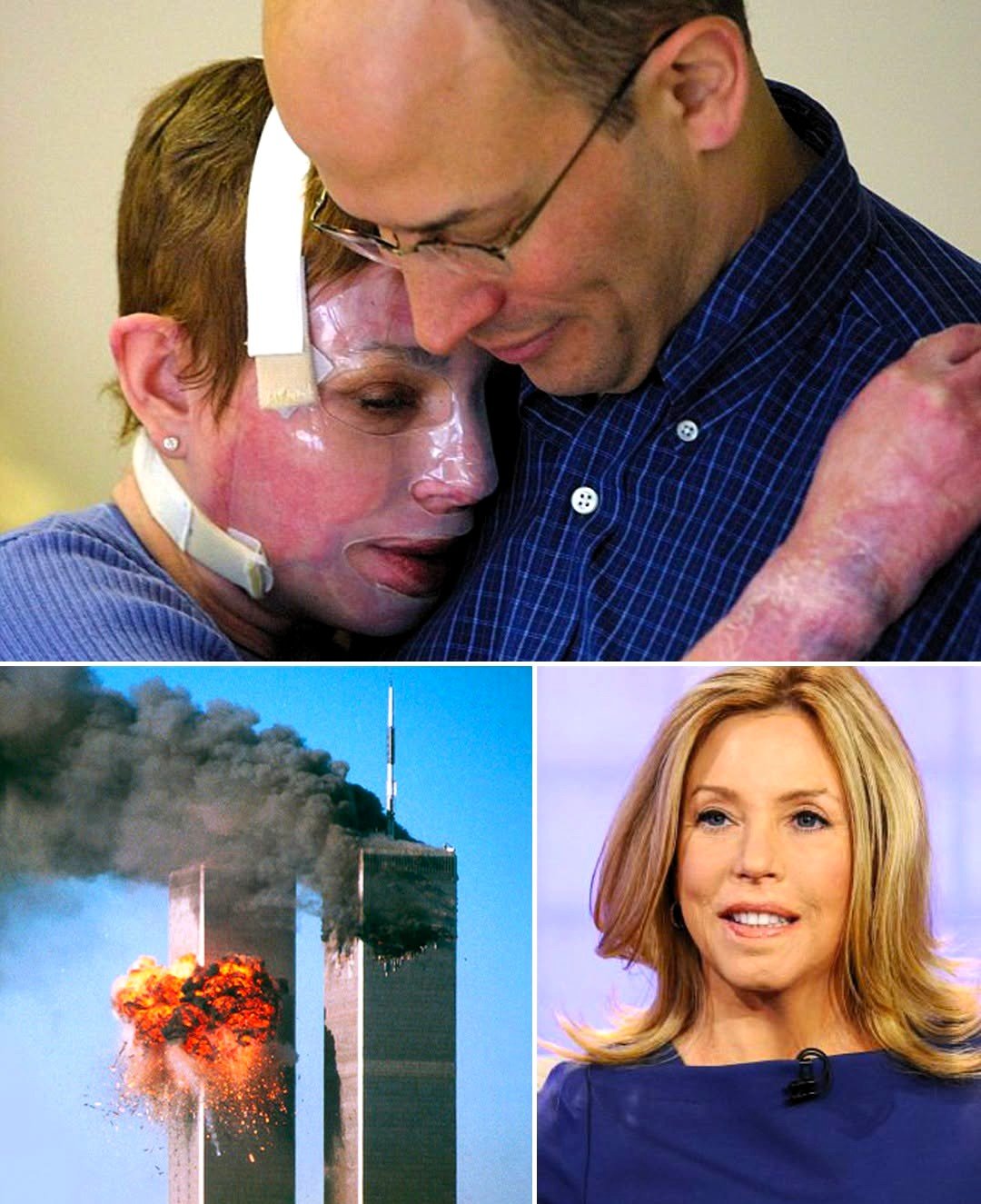

Doctors gave Lauren Manning only about a 15% chance of surviving.
As her condition grew even more critical, those already frightening odds dropped into the single digits.
But Lauren survived.
And her survival became more than a medical miracle. It became a story about motherhood, determination, unimaginable pain, and the decision to keep moving forward when life no longer looked anything like it once had.
On the morning of September 11, 2001, Lauren was on her way to work at Cantor Fitzgerald in New York City’s World Trade Center.
She was a wife.
She was a mother.
And waiting for her at home was her 10-month-old son, Tyler.
She had no idea that she was walking toward one of the darkest moments in American history.
Lauren never reached her office.
As she entered the lobby of the North Tower, American Airlines Flight 11 struck the building above her. The impact sent burning jet fuel racing through the tower’s elevator shafts.
Within moments, the lobby became a terrifying inferno.
Fire swept through the building with unimaginable force.
Lauren somehow found a way out.
But escaping the tower did not mean escaping the nightmare.
She had suffered burns across more than 82% of her body.
The injuries were so severe that doctors weren’t sure she would live.
For Lauren, the next chapter would not be about simply getting better.
It would be about fighting for every breath, every movement, and eventually, every ordinary moment of life.
She spent nearly two months heavily sedated in a medically induced coma.
While she lay unconscious, doctors performed repeated surgeries and fought a series of dangerous complications. Her body had endured an extraordinary amount of trauma, and recovery would require far more than a single operation.
Lauren remained at NewYork-Presbyterian for 91 days.
Then came another difficult chapter.
She was transferred to a rehabilitation hospital, where she spent approximately three more months learning how to function again.
But through all the pain, procedures and uncertainty, one thought remained powerful enough to keep pulling her forward.
She wanted to see her son.
Tyler was only 10 months old when Lauren left for work that September morning.
She wanted to go home to him.
She wanted to hold her baby again.
She wanted to be his mother.
Finally, in March 2002, six months after that terrible morning, Lauren returned home.
But going home did not mean the struggle was over.
It was only the beginning of another kind of fight.
Lauren continued traveling to the hospital five days a week, spending hours undergoing physical and occupational therapy. Even on Sundays, she continued therapy at home.
Every movement had to be relearned.
Every small improvement mattered.
The life she had known before September 11 could not simply be restored.
Her body had been permanently changed.
So Lauren had to build a new life around the person she had become.
And perhaps that is what makes her story so powerful.
Survival is often imagined as one dramatic moment—the instant someone escapes danger or wakes from a coma.
But Lauren’s story reminds us that survival can be much longer and much harder than that.
Sometimes survival is getting out of bed when your body hurts.
Sometimes it is showing up for therapy again when yesterday’s session exhausted you.
Sometimes it is learning to accept a changed reflection in the mirror.
And sometimes, it is simply choosing to try again when you are tired of fighting.
Years later, Lauren shared her journey in her memoir, Unmeasured Strength.
The title captures something profound about what she endured.
Her strength could not be measured by statistics.
Not by the percentage of her burns.
Not by the survival odds doctors gave her.
Not by the number of surgeries she endured.
And not even by how long her rehabilitation lasted.
Her strength was revealed in something much simpler:
She kept going.
She survived a morning that should have taken her life.
She endured injuries that left doctors uncertain whether she would make it.
She spent months in hospitals and years rebuilding her life.
And through it all, there was a reason to keep moving forward—a little boy waiting for his mother.
Lauren’s story is not a story about returning to the person she was before tragedy.
It is about discovering that even after tragedy changes everything, there can still be a future worth fighting for.
Her life shows us that courage isn’t always loud.
Sometimes courage is quiet.
It looks like opening your eyes another morning.
Taking another painful step.
Going back to therapy.
Holding your child.
And telling yourself, once again:
I am still here. I will keep going.
More than two decades later, Lauren Manning’s survival continues to remind us that the human spirit can endure far more than we ever imagine.
🌱 Sometimes strength isn’t surviving one impossible moment. Sometimes it’s having the courage to rebuild your life, one day at a time.
What do you think requires more courage—the fight to survive the first impossible moment, or the strength to keep rebuilding for years afterward?