
There are some eyes that stay with you long after you look away.
The eyes of a frightened dog are like that.
They don’t need words to tell you that something has gone wrong. Sometimes all it takes is a trembling body, a lowered head, or a pair of eyes quietly searching your face for an answer.
Are you going to hurt me too?
For animals who have experienced cruelty, trust does not come easily.
A hand that should have meant comfort may once have caused pain. A voice that should have sounded reassuring may have been followed by fear. A home that should have been a place of safety may have become the place where an animal learned what it meant to be helpless.
And yet, somehow, many of these dogs still find a way to love again.
That is what makes their stories so powerful.
At a local animal shelter, volunteers see this transformation over and over again.
A frightened dog may arrive refusing to make eye contact. It may hide in the back of its kennel whenever someone approaches. Sometimes even the simplest things—being touched, hearing a loud sound, watching a person raise a hand—can bring back memories no one else can see.
The shelter cannot erase the past.
But it can give the dog something it may never have had before:
Time.
Time to understand that food will come every day.
Time to discover that a blanket can mean warmth instead of hiding.
Time to learn that a gentle hand will not become a fist.
Time to realize that a human voice can mean kindness.
And slowly, almost imperceptibly, something changes.
The dog begins to come closer.
First, perhaps, it watches from across the room.
Then it moves a few inches forward.
One day, it accepts a treat from a volunteer’s hand.
Another day, it allows someone to sit beside it.
And eventually, there may come a moment when the dog rests its head against a person’s leg.
For the volunteer, it might seem like a tiny gesture.
For the dog, it can represent an enormous victory.
It is the moment when fear gives trust another chance.
That is why animal cruelty is so devastating.
Animals depend almost completely on humans.
They cannot call the police when they are being neglected. They cannot explain where they came from. They cannot tell a judge what happened behind a closed door. They cannot ask a stranger to rescue them.
They depend on us to notice.
They depend on us to care.
And most importantly, they depend on us to speak when they cannot.
Too often, suffering remains hidden because nobody wants to get involved. A dog that is constantly left outside. An animal that appears dangerously thin. A pet that never seems to receive proper care. A frightened animal whose behavior suddenly changes.
Sometimes there is an innocent explanation.
But sometimes there isn’t.
And when something feels wrong, ignoring it can leave an animal trapped in a situation it has no power to escape.
Speaking up does not mean taking matters into your own hands or confronting someone dangerously. It can mean contacting local animal-control authorities, a reputable rescue organization, or another appropriate agency that can safely investigate the situation.
One report might seem small.
One phone call might seem insignificant.
But for an animal with nowhere else to turn, it could be the difference between another night of suffering and the beginning of a completely different life.
The work of rescue organizations and shelters is rarely glamorous.
There are difficult medical cases.
There are frightened animals.
There are heartbreaking discoveries.
There are long days spent cleaning kennels, preparing food, arranging veterinary care and comforting animals who don’t yet understand that they are finally safe.
And there are setbacks.
Not every dog recovers quickly.
Some carry emotional scars for years.
Some will always be nervous around certain sounds or situations.
But then there are the moments that make every difficult day worthwhile.
A dog that once trembled in the corner begins wagging its tail.
A dog that once avoided people starts asking for affection.
A dog that arrived believing humans could only bring pain discovers that humans can also bring safety.
That transformation is not magic.
It is patience.
It is consistency.
It is kindness repeated so many times that eventually the animal begins to believe it.
And children have an important role in creating that kinder future.
Teaching a child to respect animals is about more than telling them not to hurt a dog.
It is teaching them that animals have feelings.
That a frightened animal should be given space.
That a pet is not a toy.
That responsibility doesn’t disappear when the novelty of having an animal wears off.
Children who learn compassion toward animals can carry that lesson into every part of their lives.
Because cruelty rarely begins with some dramatic act.
Sometimes it begins with treating a living creature as though its feelings don’t matter.
Kindness begins by understanding that they do.
A dog doesn’t care how expensive your house is.
It doesn’t care what car you drive.
It doesn’t care how many followers you have or what your job title is.
Give a dog food, safety and affection, and it may give you something priceless in return.
Loyalty.
Companionship.
Unconditional love.
For many dogs, their entire world is the person who feeds them, opens the door, takes them outside and sits beside them at the end of a difficult day.
That is an enormous responsibility.
When an animal places that kind of trust in a human being, it deserves protection in return.
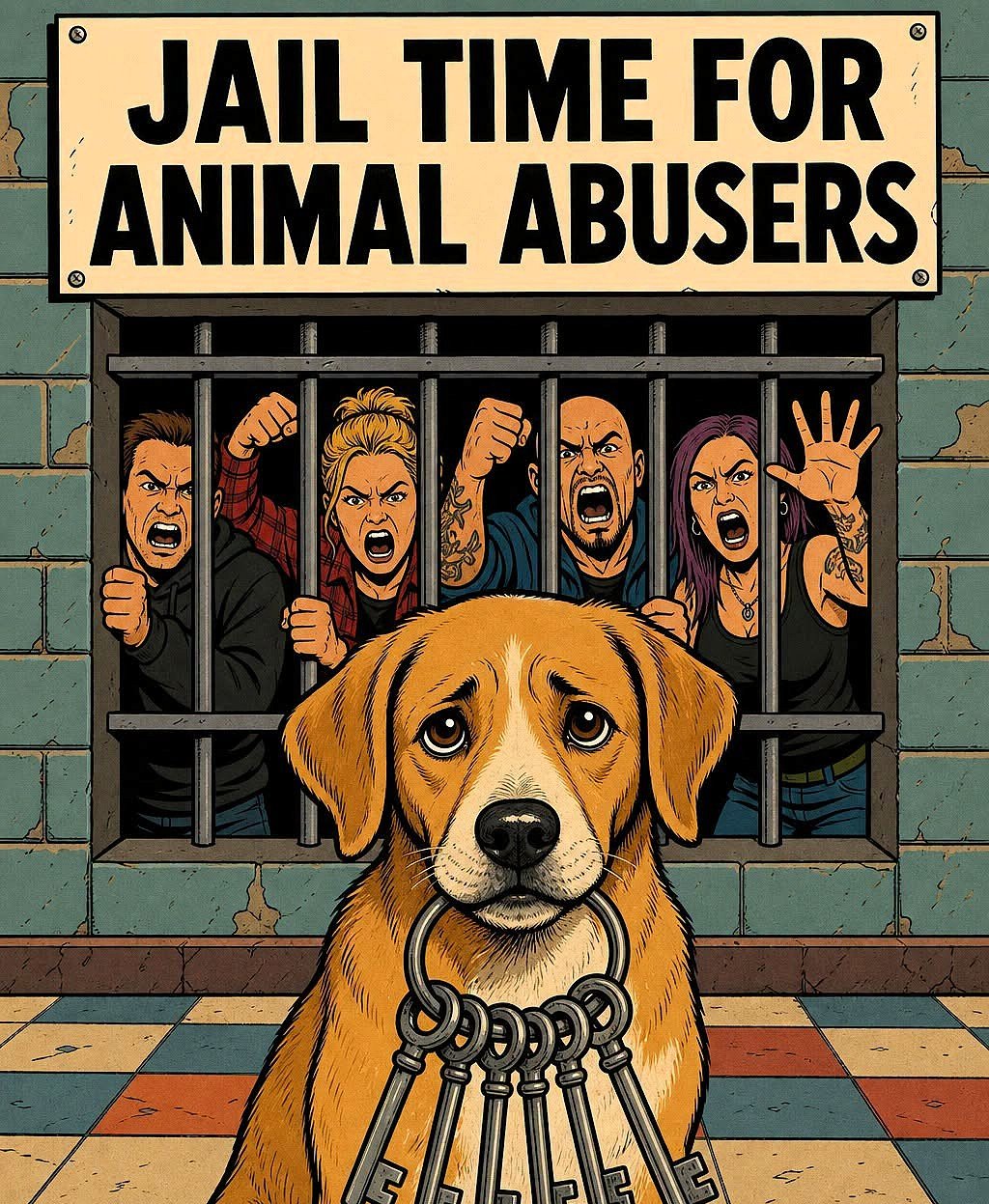
The image of a frightened dog surrounded by people behind bars carries a powerful message. The punishment should never be about revenge. It should be about accountability, prevention and making it clear that cruelty toward vulnerable animals has consequences.
Laws matter.
Enforcement matters.
Education matters.
But compassion matters too.
Because laws can punish someone after cruelty occurs.
Kindness can help prevent it from happening in the first place.
So if you have a dog, look into those eyes tonight.
Remember how completely that animal depends on you.
If you see an animal that may be suffering, don’t simply scroll past the image or walk away from the situation.
Learn how to report suspected abuse safely.
Support your local shelter.
Donate if you can.
Volunteer if you have the time.
Adopt responsibly.
Teach children to be gentle.
And when an animal finally finds the courage to trust again, give it every reason to believe that it made the right choice.
Because they cannot tell their side of the story.
They cannot defend themselves with words.
They cannot explain the pain they have survived.
But we can speak for them.
And sometimes, all it takes to change a life is for one person to decide that an animal’s suffering will not be ignored.