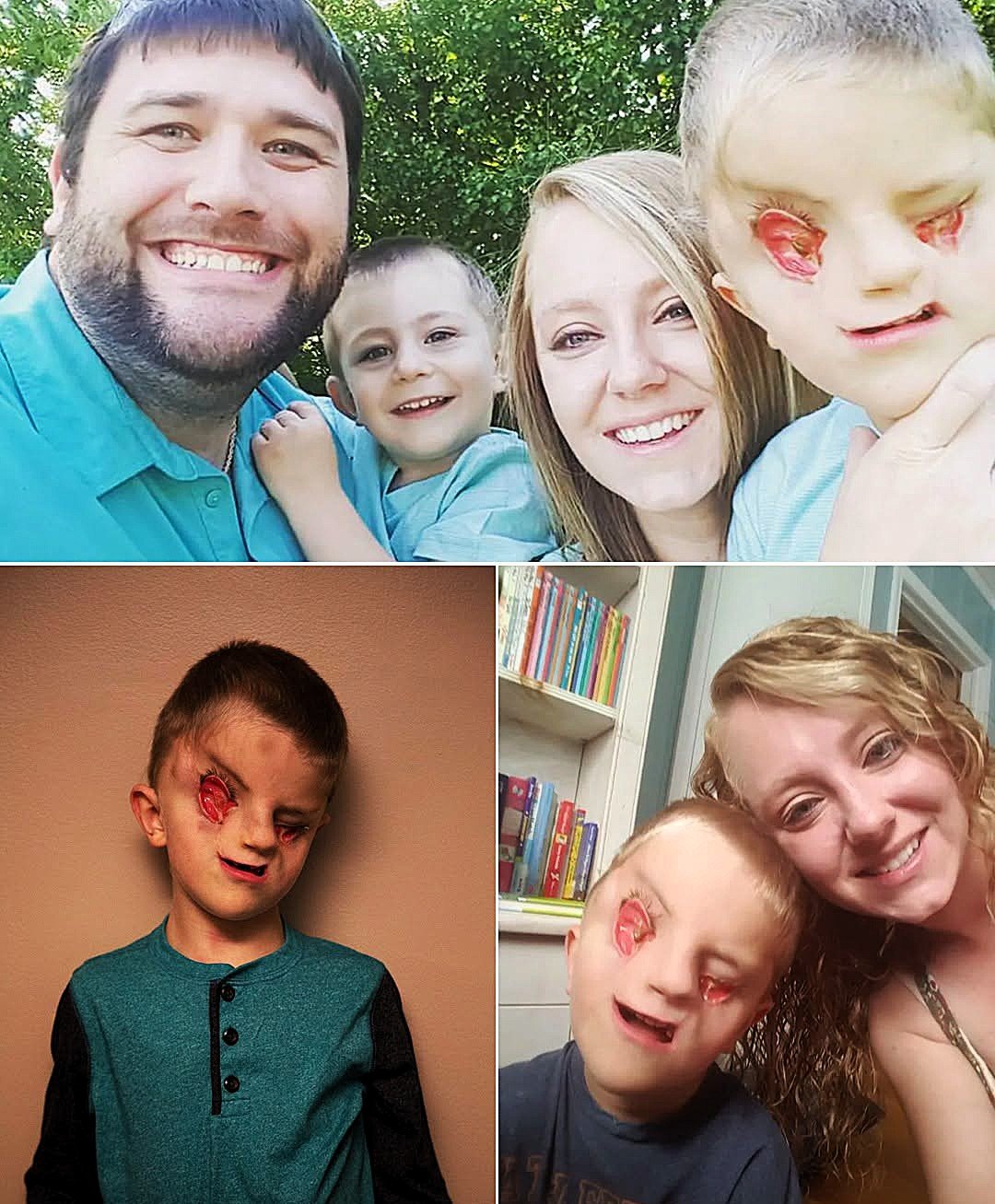
When Christian Buchanan entered the world in February 2011, the delivery room fell into an unexpected silence.
His mother, Lacey, could immediately sense that something was wrong. Throughout her pregnancy, doctors had warned the family that their unborn baby had a severe cleft lip and palate. Yet even with the medical scans, no one could fully prepare them for what they would discover when Christian was finally born.
The reality was much more complicated than anyone had expected.
Christian was born with an extremely rare facial condition known as a Tessier facial cleft. His eyes had not developed, which meant he would never be able to see the world in the way most children do.
For his parents, those first moments were filled with fear, confusion and countless unanswered questions.
Lacey remembered medical staff quietly asking her if she wanted to see her newborn son.
She said yes.
And when she finally saw Christian, she didn’t see a diagnosis.
She saw her baby.
She saw the little boy she had carried, waited for and already loved.
It was only the beginning of a journey that would test the entire family in ways they could never have imagined.
Christian’s medical needs were immediate. Because his facial cleft made ordinary feeding impossible, he underwent surgery at just four days old to have a feeding tube placed. He spent his first month in intensive neonatal care, surrounded by doctors, nurses and medical equipment.
And that first surgery would not be his last.
As Christian grew, additional procedures would become part of his childhood. His parents had to learn how to care for a child with significant medical needs while navigating a world that often did not know how to respond to someone who looked different.
But the medical challenges were only one part of their struggle.
There were also the people.
People stared.
Some whispered.
Others made insensitive or cruel comments about Christian’s appearance.
For Lacey and her husband, Chris, watching strangers react to their son could be heartbreaking. They were already trying to understand their own emotions and figure out how to give Christian the best possible life. Now they also had to deal with the judgment of people who knew nothing about their family.
The pressure became so intense that it even affected their marriage. There were periods when Lacey and Chris struggled deeply, and their relationship came close to breaking under the weight of everything they were experiencing.
Yet through all of it, Christian continued to grow.
And slowly, something remarkable began to happen.
People who initially saw only his facial difference began discovering the child behind it.
Christian wasn’t defined by the way his face looked.
He was a boy with a personality, a sense of humor, curiosity and a desire to experience life.
He learned to walk.
He learned to communicate.
He went to the Tennessee School for the Blind, where he began learning Braille and developing new ways to interact with the world around him.
Because Christian was blind, many ordinary childhood activities required creative adaptations. But rather than allowing blindness to become a wall between Christian and the things he loved, the people around him helped him find different ways to participate.
One of those activities was karate.
His instructor adapted the lessons so Christian could learn through touch, physical guidance and repetition. Instead of relying on visual demonstrations, Christian learned movements by feeling them and practicing them again and again.
He wasn’t asking for the world to become easier.
He was learning how to navigate the world on his own terms.
Then came music.
Christian began learning to play the violin.
For a child who had never experienced sight, music offered another way of exploring and expressing himself. The instrument became more than an activity. It became another reminder that there were countless things he could still discover.
And that was one of the most important lessons Christian’s story offered.
His blindness changed how he experienced the world.
His facial condition changed how strangers reacted to him.
His medical history changed the kind of childhood he had.
But none of those things decided how much life he was capable of living.
As Christian grew older, his mother began sharing more of his story publicly.
Her goal wasn’t simply to show people what life looked like for a child with a rare facial difference.
She wanted people to look longer.
To look beyond the first impression.
To understand that there is an entire human being behind every appearance.
Christian was not simply “the blind boy.”
He was not merely a child born without eyes.
He was a curious young boy who could laugh until his family laughed with him. He could learn new skills. He could play. He could spend time with his younger brother. He could discover music, practice karate and find his own ways of making sense of the world.
In other words, Christian was doing something children are supposed to do.
He was living.
His story also challenged the people around him to reconsider what they believed disability meant.
Too often, society sees a visible difference before it sees a person’s personality.
We notice the things that make someone unusual and forget to notice everything that makes them human.
Christian’s life reminds us that a person’s appearance may tell us something about their circumstances, but it tells us almost nothing about their dreams, personality, courage or potential.
His parents could not remove every obstacle from his path.
They could not stop every stranger from staring.
They could not prevent every insensitive comment.
They could not make his medical journey disappear.
What they could do was love him, support him and give him opportunities to discover what he could accomplish.
And Christian kept showing them.
Step by step.
Lesson by lesson.
Milestone by milestone.
He showed that a different beginning does not have to mean a smaller life.
His condition changed almost everything about the way Christian experiences the world.
But it never determined how much of the world he could experience.
Perhaps that is the part of his story we should remember most.
The next time we see someone who looks different, we have a choice.
We can stare.
We can whisper.
We can judge based on what we see in a few seconds.
Or we can choose something better.
We can remember that there is always a story behind the face in front of us—one filled with struggles we may never know, victories we may never witness and dreams we may never see.
Christian’s journey is not simply a story about blindness, surgeries or a rare facial condition.
It is a story about a family learning to adapt.
A mother choosing to see her son before she saw his diagnosis.
A child discovering that limitations do not erase possibilities.
And a world slowly being reminded that different does not mean less.
Christian never needed people to pretend that his challenges didn’t exist.
He needed people to understand that his challenges were only one part of who he was.
And perhaps that is the question his life leaves with all of us:
If you were raising a child who looked noticeably different, would you protect them from the world’s attention—or would you teach the world how to see them differently?