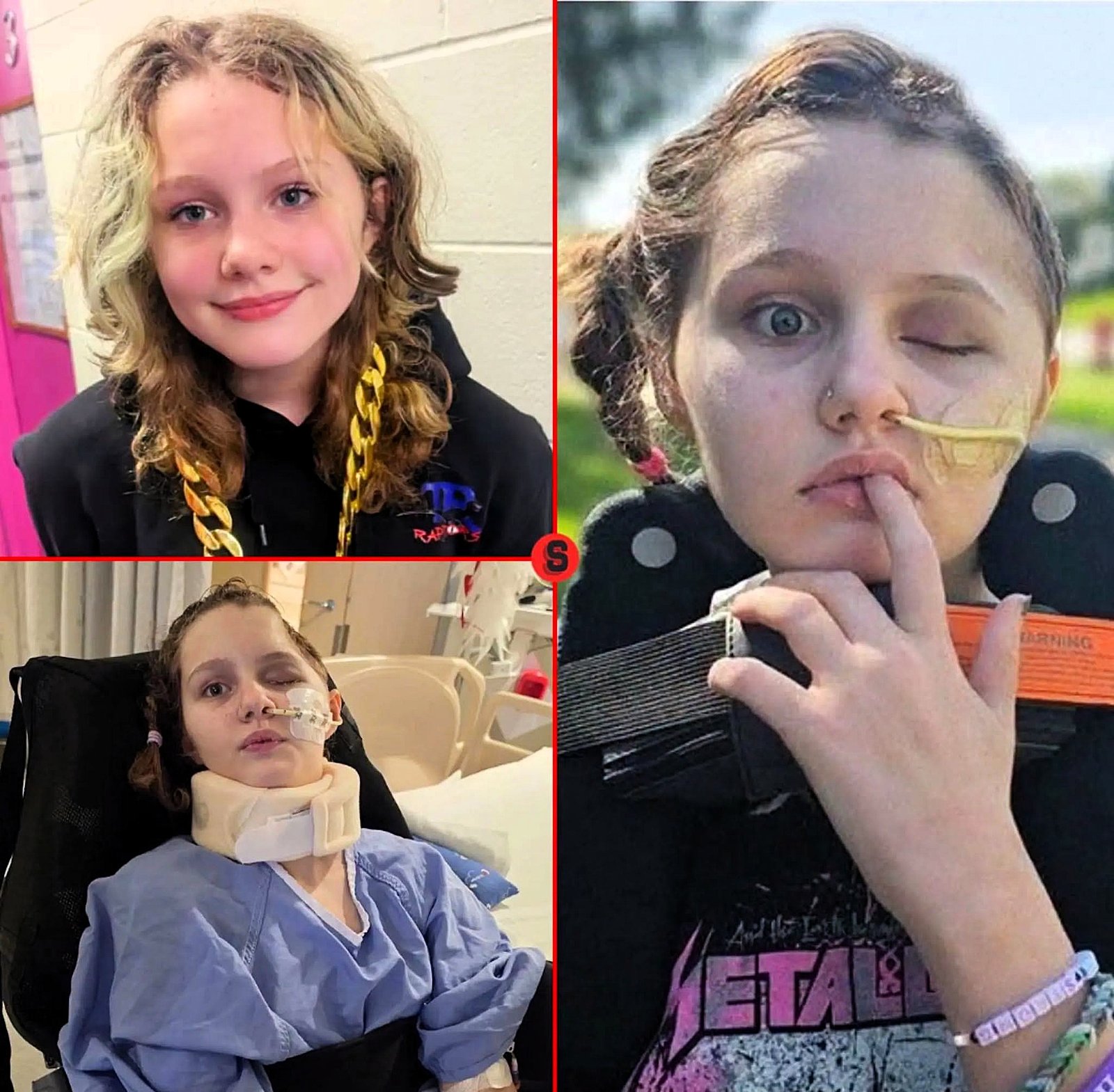
In a moment of unimaginable fear and chaos, 12-year-old Maya Gebala made a decision that may have saved the lives of her classmates. When an attacker stormed into a school in Tumbler Ridge, British Columbia, in February 2026, Maya reportedly tried to protect other students by blocking the school door and preventing the attacker from getting inside.
What happened next left the young girl with severe head and neck injuries and began a long and difficult journey of emergency treatment, intensive care, neurosurgery, and rehabilitation.
For Maya, what began as an ordinary school day suddenly turned into a life-threatening emergency. As the attack unfolded, panic spread through the school. Students and staff faced an unimaginable situation, with very little time to react.
Amid the confusion, Maya stepped forward.
Instead of simply trying to escape, she attempted to use the school door as a barrier, putting herself between the attacker and her classmates. It was an instinctive act of protection that came at an enormous personal cost.
During the assault, Maya suffered devastating injuries to her head and neck. The severity of her condition required immediate emergency medical attention. She was urgently transported for specialized care and admitted in critical condition.
Doctors faced an extremely serious medical situation.
Her injuries included severe fractures to the head, requiring highly complex treatment and multiple neurosurgical interventions. For Maya’s family, the days that followed were filled with uncertainty as medical teams worked to stabilize her condition and give her the best possible chance of recovery.
The road ahead was far from easy.
Severe head injuries can affect many aspects of a person’s life, including communication, movement, coordination, and the ability to perform everyday activities. Maya’s condition meant that her recovery would not simply depend on surviving the initial emergency. She would also need extensive rehabilitation to gradually regain abilities that had been affected by her injuries.
Her medical journey therefore became a long-term process involving intensive treatment, monitoring, and rehabilitation.
While Maya was fighting to recover physically, her family remained by her side. Their support became an important part of her journey as she moved through one difficult stage after another.
Eventually, there was a significant sign of hope.
Maya was able to leave the intensive care unit, marking an important milestone in her recovery. Although leaving intensive care did not mean that the battle was over, it represented a major step forward after the critical period following her injuries.
From there, her recovery continued gradually.
She began working toward regaining communication and mobility, facing the difficult realities of rehabilitation one step at a time. Progress after a severe injury can often be slow, requiring patience, determination, and continued medical support.
For a 12-year-old child, that journey is especially difficult.
Yet Maya’s story has also become a story of courage.
Her decision to stand in the doorway and attempt to protect her classmates has drawn attention to the extraordinary bravery that can emerge during moments of crisis. Children should never have to face circumstances like these, but when Maya found herself confronted with danger, she acted with remarkable courage.
Her actions came at a tremendous personal cost.
The injuries she suffered changed the course of her young life and placed her family in an extraordinarily difficult situation. Instead of worrying about school, friends, and the ordinary experiences of childhood, Maya and her family were suddenly facing surgeries, intensive medical care, rehabilitation, and an uncertain recovery.
But they were not alone.
As news of Maya’s condition spread, messages of support began coming from people far beyond her immediate community. Her story inspired a wave of international solidarity, with people expressing their hopes and prayers for her recovery.
That support has provided another source of strength for Maya and her family during an incredibly challenging period.
Her journey also highlights the extraordinary work of the medical professionals who cared for her. Treating severe head and neck injuries requires specialized expertise, rapid decision-making, and extensive resources. In Maya’s case, multiple complex neurosurgical procedures were necessary, followed by a demanding rehabilitation process.
The fact that she was eventually able to leave intensive care and begin working on her communication and mobility represented meaningful progress.
Recovery, however, is rarely a straight line.
There can be difficult days, setbacks, and moments when progress seems almost impossible to see. Rehabilitation often requires repeating basic movements and skills again and again, with every small improvement becoming meaningful.
For Maya, every step forward represents another part of her life being rebuilt.
Her story is therefore not simply about the terrible event that caused her injuries. It is also about resilience, family, medical dedication, and the human capacity to keep fighting after tragedy.
Maya’s courage has left a lasting impression because she was only 12 years old when she made the decision to try to protect others. At an age when most children should be thinking about classes, friendships, hobbies, and their futures, she found herself in a situation no child should ever have to experience.
And instead of thinking only of herself, she tried to protect the people around her.
Today, her recovery continues to represent hope.
Her family remains an important source of encouragement, while medical professionals continue supporting her rehabilitation. The international attention surrounding her story has also shown how people from different communities can come together to support a young person facing an extraordinary challenge.
Maya still has a long road ahead, but the progress she has already made is significant.
From a critical condition requiring intensive medical intervention to reaching the point where she could leave the ICU and begin working toward recovering communication and mobility, her journey demonstrates just how powerful perseverance can be.
Her story is a reminder that courage does not always look like something dramatic or planned. Sometimes, it is a split-second decision made in the middle of fear.
For Maya, that decision was to stand between danger and her classmates.
She paid a heartbreaking price for that act of bravery, but her determination to recover has become another powerful part of her story.
As she continues rehabilitation with her family beside her, people around the world are hoping for further progress and a future filled with possibilities.
Maya’s journey is far from over.
But every step she takes toward recovery is a reminder that even after unimaginable tragedy, hope can remain.