
Today, getting from one place to another can be as simple as opening an app on a smartphone.
We can enter an address, press a button, and instantly see our location on a digital map. Satellites orbiting hundreds of miles above Earth help determine where we are, while sophisticated computers calculate routes within seconds.
But long before smartphones, Google Maps, and turn-by-turn navigation existed, one brilliant mathematician was quietly working on a problem that would become essential to modern navigation.
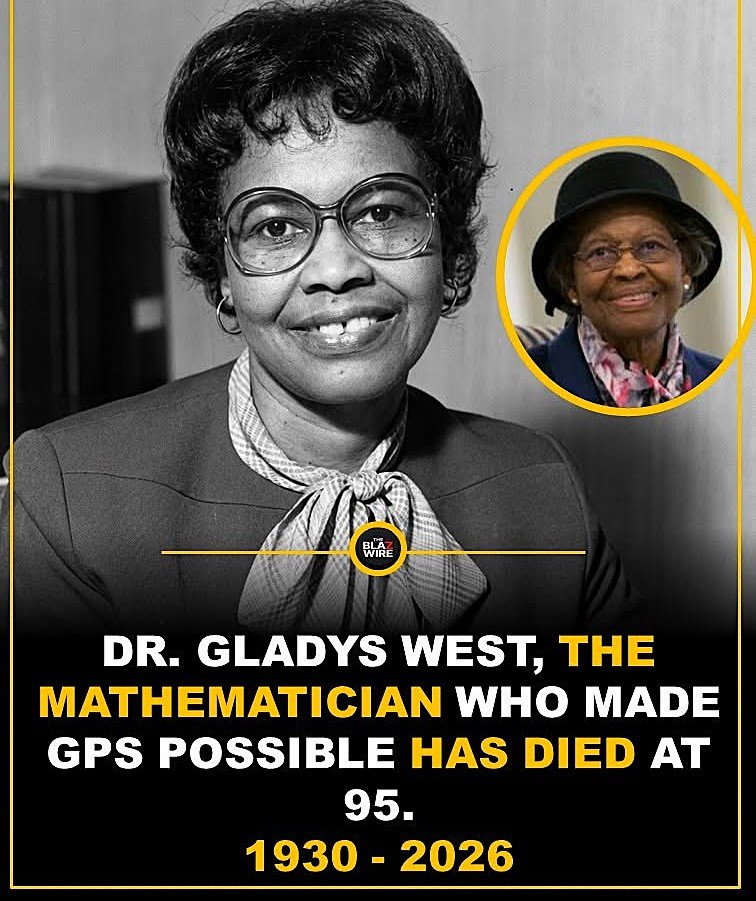
Her name was Gladys Mae West.
West was a mathematician and computer programmer whose groundbreaking work in geodesy—the scientific study of Earth’s shape, size and gravitational field—helped create the extremely accurate models needed for modern satellite-based positioning.
She did not invent GPS by herself, nor did she build the GPS satellites. But her mathematical work helped establish the precise understanding of Earth’s shape that modern GPS systems depend upon.
And for many years, very few people knew her name.
From a Farm in Virginia to the World of Mathematics
Gladys West was born in 1930 in Dinwiddie County, Virginia, at a time when opportunities for Black women in science and mathematics were severely limited.
She grew up in a farming community, where her family worked hard to make a living.
From an early age, West understood the importance of education.
She was an excellent student and eventually earned a scholarship to Virginia State College, a historically Black institution. She studied mathematics and graduated with a bachelor’s degree.
Her education opened the door to a career that would take her far beyond the rural community where she had grown up.
In 1956, West began working at the Naval Weapons Laboratory in Dahlgren, Virginia.
It was there that she entered a field that was rapidly transforming because of computers, radar and space technology.
A Career Built on Precision
At the Naval Weapons Laboratory, West worked as a mathematician and programmer.
Her job involved solving complicated mathematical problems and analyzing enormous amounts of data.
At the time, computers were nothing like the devices we use today.
There were no smartphones or modern laptops. Computing systems were large, expensive and difficult to operate.
Mathematicians and programmers had to carefully design calculations and processes that machines could execute.
West became highly skilled at using computers to solve complex geodetic problems.
One of the biggest challenges was understanding the exact shape of Earth.
Although Earth looks round from space, it is not a perfect sphere.
Its surface contains mountains, valleys, oceans and other irregularities. Its gravitational field also varies from place to place.
These differences matter enormously when scientists are trying to determine extremely precise positions.
The Geoid: Understanding Earth’s Real Shape
One of West’s most important areas of work involved creating mathematical models of Earth’s shape.
Scientists use a reference surface known as the geoid to represent Earth’s shape based largely on its gravitational field and mean sea level.
Creating an accurate geoid model is extraordinarily complicated.
Even tiny inaccuracies can affect calculations involving satellite positions and measurements on Earth’s surface.
West worked on mathematical techniques that helped scientists understand these variations with increasing precision.
Using satellite data, computer models and sophisticated calculations, she helped improve the ability to represent Earth’s physical and gravitational characteristics.
Her work was painstaking.
It involved processing huge quantities of information and repeatedly checking mathematical results.
There was no quick shortcut.
She had to make the calculations as accurate as possible.
Satellites Changed Everything
As the space age progressed, satellites became increasingly important for studying Earth.
West contributed to satellite-related projects, including work associated with radar altimetry.
Radar altimetry allows scientists to measure the height of Earth’s surface—particularly the ocean surface—from satellites orbiting above the planet.
These measurements can reveal subtle variations in Earth’s shape and gravitational field.
Projects such as Seasat and GEOSAT generated valuable information that scientists could use to improve models of Earth.
West’s mathematical expertise helped transform satellite observations into useful geodetic models.
Her work was not something most people would ever see.
There were no dramatic rocket launches associated with her name.
She was often working behind the scenes, processing data and refining mathematical models.
But those calculations mattered.
The Connection to GPS
The Global Positioning System was developed by the United States Department of Defense through a large, collaborative effort involving satellites, ground systems, engineers, scientists and mathematicians.
Gladys West did not create GPS alone.
However, her work on highly accurate models of Earth’s shape and gravitational field contributed to the broader scientific foundation that makes precise satellite positioning possible.
GPS receivers determine location by measuring signals from satellites.
To calculate a position accurately, the system needs an extremely precise understanding of where those satellites are and how their measurements relate to Earth’s surface.
That is where geodesy becomes crucial.
If the mathematical model of Earth were significantly inaccurate, satellite-based positioning would also become less precise.
West’s work helped improve the mathematical representation of Earth, contributing to the precision required by modern satellite navigation.
In other words, while she was not the inventor of the GPS system, her work helped make the highly accurate positioning environment that GPS relies upon possible.
A Career That Remained Mostly Invisible
Perhaps the most remarkable part of Gladys West’s story is how long she worked without receiving widespread public recognition.
For decades, she continued doing her job without becoming a household name.
She eventually retired from her position after a long career.
But retirement did not end her pursuit of knowledge.
West earned a master’s degree in public administration and later completed a doctorate through the Virginia Tech program.
She continued to demonstrate the same determination that had defined her career.
Then something unexpected happened.
People began discovering just how important her work had been.
Finally, Her Story Was Recognized
West’s contributions eventually received increasing attention.
She was inducted into the United States Air Force Space and Missile Pioneers Hall of Fame in 2018.
She also received numerous honors recognizing her contribution to satellite geodesy and technology.
Her story became particularly inspirational because it challenged the idea that groundbreaking technological achievements always come from famous inventors standing in the spotlight.
Sometimes, innovation comes from people whose names remain unknown for decades.
West was one of those people.
She spent years solving difficult mathematical problems that most people would never understand, helping create models that would eventually support technologies used by billions of people.
From Complex Mathematics to Everyday Life
Think about how often you use GPS.
You may use it while driving to work.
You may use it to find a restaurant.
You may rely on it when traveling to another city.
Emergency services use satellite positioning to locate people.
Businesses use it to track vehicles and shipments.
Aircraft, ships and countless other technologies depend on precise positioning and timing.
The technology seems effortless.
But behind that simplicity are decades of scientific research.
There are satellites orbiting Earth.
There are engineers maintaining complex systems.
There are scientists studying our planet.
And there are mathematicians like Gladys West whose calculations helped make extraordinary precision possible.
A Legacy Written in Numbers
Gladys West’s life is a reminder that important contributions do not always look spectacular when they are being made.
Her work was built on patience.
It was built on mathematics.
It was built on accuracy.
And it was built on refusing to give up when the problem was incredibly complicated.
She worked at a time when being a Black woman in a technical scientific field could mean facing barriers that others did not have to overcome.
Yet she continued forward.
She turned mathematics into something far more powerful than numbers on a page.
Her calculations helped scientists better understand the planet beneath our feet—and contributed to the technological foundations behind the navigation systems we now take for granted.
Today, millions of people can look at a tiny blue dot on their phone and instantly know where they are.
That simple blue dot represents decades of scientific progress.
And somewhere in that history is the quiet, determined work of Gladys West.
She didn’t invent the smartphone.
She didn’t launch the GPS satellites.
She didn’t single-handedly create the Global Positioning System.
But through her pioneering work in geodesy and satellite modeling, she helped improve our ability to measure and understand Earth’s shape with extraordinary precision.
For years, her contribution remained largely invisible.
Now, her story is remembered.
And perhaps that is the greatest lesson of all:
You don’t always have to be the person standing in the spotlight to change the world. Sometimes, the most important work happens quietly—one calculation, one discovery, and one precise measurement at a time.
Gladys West’s legacy lives on every time technology helps someone find their way home.