
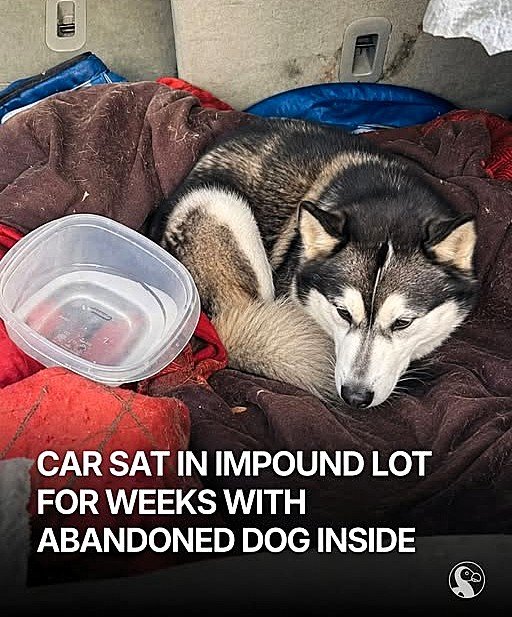

When workers at an impound lot prepared to demolish an abandoned SUV, they expected to find nothing more than an empty vehicle.
The SUV had been sitting there for weeks, untouched and apparently forgotten. As part of the normal process before the vehicle was removed, workers finally opened it to make sure nothing remained inside.
But what they discovered in the back of the vehicle was something they would never forget.
Curled up in the darkness was an elderly Alaskan Malamute.
He was weak, exhausted, and desperately thin. Somehow, despite the difficult conditions, the old dog was still alive.
No one knew exactly how long he had been trapped inside the abandoned SUV. There were no clear answers about how he had ended up there or why nobody had come looking for him.
What was clear was that he had been struggling to survive.
The dog had apparently managed to live on very little water and whatever tiny scraps of food he could find. By the time rescuers reached him, his body showed the consequences of prolonged neglect.
His teeth were severely decayed.
His nails had grown painfully long.
His coat and overall condition reflected weeks, perhaps longer, of hardship and neglect.
He looked like a dog who had almost given up.
But then something incredibly small happened.
As rescuers approached him, the exhausted Malamute slowly lifted his head.
And then, with whatever strength he had left, he gave them the tiniest wag of his tail.
It was barely noticeable.
But to the people who had come to rescue him, that tiny movement meant everything.
The old dog had every reason to be frightened. He had been left alone in an abandoned vehicle, surrounded by darkness and uncertainty. He was weak, sick, and completely dependent on someone else to help him.
Yet when help finally arrived, he responded with a tiny sign of trust.
The rescuers named him Otto.
Instead of leaving him to suffer any longer, they immediately rushed him into veterinary care.
Otto needed much more than food and a warm place to sleep. His body required careful medical attention after everything he had endured.
Veterinary professionals began treating his neglected condition, while rescuers made sure he received nutritious meals and plenty of fresh water.
For the first time in what may have been a very long time, Otto was safe.
There was no cold vehicle floor beneath him.
No darkness surrounding him.
No uncertainty about where his next meal would come from.
And most importantly, there were people nearby who genuinely cared about whether he survived.
His recovery would not happen overnight.
An elderly dog who has experienced severe neglect needs time to regain strength. His physical condition was only one part of the problem. After being isolated for so long, Otto also had to learn that people could be trusted.
Fortunately, something beautiful began to happen.
As Otto became healthier, rescuers started seeing a completely different dog emerge.
The frightened and exhausted Malamute gradually began showing his personality.
And one thing quickly became obvious:
Otto wanted to be close to people.
Very close.
After spending so much time alone, he seemed determined never to let his humans disappear from sight again.
He became what rescuers affectionately described as a “Velcro Malamute”—a dog who wanted to follow his person everywhere.
If his foster family moved from one room to another, Otto wanted to follow.
If someone sat down, Otto wanted to be nearby.
If someone offered him affection, he welcomed it.
Every bit of attention seemed precious to him.
Perhaps after experiencing such profound loneliness, Otto had discovered something he never wanted to lose again: companionship.
His transformation was emotional to witness.
The same dog who had once been found curled up inside an abandoned SUV was now discovering the comfort of a soft bed, regular meals, gentle voices, and loving hands.
He was learning that humans could bring safety instead of fear.
He was learning that someone would come back.
He was learning what it meant to belong.
For Otto, these things may sound simple, but they represented an entirely new chapter of his life.
His story also highlights an important reality about animal neglect.
Dogs cannot explain what happened to them.
They cannot tell rescuers how many days they spent hungry or frightened. They cannot describe the people who abandoned them or explain why they were left behind.
All they can do is survive.
And sometimes, even after everything they have endured, they still find a way to trust again.
That tiny wag of Otto’s tail was a perfect example.
He could have remained fearful.
He could have refused to respond.
Instead, he lifted his head and offered the rescuers the smallest possible sign that he was still fighting.
That tiny gesture became unforgettable.
It was almost as though Otto was saying, “I know you are here.”
And perhaps, in his own way, he was also saying, “Please don’t leave me again.”
Thankfully, Otto didn’t have to face the rest of his journey alone.
He was placed in a loving foster environment where he could continue recovering physically and emotionally.
There, he began experiencing something every dog deserves from the beginning of life: security.
He could sleep without fear.
He could eat without wondering when his next meal would arrive.
He could receive affection without having to earn it.
And he could simply be a dog.
As his health improved, his personality continued to shine.
The once-abandoned senior Malamute became affectionate, loyal, and deeply attached to his foster family.
His desire to stay close may have been shaped by his traumatic experience, but it also showed just how much he valued the people who had finally given him a second chance.
Otto’s story is a reminder that rescue doesn’t always end when an animal is removed from danger.
Sometimes, rescue is only the beginning.
The real journey is helping an animal understand that life can be different.
For Otto, that journey meant going from an abandoned vehicle to a safe home.
From hunger to regular meals.
From isolation to companionship.
From neglect to medical care.
And from being forgotten to finally being loved.
His story may have started in one of the saddest places imaginable, but it doesn’t have to end there.
Today, Otto is discovering the simple joys that should have always been part of his life.
A comfortable place to sleep.
A gentle hand.
A full bowl of food.
A safe home.
And someone who doesn’t mind having a large, fluffy Malamute following them from room to room.
Sometimes, we look for dramatic moments to remind us of hope.
But Otto’s story shows that hope can be incredibly small.
Sometimes, hope looks like an old dog lifting his head.
Sometimes, it looks like a tired animal finding enough strength to move his tail.
And sometimes, the smallest tail wag can say more than words ever could.
After everything Otto endured, that tiny movement was a sign that he hadn’t completely lost faith in people.
Someone finally found him.
Someone finally cared.
And now, instead of being remembered as the dog who was abandoned inside an SUV, Otto has the chance to be remembered as the dog who survived—and finally found the love he had been waiting for.
His journey is a beautiful reminder that every animal deserves compassion, care, and a safe place to call home.
And for Otto, the smallest wag of his tail may have been his first “thank you” to the people who gave him another chance.
🥹🐾💙