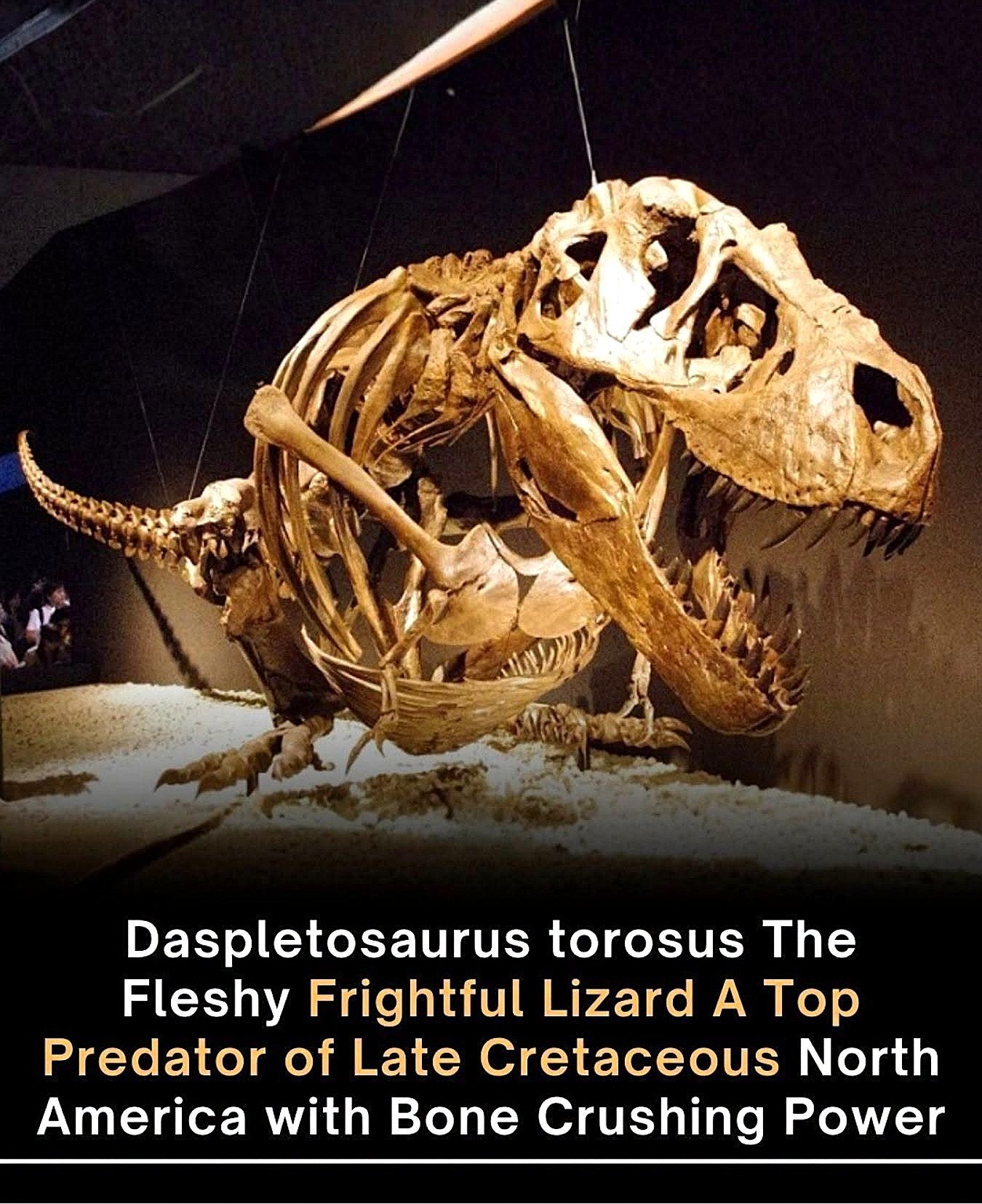
Around 75 million years ago, long before humans appeared on Earth, a powerful predator moved through the forests and floodplains of western North America.
It was not the largest tyrannosaur ever to exist, but it was one of the most formidable predators of its time.
This was Daspletosaurus torosus, a heavily built tyrannosaurid whose name can be translated roughly as “frightful lizard.” Living approximately 77 to 74 million years ago, this dinosaur occupied an ecosystem filled with large herbivores—and it stood near the top of the food chain.
With a massive skull, powerful jaws, serrated teeth and a muscular body weighing several tonnes, Daspletosaurus was built for one purpose: hunting and killing.
A Powerful Relative of Tyrannosaurus rex
When people hear the word tyrannosaur, the first dinosaur that usually comes to mind is Tyrannosaurus rex.
Daspletosaurus was a close relative, belonging to the same tyrannosaurid family, but it lived millions of years before T. rex became famous.
Adults of Daspletosaurus torosus are estimated to have reached approximately 8.5 to 9 metres in length, measured from the tip of the snout to the end of the tail. Their weight may have reached around 2 to 3 metric tons.
That made them enormous predators by any standard.
Rather than having a lightweight, delicate build, Daspletosaurus appears to have been relatively robust. Its body was designed to support a huge head and powerful jaws, giving the animal the appearance of a heavily armed prehistoric predator.
The Skull Was Its Ultimate Weapon
The most impressive part of Daspletosaurus was undoubtedly its skull.
The skull could exceed one metre in length, creating an enormous platform for powerful jaw muscles and rows of specialized teeth.
The bones across the top of the snout were also fused together. This reinforcement would have made the skull more resistant to the tremendous stresses produced when the animal closed its jaws with enormous force.
For a predator that regularly attacked large prey, a reinforced skull would have been extremely valuable.
Instead of relying only on speed, Daspletosaurus could use its powerful head and jaws to deliver devastating bites.
Its hunting strategy may therefore have depended heavily on strength and precision rather than simply chasing prey over long distances.
More Than 60 Teeth Designed for Destruction
Daspletosaurus possessed an impressive set of teeth.
Adults likely had more than 60 serrated teeth, and these teeth were not all identical.
The species displayed what palaeontologists call heterodont dentition, meaning different teeth had different shapes and potentially different functions.
The teeth toward the front of the upper jaw were relatively more delicate and D-shaped, while those farther back were more robust and had an oval cross-section.
This arrangement may have allowed different teeth to perform different jobs.
The stronger rear teeth could withstand enormous forces during biting, while the front teeth may have been better suited for gripping and handling prey.
The serrated edges of the teeth would have helped slice through flesh, making each bite potentially devastating.
For a large predator attacking heavily built herbivores, having teeth capable of surviving repeated high-force impacts was essential.
A Body Built for Power
Although Daspletosaurus had the famously tiny forelimbs associated with tyrannosaurs, the rest of its body was anything but weak.
Its hind limbs were strong and muscular, supporting the enormous weight of the animal.
Behind the body stretched a long, powerful tail that helped provide balance as the dinosaur moved.
The combination of a massive head, strong legs and muscular tail gave Daspletosaurus a formidable body plan.
Its anatomy suggests an animal that could move efficiently through its environment while carrying a huge predatory apparatus at the front of its body.
Even without knowing exactly how fast it could run, there is little doubt that encountering one at close range would have been an extremely dangerous experience.
How Did Daspletosaurus Hunt?
Scientists cannot watch a dinosaur hunt, so its exact hunting behavior remains uncertain.
However, its anatomy provides clues.
Daspletosaurus may have relied on a combination of ambush, strength and powerful biting.
Rather than pursuing prey across enormous distances, it may have used vegetation and the surrounding environment to approach large herbivores before launching a sudden attack.
Once within striking distance, its massive jaws could have delivered a powerful bite.
The Late Cretaceous ecosystems where Daspletosaurus lived contained large plant-eating dinosaurs, providing potential prey for a predator of its size.
A successful attack would have required enormous physical power, but it may also have required precision. A predator that could inflict severe injuries with a well-placed bite would not necessarily need to chase an injured animal for a long distance.
A Predator Living Among Giants
Daspletosaurus lived in what is now western North America, particularly regions that were part of ancient ecosystems in present-day Canada.
The landscape was very different from modern Alberta.
Forests, rivers and floodplains created a rich environment supporting numerous dinosaur species.
Large herbivores moved through these landscapes, while predators such as Daspletosaurus occupied the upper levels of the food web.
This meant Daspletosaurus was not simply another dinosaur wandering through the environment.
It was one of the dominant carnivores of its ecosystem.
Its enormous size and powerful bite would have made it capable of targeting substantial prey, while its robust anatomy suggests that it was well equipped for the physical demands of a predator’s lifestyle.
The Fossil Story
The scientific history of Daspletosaurus torosus is also fascinating.
Fossils of this animal were discovered in Alberta, Canada, but the material was initially interpreted differently.
Some of the fossils were originally assigned to Gorgosaurus, another tyrannosaurid from western North America.
As scientists studied the fossils more carefully, differences in anatomy became apparent.
In 1970, palaeontologist Dale Russell recognized the animal as a distinct species and named it Daspletosaurus torosus.
Since then, additional discoveries have helped palaeontologists investigate the animal’s growth, anatomy, variation and ecological role.
Every new fossil can provide another piece of the puzzle, helping scientists reconstruct how this predator lived millions of years ago.
A Dinosaur With a Surprisingly Complex Mouth
One of the strangest details about Daspletosaurus is the difference between its front and rear teeth.
At first glance, a tyrannosaur’s mouth might seem like a simple collection of giant killing teeth.
But the reality was more complicated.
The different shapes of its teeth suggest that the dinosaur’s mouth may have performed several specialized functions.
Some palaeontologists have even speculated that the unusual front teeth could have been useful for more delicate activities, such as grasping objects or interacting carefully with members of its own species.
One particularly intriguing possibility is that such teeth might have helped adults handle or interact with young animals without relying on the crushing power of their larger rear teeth.
This idea remains speculative, but it highlights how much scientists can learn from tiny anatomical differences preserved in fossils.
The “Frightful Lizard” of Ancient North America
Daspletosaurus torosus may never have achieved the fame of Tyrannosaurus rex, but it deserves a place among the most impressive predators in dinosaur history.
It was a massive animal with a skull more than a metre long, powerful jaws, dozens of serrated teeth, strong hind limbs and a muscular tail.
For millions of years, its ancestors and relatives occupied the role of apex predators across western North America.
When we picture the Late Cretaceous, it is easy to imagine T. rex dominating every scene.
But the world was filled with other tyrannosaurs that were equally fascinating—and Daspletosaurus was one of them.
Its fossils reveal a predator that combined power, reinforced anatomy and specialized teeth into one highly effective hunting machine.
Millions of years later, only fossilized bones remain.
Yet those fossils allow scientists to reconstruct a remarkable picture of an animal that once walked through ancient forests and floodplains, searching for its next meal.
Daspletosaurus torosus truly earned its name: the “frightful lizard.”
Strange Fact
The unusual front teeth of Daspletosaurus may have had functions beyond simply tearing flesh. Some palaeontologists have proposed that their shape could have allowed the dinosaur to perform more delicate gripping tasks—possibly even interacting with its young—while its massive rear teeth were better suited for powerful bites.
Read Next
- Tucker Budzyn: The Golden Retriever Who Made Millions of People Smile Has Died
- In 2018, photographs of Selena Gomez in a bikini began spreading across the internet. Almost immediately, people started commenting on her body.
- Sometimes, the smallest acts of kindness create the moments people remember forever