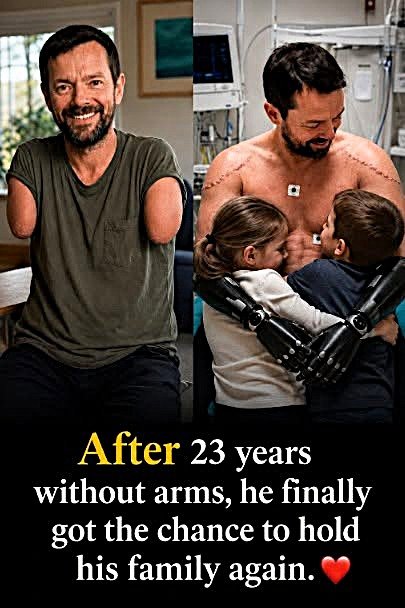
In 1998, Guðmundur Felix Grétarsson, an electrician from Iceland, experienced a devastating accident that would completely change the course of his life.
While working, Felix came into contact with a high-voltage electrical line. The current caused catastrophic injuries to his body, destroying both of his arms. Despite efforts to save them, doctors were eventually forced to amputate both arms.
He was still a young man.
Suddenly, everyday actions that most people never think twice about—holding a cup, opening a door, shaking someone’s hand, getting dressed, or simply reaching out to hug a loved one—became impossible.
For Felix, the loss was not only physical. It meant adapting to an entirely different way of living.
Yet through all the years that followed, he refused to completely give up on the possibility that medicine might one day offer him another chance.
For more than two decades, Felix lived without his arms.
He learned to adapt. He built a life around the limitations created by the accident. But somewhere in the back of his mind remained a hope that medical science would eventually advance far enough to help him regain something he had lost.
Then, after 23 years, that possibility became real.
In January 2021, Felix traveled to Lyon, France, where he became the recipient of an extraordinary transplant operation.
A multidisciplinary team of surgeons performed a highly complex procedure that lasted approximately 15 hours. Instead of transplanting only the arms, the medical team transplanted both arms together with the shoulders.
The operation represented a remarkable achievement in reconstructive transplantation and was widely described as the first successful bilateral arm-and-shoulder transplant.
For the medical team, it was a historic moment.
For Felix, however, the surgery was not the end of his journey.
It was the beginning of an entirely new one.
A transplant of this kind does not instantly restore movement. The transplanted limbs have to become part of the recipient’s body, and the nervous system has to slowly reconnect with them.
That meant Felix faced months and years of intensive rehabilitation.
His transplanted nerves had to regenerate gradually. His muscles had to become stronger. His brain had to learn how to communicate with limbs that had been missing for more than two decades.
After living for 23 years without arms, his body had to learn a completely different language.
Progress came slowly.
At first, the movements were tiny.
Then, little by little, more control began to return.
Felix worked relentlessly through rehabilitation, repeating movements and exercises that most people would take for granted. Every small improvement represented another step toward independence.
Eventually, he began gaining the ability to move his transplanted arms and hands with increasing control.
He could begin practicing how to grasp objects.
He could work toward performing everyday tasks.
Movements that once seemed completely out of reach were gradually becoming possible again.
But among all the things Felix hoped to regain, there was one ability that carried a meaning far greater than simply being able to perform a physical task.
He wanted to hug his family.
Some of Felix’s children had been very young when he lost his arms in the accident.
They had grown up during the 23 years he lived without them.
For more than two decades, Felix could love his children, care for them, speak to them, and be present in their lives—but he could not physically wrap his arms around them.
A hug is such an ordinary thing for most families.
But for Felix, it represented something he had been unable to do for 23 years.
As movement gradually returned after the transplant, that simple act became possible again.
He could reach out.
He could move his arms.
And eventually, he could embrace the people he loved.
That moment represented far more than the successful movement of transplanted limbs.
It represented the restoration of a deeply human connection.
The surgery demonstrated what modern medicine and transplantation can accomplish. It showed how far reconstructive surgery, nerve regeneration, rehabilitation, and medical teamwork have advanced.
But Felix’s story is not simply a story about an extraordinary operation.
It is also a story about patience.
It is a story about resilience.
And perhaps most importantly, it is a story about hope.
For 23 years, Felix lived with a loss that could not be easily reversed. There was no guarantee that a suitable transplant would ever become available. There was no certainty that the surgery would work. And even after the operation, there was no instant transformation.
He had to work for every movement.
He had to endure rehabilitation.
He had to wait for nerves to regenerate.
He had to teach his brain and muscles how to use his new limbs.
And he had to keep believing that the small improvements would eventually lead to something much bigger.
They did.
The man who had lost both arms in a devastating workplace accident eventually began using transplanted arms and shoulders to perform movements he had not been able to make for more than two decades.
His journey reminds us that medical breakthroughs are not always about creating something entirely new.
Sometimes, they are about giving someone back a part of life they thought they had lost forever.
For surgeons, Felix’s transplant was a landmark achievement.
For researchers and rehabilitation specialists, it represented an extraordinary opportunity to understand what is possible when transplantation and nerve recovery are pushed to their limits.
But for Felix, the meaning was much simpler.
He was getting the chance to use his arms again.
He was getting the chance to reach.
To hold.
To touch.
And, most importantly, to hug his family.
After 23 years without arms, Felix wasn’t simply learning how to use transplanted limbs.
He was rediscovering the ordinary moments that make life meaningful.
And sometimes, the most powerful measure of a medical miracle isn’t a complicated movement or a scientific milestone.
Sometimes, it’s a hug.
Read Next
- The same feet that Dejana Bačko uses to create beautiful paintings also carried her to the top of the world in para taekwondo.
- Chained to a Tree While Pregnant, Hope Finally Found the Life She Deserved
- In 2018, photographs of Selena Gomez in a bikini began spreading across the internet. Almost immediately, people started commenting on her body.