On September 3, 2019, an ordinary home in Edsbyn, Sweden, became the scene of a terrifying fight for survival.
Inside the house were six children.
Their mother, Emma Schols, had only seconds to make decisions that would change her life forever.
When the fire began spreading through the family home, Emma did not run away from the flames. Instead, she repeatedly went back inside, searching for each of her children.
By the time the rescue was over, all six children were alive.
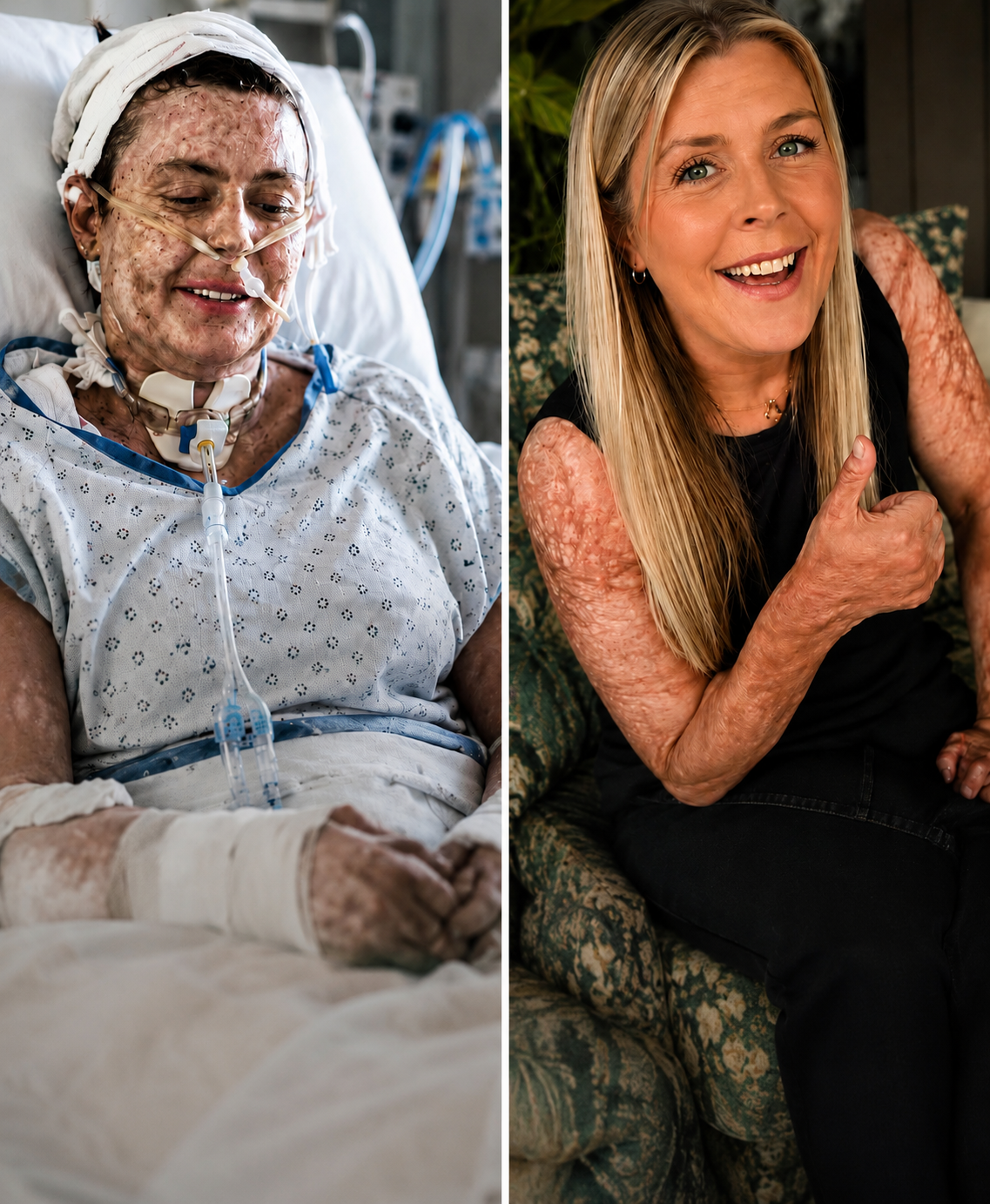
Emma, however, had suffered catastrophic burns covering approximately 93 percent of her body. She would spend weeks fighting for her life and face a recovery that would continue long after she left the hospital.
Her story has since become one of extraordinary courage, survival and a mother’s determination to protect her children at any cost.
A Normal Morning Turned Into a Nightmare
It was the early morning of September 3, 2019, when Emma woke to signs that something was terribly wrong.
Smoke had begun filling the family home. Two of her youngest children were downstairs when the fire broke out, while the other children were upstairs.
The situation was rapidly becoming dangerous.
Emma immediately went toward the flames.
According to accounts of the rescue, she found her two youngest sons trapped downstairs. Instead of waiting for help, she moved into the burning area and used her own body to protect them from the flames as she tried to get them out.
She managed to get the boys outside.
For most people, escaping a burning building would have been the obvious moment to stop.
But Emma knew the danger wasn’t over.
Four of her children were still upstairs.
The Staircase Was Already Burning
The path to the upper floor was becoming engulfed in flames.
Yet Emma went back inside.
She climbed through the burning house to reach the children who remained upstairs. Her eldest son also played a role in helping the family escape, and the children were eventually brought toward a balcony where they could be moved to safety.
Every trip back into the house exposed Emma to more heat, smoke and flames.
And then came another terrifying realization.
One of her youngest children was still inside.
So Emma returned again.
She wasn’t thinking about the injuries she was already suffering. She wasn’t thinking about what the fire might do to her.
She was thinking about her children.
The rescue became a race against time.
The fire was destroying the house around her, but Emma continued searching until every one of her children had been brought out.
By the time the ordeal ended, all six children had survived.
The Price of the Rescue
Emma’s children escaped the fire, but their mother’s injuries were devastating.
Approximately 93 percent of her body had suffered burns. Her injuries were so severe that she was fighting for her life in hospital.
Reports from the time described her condition as critical. She spent weeks receiving intensive medical treatment at Akademiska Hospital in Uppsala.
Later accounts reported that Emma spent about three weeks on a respirator, remained in an induced coma for roughly two months, and underwent more than 20 operations during her recovery.
Surviving such extensive burns was itself extraordinary.
But Emma’s physical injuries were only part of what she had to overcome.
There was also the emotional aftermath of waking up and confronting what had happened.
Her First Thought Wasn’t About Herself
After spending weeks unconscious, Emma eventually woke.
She had every reason to be focused on her own condition.
Her body had been severely burned. She had endured countless medical procedures. She was facing an incredibly long road to recovery.
But according to accounts of her story, her first concern was her children.
She wanted to know whether they were alive.
That moment says something powerful about what had driven her through the fire in the first place.
For Emma, surviving the fire was never the only goal.
Getting her children out alive was.
A Recovery Measured in More Than Days
Surviving the fire was only the beginning.
Severe burns can require extensive medical treatment, rehabilitation and repeated procedures. For Emma, the physical recovery would become a long-term part of her life.
She had to learn to live with scars covering much of her body.
But rather than allowing those scars to define her as a victim, Emma eventually chose to embrace them.
Her scars became reminders of the day she refused to leave her children behind.
She has spoken publicly about her experience and later shared her story in a memoir, Ärren bär jag med stolthet, translated as I Carry My Scars With Pride.
The title itself reflects an important part of Emma’s journey.
Her scars represent pain, but they also represent survival.
They represent six children who made it out alive.
From Tragedy to Recognition
Emma’s actions during the fire attracted widespread attention in Sweden.
Her family and rescuers described her actions as heroic. Swedish public broadcaster SVT reported that both relatives and rescue leadership viewed her as a hero after she repeatedly entered the burning home to save her children.
Her courage was later recognized nationally.
In 2020, Emma was named Lifesaver of the Year at Sweden’s Svenska Hjältar gala, an award recognizing extraordinary acts of courage and lifesaving.
But awards could never change what the fire had taken from her.
They could not erase the scars.
They could not undo the pain.
What they could do was acknowledge something Emma’s family already knew.
When her children needed her most, she went toward the danger.
What Makes Her Story So Powerful
Stories of heroism are often told through dramatic moments.
But Emma Schols’ story is powerful because it was not one single act of bravery.
It was a series of choices.
Every time she returned to the burning house, she had another opportunity to stop.
She could have stayed outside after rescuing the first children.
She could have waited for firefighters.
She could have decided that the flames were simply too dangerous.
Instead, she continued.
The details of the rescue show just how quickly a person can be forced to make impossible decisions during a house fire. The fire was spreading rapidly, visibility was limited, and the route between the children and safety was becoming increasingly dangerous.
Emma’s response was driven by one overriding thought:
Her children were still inside.
A Mother’s Love Beyond Words
There is an old expression that a parent would walk through fire for their children.
For Emma Schols, it became literal.
She didn’t simply risk her life once.
She repeatedly entered a burning home because she knew that the people she loved most were trapped inside.
The physical consequences were almost unimaginable.
Ninety-three percent of her body was burned.
She spent weeks in intensive care.
She underwent numerous surgeries.
She faced a long rehabilitation.
And she would carry the scars of that morning for the rest of her life.
Yet six children survived.
That is the part of the story Emma appears to hold closest.
The Scars Tell a Different Story
For many survivors of devastating injuries, scars can become painful reminders of the past.
Emma chose to see hers differently.
They are evidence of what happened, but they are also evidence that she survived.
More importantly, they remind her of the six children she fought to save.
Her story demonstrates that courage doesn’t necessarily mean being fearless.
Emma had every reason to fear the flames.
Courage meant moving forward despite that fear.
It meant acting when there was no time to plan.
It meant putting the lives of her children before her own.
And when the fire was finally over, it meant surviving the aftermath.
The Morning That Changed Everything
September 3, 2019, became a dividing line in Emma’s life.
There was life before the fire.
And there was life after it.
Before that morning, she was simply a mother raising six children in Sweden.
Afterward, she became a survivor of one of the most devastating house fires imaginable.
But perhaps the most important part of her story is that she never allowed the fire to become the final chapter.
She survived.
She underwent treatment.
She endured surgeries and rehabilitation.
She learned to live with her scars.
And she continued raising the children she had fought so desperately to save.
The fire may have changed her body forever.
It did not take away her identity as a mother.
A Story of Survival, Not Just Sacrifice
It is easy to describe Emma Schols only as a woman who sacrificed herself for her children.
But her story is bigger than that.
It is also a story about survival.
She survived injuries that could have ended her life.
She survived months of intensive medical treatment.
She survived the psychological aftermath of a traumatic event.
And she emerged determined to live with the scars rather than hide from them.
Her children survived too.
That outcome is what makes the story so extraordinary.
A devastating fire destroyed their home and left their mother with life-changing injuries—but it did not take the six children Emma fought to protect.
The Mother Who Refused to Stop
The image that remains from Emma Schols’ story is simple.
A burning house.
Six children trapped inside.
And a mother who kept going back.
She didn’t stop after saving one child.
She didn’t stop after saving two.
She continued until every child was out.
Her injuries became permanent.
Her scars became part of her life.
But so did the knowledge that all six of her children survived that terrible morning.
Emma’s story is ultimately a reminder of how powerful a parent’s love can be when the people they love are in danger.
Sometimes courage looks like running toward something everyone else is running away from.
Sometimes strength means surviving what should have broken you.
And sometimes the greatest measure of a person’s bravery is simply refusing to stop until the people they love are safe.
Emma Schols walked through fire for her six children—and survived to carry the scars with pride.
Read Next
- 12-Year-Old Maya Gebala Risked Her Life to Protect Classmates During a School Attack
- For most people, seeing someone for the first time means noticing their smile, their eyes, their expression, or perhaps the way they carry themselves
- She Refused to Leave the Rescue Van — Then Her Unmoving Stare Sent a Volunteer Back Into the Drainage Pipe